383 posters, 2 videos, 1 audios, 8 topics, 28 sessions, 328 authors, 225 institutions
ePostersLive by SciGen Technologies S.A. All rights reserved.
50th Annual Regional Anesthesiology and Acute Pain Medicine Meeting
May 1 - 3, 2025 | Orlando, Florida

6610
PAIN MODULATION OF THE PREFRONTAL CORTEX FOLLOWING DIAGNOSTIC NERVE BLOCKS IN CHRONIC PAIN PATIENTS: AN FNIRS STUDY
Poster Presenter
Authors
Affiliations
Part of Topic
Scientific Abstracts > Chronic Pain
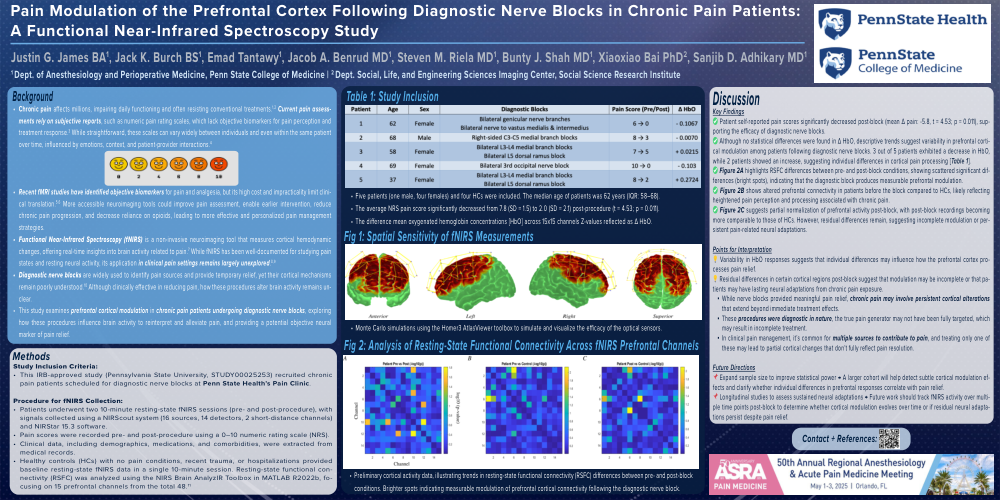
Pain Modulation of the Prefrontal Cortex Following Diagnostic Nerve Blocks in Chronic Pain Patients: A Functional Near-Infrared Spectroscopy Study
Authors: Justin G. James BA, Jack K. Burch, Emad Tantawy, Jacob A. Benrud MD, Steven M. Riela MD, Bunty J. Shah MD, Xiaoxiao Bai PhD, Sanjib D. Adhikary MD
Background:
Chronic pain affects millions, impairing daily functioning and often resisting conventional treatments.1,2 Current pain assessments rely on subjective reports, such as numeric pain rating scales, which lack objective biomarkers for pain perception and treatment response.3 While straightforward, these scales can vary widely between individuals and even within the same patient over time, influenced by emotions, context, and patient-provider interactions.4
Recent fMRI studies have identified objective biomarkers for pain and analgesia, but its high cost and impracticality limit clinical translation.5,6 More accessible neuroimaging tools could improve pain assessment, enable earlier intervention, reduce chronic pain progression, and decrease reliance on opioids, leading to more effective and personalized pain management strategies.
Functional Near-Infrared Spectroscopy (fNIRS) is a non-invasive neuroimaging tool that measures cortical hemodynamic changes, offering real-time insights into brain activity related to pain.7 While fNIRS has been well-documented for studying pain states and resting neural activity, its application in clinical pain settings remains largely unexplored.8,9
Diagnostic nerve blocks are widely used to identify pain sources and provide temporary relief, yet their cortical mechanisms remain poorly understood.10 Although clinically effective in reducing pain, how these procedures alter brain activity remains unclear.
This study examines prefrontal cortical modulation in chronic pain patients undergoing diagnostic nerve blocks, exploring how these procedures influence brain activity to reinterpret and alleviate pain, and providing a potential objective neural marker of pain relief.