383 posters, 2 videos, 1 audios, 8 topics, 28 sessions, 328 authors, 225 institutions
ePostersLive by SciGen Technologies S.A. All rights reserved.
50th Annual Regional Anesthesiology and Acute Pain Medicine Meeting
May 1 - 3, 2025 | Orlando, Florida

6387
PERCUTANEOUS HYDROTOMY – A NOVEL APPROACH TO THE TREATMENT OF LOWER BACK PAIN
Poster Presenter
Authors
Affiliations
Part of Topic
Scientific Abstracts > Chronic Pain
Percutaneous Hydrotomy – A Novel Approach to the Treatment of Lower Back Pain
Co-Author(s) Details:
-
Dr. Johnathan Edwards M.D.
-
Dr. Shams Sohani M.D.
-
Fernando Gomez II MS4
-
Britany Font MS4
-
Dr. Bernard Guez M.D
Introduction
Chronic low back pain (LBP) remains a significant public health challenge, affecting millions globally and driving substantial healthcare costs. Conventional treatments—ranging from physical therapy to invasive surgeries—often yield limited efficacy, with significant side effects or complications. Mesotherapy, a minimally invasive technique using subcutaneous injections of diluted medications, has shown promise in pain management. Building on mesotherapy, percutaneous hydrotomy employs large-volume subcutaneous delivery of therapeutic agents, offering a novel alternative for chronic LBP management.
Methods
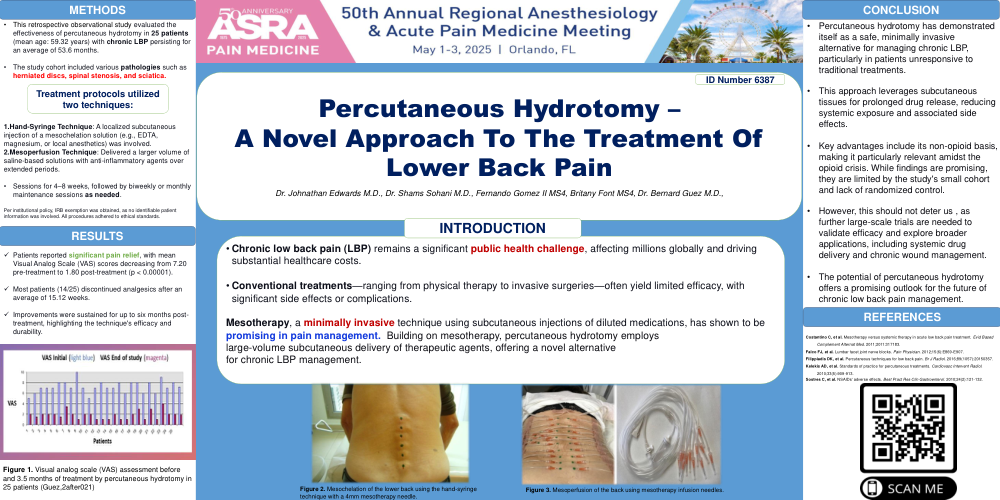
This retrospective observational study evaluated the effectiveness of percutaneous hydrotomy in 25 patients (mean age: 59.32 years) with chronic LBP persisting for an average of 53.6 months. The study cohort included various pathologies, such as herniated discs, spinal stenosis, and sciatica. Treatment protocols utilized two techniques:
-
Hand-Syringe Technique: A localized subcutaneous injection of a mesochelation solution (e.g., EDTA, magnesium, or local anesthetics) was involved.
-
Mesoperfusion Technique: Delivered a larger volume of saline-based solutions with anti-inflammatory agents over extended periods.
Sessions were conducted weekly for 4–8 weeks, followed by biweekly or monthly maintenance sessions as needed. Per institutional policy, IRB exemption was obtained, as no identifiable patient information was involved. All procedures adhered to ethical standards.
Results
Patients reported significant pain relief, with mean Visual Analog Scale (VAS) scores decreasing from 7.20 pre-treatment to 1.80 post-treatment (p < 0.00001). Most patients (14/25) discontinued analgesics after an average of 15.12 weeks. Improvements were sustained for up to six months post-treatment, highlighting the technique's efficacy and durability.
Discussion
Percutaneous hydrotomy has demonstrated itself as a safe, minimally invasive alternative for managing chronic LBP, particularly in patients unresponsive to traditional treatments. This approach leverages subcutaneous tissues for prolonged drug release, reducing systemic exposure and associated side effects. Key advantages include its non-opioid basis, making it particularly relevant amidst the opioid crisis. While findings are promising, they are limited by the study's small cohort and lack of randomized control. However, this should not deter us, as further large-scale trials are needed to validate efficacy and explore broader applications, including systemic drug delivery and chronic wound management. The potential of percutaneous hydrotomy offers a promising outlook for the future of chronic low back pain management.
References
-
Costantino C, et al. Mesotherapy versus systemic therapy in acute low back pain treatment. Evid Based Complement Alternat Med. 2011;2011:317183.
-
Filippiadis DK, et al. Percutaneous techniques for low back pain. Br J Radiol. 2016;89(1057):20150357.
-
Kelekis AD, et al. Standards of practice for percutaneous treatments. Cardiovasc Intervent Radiol. 2010;33(5):909-913.
-
Sostres C, et al. NSAIDs' adverse effects. Best Pract Res Clin Gastroenterol. 2010;24(2):121-132.
-
Falco FJ, et al. Lumbar facet joint nerve blocks. Pain Physician. 2012;15(6):E869-E907.