383 posters, 2 videos, 1 audios, 8 topics, 28 sessions, 328 authors, 225 institutions
ePostersLive by SciGen Technologies S.A. All rights reserved.
50th Annual Regional Anesthesiology and Acute Pain Medicine Meeting
May 1 - 3, 2025 | Orlando, Florida

6804
A PILOT STUDY EVALUATING CANNABIDIOL ORAL SOLUTION IN BILATERAL TOTAL KNEE ARTHROPLASTY
Poster Presenter
Authors
Affiliations
Part of Topic
Scientific Abstracts > Acute Pain
Title: A pilot study evaluating cannabidiol oral solution in bilateral total knee arthroplasty
Co-authors: Sideris A, Chan W, Liu J, Gonzalez Della Valle A, Illescas A, Baaklini L, Rodriguez J, Kirksey M, Chalmers B, Mayman D, Soffin E, Maalouf D, Long W, Haas S, Boettner F, Alexiades M, Saleh J, Waldman S, Sculco P, Jules-Elysee K
Introduction
Cannabidiol (CBD) is a non-intoxicating phytocannabinoid with a complex pharmacological profile, distinct from delta-9-tetrahydrocannabinol (THC). [1-2] In studies using animal models of acute and chronic pain, CBD relieves hyperalgesia and edema associated with inflammation, and reduces allodynia and anxiety associated with nerve injury.[2] Epidiolex® is the only CBD formulation approved by the Food and Drug Administration (FDA) and is indicated for the treatment of seizures associated with Lennox-Gastaut Syndrome, Dravet Syndrome, and tuberous sclerosis complex. Given the promising animal literature on CBD’s effects on pain behaviors and inflammation, and the increasing use of CBD in patients presenting for orthopedic surgery, we conducted a pilot study of off-label Epidiolex® versus placebo in bilateral total knee arthroplasty patients to assess opioid requirements, pain levels, inflammatory markers, tolerability, effect on sleep and mood, and pharmacokinetics.
Methods
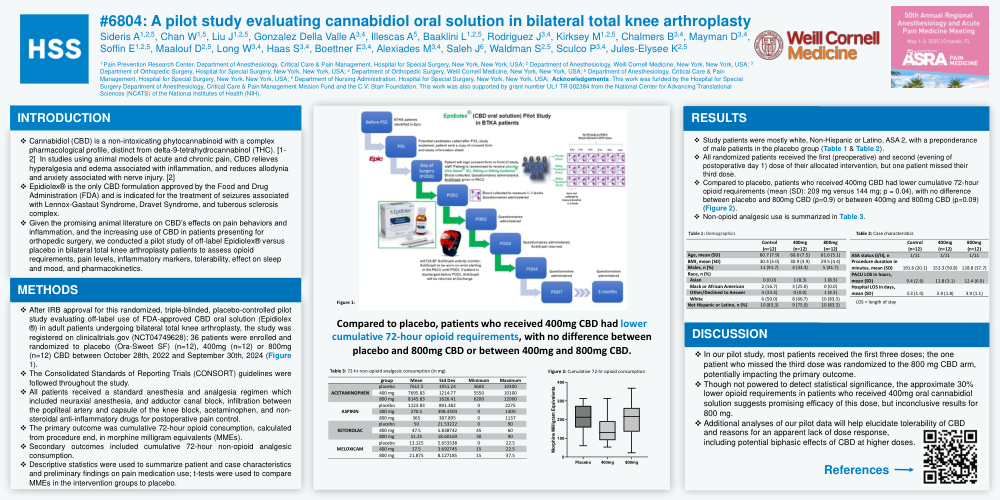
After IRB approval for this randomized, triple-blinded, placebo-controlled pilot study evaluating off-label use of FDA-approved CBD oral solution (Epidiolex ®) in adult patients undergoing bilateral total knee arthroplasty, the study was registered on clinicaltrials.gov (NCT04749628); 36 patients were enrolled and randomized to placebo (OraSweet SF) (n=12), 400mg (n=12) or 800mg (n=12) CBD between October 28th, 2022 and September 30th, 2024 (figure 1). The Consolidated Standards of Reporting Trials (CONSORT) guidelines were followed throughout the study. All patients received a standard anesthesia and analgesia regimen which included neuraxial anesthesia, and adductor canal block, infiltration between the popliteal artery and capsule of the knee block, acetaminophen, and non-steroidal anti-inflammatory drugs for postoperative pain control. The primary outcome was cumulative 72-hour opioid consumption, calculated from procedure end, in morphine milligram equivalents (MMEs). Secondary outcomes included cumulative 72-hour non-opioid analgesic consumption. Descriptive statistics were used to summarize patient and case characteristics and preliminary findings on pain medication use; t-tests were used to compare MMEs in the intervention groups to placebo.
Results
Study patients were mostly white, Non-Hispanic or Latino, ASA 2, with a preponderance of male patients in the placebo group (Table 1 & Table 2). All randomized patients received the first (preoperative) and second (evening of postoperative day 1) dose of their allocated intervention, but one patient missed their third dose. Compared to placebo, patients who received 400mg CBD had lower cumulative 72-hour opioid requirements (mean (SD): 209 mg versus 144 mg; p = 0.04), with no difference between placebo and 800mg CBD (p=0.9) or between 400mg and 800mg CBD (p=0.09) (figure 2). Non-opioid analgesic use is summarized in Table 3.
Discussion
In our pilot study, most patients received the first three doses; the one patient who missed the third dose was randomized to the 800 mg CBD arm, potentially impacting the primary outcome. Though not powered to detect statistical significance, the approximate 30% lower opioid requirements in patients who received 400mg oral cannabidiol solution suggests promising efficacy of this dose, but inconclusive results for 800 mg. Additional analyses of our pilot data will help elucidate tolerability of CBD and reasons for an apparent lack of dose response, including potential biphasic effects of CBD at higher doses.
References
- Sideris A, Doan LV. An Overview of Cannabidiol. Anesth Analg. 2024 Jan 1;138(1):54-68. Epub 2023 Dec 15. PMID: 38108806.
- Sideris A, Lauzadis J, Kaczocha M. The Basic Science of Cannabinoids. Anesth Analg. 2024 Jan 1;138(1):42-53. Epub 2023 Dec 15. PMID: 38100799; PMCID: PMC10788142.