383 posters, 2 videos, 1 audios, 8 topics, 28 sessions, 328 authors, 225 institutions
ePostersLive by SciGen Technologies S.A. All rights reserved.
50th Annual Regional Anesthesiology and Acute Pain Medicine Meeting
May 1 - 3, 2025 | Orlando, Florida

6641
SUZETRIGINE, A NON-OPIOID, PAIN SIGNAL INHIBITOR WITH THE POTENTIAL FOR VOMITING- OR NAUSEA-FREE ACUTE PAIN RELIEF
Poster Presenter
Authors
Part of Topic
Scientific Abstracts > Acute Pain
Suzetrigine, a Non-opioid, Pain Signal Inhibitor With the Potential for Vomiting- or Nausea-free Acute Pain Relief
Todd Bertoch1, Dominick D’Aunno2, Jessica McCoun3, Daneshvari Solanki4, Louise Taber5, Joshua Urban6, Jessica Oswald7, Matthew W. Swisher8, Ina Jazić9, Simon Tian9, Wendy Kampman9, Darin J. Correll9, Scott G. Weiner10
1CenExel JBR Clinical Research, Salt Lake City, UT; 2ERG Clinical, Houston, TX; 3CenExel ACMR Clinical Research, Atlanta, GA; 4HD Research, LLC, Bellaire, TX; 5Arizona Research Center, Phoenix, AZ; 6OrthoNebraska, Omaha, NE; 7Departments of Emergency Medicine and Anesthesia, UC San Diego Health, San Diego, CA; 8UC San Diego Health, San Diego, CA; 9Vertex Pharmaceuticals, Boston, MA; 10Brigham and Women’s Hospital, Boston, MA
INTRODUCTION
Opioids are effective for the management of moderate-to-severe acute pain but have safety, tolerability (including gastrointestinal tolerability issues such as vomiting and nausea), and addiction concerns1
Voltage-gated sodium channel 1.8 (NaV1.8) is a therapeutic target for pain based on its role in pain signaling and its selective expression in the peripheral nervous system2
Suzetrigine (SUZ) is a highly selective NaV1.8 inhibitor with no addiction potential based on its mechanism of action2
In two Phase 3 trials evaluating SUZ, the primary endpoint of the time-weighted sum of the pain intensity difference as recorded on the numeric pain rating scale (NPRS) from 0 to 48 hours compared to placebo was met with SUZ treatment having a statistically significant greater reduction in pain compared to placebo3
SUZ is approved in the US to treat moderate-to-severe acute pain in adults
Here we report data including a post hoc analysis from the Phase 3 SUZ trials that evaluates a clinically relevant composite endpoint to assess the benefit/risk profile of SUZ relative to hydrocodone bitartrate/acetaminophen (HB/APAP)
OBJECTIVE
To evaluate a clinically relevant composite endpoint to assess the benefit/risk profile of suzetrigine relative to HB/APAP
MATERIAL AND METHODS
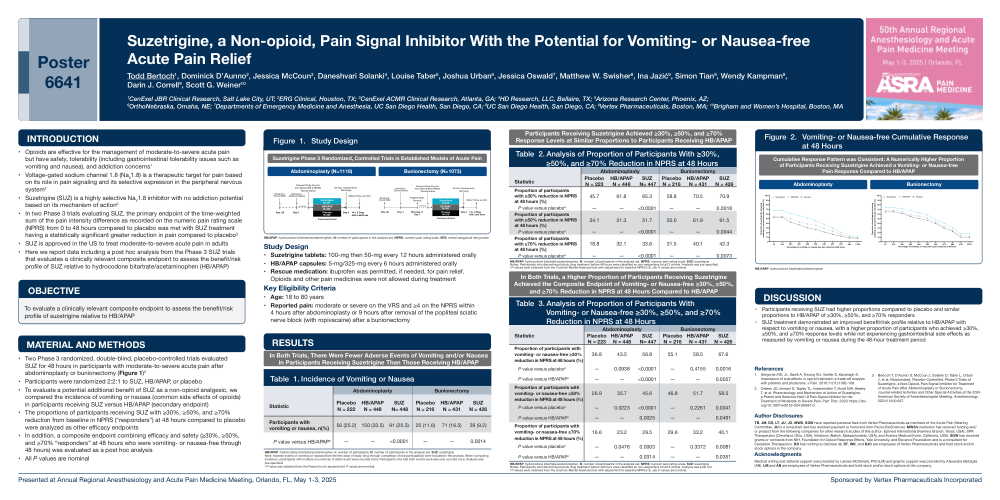
Two Phase 3 randomized, double-blind, placebo-controlled trials evaluated SUZ for 48 hours in participants with moderate-to-severe acute pain after abdominoplasty or bunionectomy (Figure 1)3
Participants were randomized 2:2:1 to SUZ, HB/APAP, or placebo
To evaluate a potential additional benefit of SUZ as a non-opioid analgesic, we compared the incidence of vomiting or nausea (common side effects of opioids) in participants receiving SUZ versus HB/APAP (secondary endpoint)
The proportions of participants receiving SUZ with ≥30%, ≥50%, and ≥70% reduction from baseline in NPRS (“responders”) at 48 hours compared to placebo were analyzed as other efficacy endpoints
In addition, a composite endpoint combining efficacy and safety (≥30%, ≥50%, and ≥70% “responders” at 48 hours who were vomiting- or nausea-free through 48 hours) was evaluated as a post hoc analysis
All P values are nominal
Study Design
Suzetrigine tablets: 100-mg then 50-mg every 12 hours administered orally
HB/APAP capsules: 5-mg/325-mg every 6 hours administered orally
Rescue medication: ibuprofen was permitted, if needed, for pain relief. Opioids and other pain medicines were not allowed during treatment
Key Eligibility Criteria
Age: 18 to 80 years
Reported pain: moderate or severe on the VRS and ≥4 on the NPRS within 4 hours after abdominoplasty or 9 hours after removal of the popliteal sciatic nerve block (with ropivacaine) after a bunionectomy
RESULTS
In Both Trials, There Were Fewer Adverse Events of Vomiting and/or Nausea in Participants Receiving Suzetrigine Than Those Receiving HB/APAP
Participants Receiving Suzetrigine Achieved ≥30%, ≥50%, and ≥70% Response Levels at Similar Proportions to Participants Receiving HB/APAP
In Both Trials, a Higher Proportion of Participants Receiving Suzetrigine Achieved the Composite Endpoint of Vomiting- or Nausea-free ≥30%, ≥50%, and ≥70% Reduction in NPRS at 48 Hours Compared to HB/APAP
Cumulative Response Pattern was Consistent: A Numerically Higher Proportion of Participants Receiving Suzetrigine Achieved a Vomiting- or Nausea-free Pain Response Compared to HB/APAP
DISCUSSION
Participants receiving SUZ had higher proportions compared to placebo and similar proportions to HB/APAP of ≥30%, ≥50%, and ≥70% responders
SUZ treatment demonstrated an improved benefit/risk profile relative to HB/APAP with respect to vomiting or nausea, with a higher proportion of participants who achieved ≥30%, ≥50%, and ≥70% response levels while not experiencing gastrointestinal side effects as measured by vomiting or nausea during the 48-hour treatment period