383 posters, 2 videos, 1 audios, 8 topics, 28 sessions, 328 authors, 225 institutions
ePostersLive by SciGen Technologies S.A. All rights reserved.
50th Annual Regional Anesthesiology and Acute Pain Medicine Meeting
May 1 - 3, 2025 | Orlando, Florida

6865
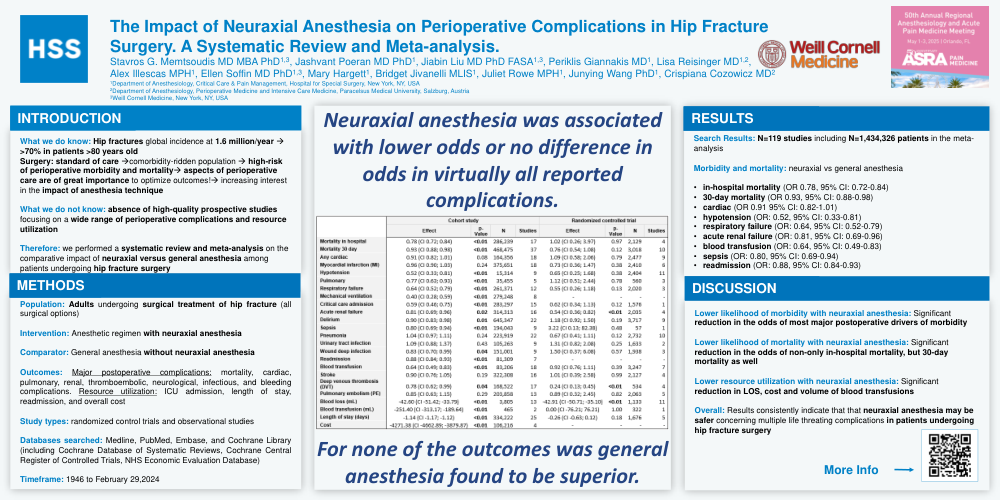
THE IMPACT OF NEURAXIAL ANESTHESIA ON PERIOPERATIVE COMPLICATIONS IN HIP FRACTURE SURGERY. A SYSTEMATIC REVIEW AND META-ANALYSIS.
Poster Presenter
Authors
Affiliations
Part of Topic
Scientific Abstracts > Regional Anesthesia
Hip fractures and their consequences represent a major public health concern among the elderly
population. The global incidence is estimated at 1.6 million per year with more than 70% occurring in
patients beyond the age of 80 years. Surgical treatment is usually required, placing this comorbidity
ridden population at high risk for perioperative morbidity and mortality. It is estimated that the
global number of hip fracture surgeries will increase to 4.5 million by the 2050, thus identifying this
entity as a high priority target for interventions to mitigate adverse outcomes is crucial. (1, 2) Aspects
of perioperative care are therefore of high importance with the goal of increasing patient safety on a
population-based level.(3) In this context there has been increasing interest in the impact of
anesthesia technique on the risk for various outcomes. In the absence of adequate prospective
studies focusing on the outcome of a wide range of perioperative complications, we performed a
systematic review and meta-analysis on the comparative impact of neuraxial versus general
anesthesia among patients undergoing hip fracture surgery. Subsequently the International
Consensus on Anesthesia-Related Outcomes after Surgery group (ICAROS) will convene for the
development of evidence-based recommendations.
Methods: in this systematic review with meta-analysis, randomized controlled trials and
observational studies comparing neuraxial to general anesthesia were included. The outcomes of
interest were major postoperative complications, including mortality, cardiac, pulmonary, renal,
thromboembolic, neurological, infectious, and bleeding complications. Furthermore, outcomes of
resource utilization including ICU admission, length of stay, readmission, and overall cost were
analyzed. Medline, PubMed, Embase, and Cochrane Library (including Cochrane Database of
Systematic Reviews, Cochrane Central Register of Controlled Trials, NHS Economic Evaluation
Database), from 1946 to February 29, 2024, were queried.
Results: Analysis of 119 studies including 1,434,326 patients revealed that neuraxial anesthesia was
associated with lower odds or no difference in virtually all reported complications. Odds ratios (OR)
for complications in patients undergoing hip fracture surgery with neuraxial vs general anesthesia
were as follows: in-hospital mortality (OR 0.78, 95% confidence interval (CI): 0.72-0.84; 30-day
mortality OR: 0.93, 95% CI: 0.88-0.98); cardiac (OR 0.91 95% CI: 0.82-1.01); hypotension (OR: 0.52,
95% CI: 0.33-0.81); respiratory failure (OR: 0.64, 95% CI: 0.52-0.79); acute renal failure (OR: 0.81,
95% CI: 0.69-0.96); blood transfusion (OR: 0.64, 95% CI: 0.49-0.83); sepsis (OR: 0.80, 95% CI: 0.69-
0.94); and readmission (OR: 0.88, 95% CI: 0.84-0.93). For none of the outcomes was general
anesthesia found to be superior.
Conclusions: The use of neuraxial anesthesia was associated with a significant reduction in the odds
for complications for numerous serious postoperative events, including mortality, respiratory, renal,
bleeding and infectious complications.(4) Moreover, among patients who received neuraxial
anesthesia, a lower risk for critical care admissions and hospital readmissions was observed
concurrent with a significant reduction in length of stay, cost, and volume of blood transfusions.
Overall, results consistently indicate that that neuraxial anesthesia may be safer concerning multiple
life threating complications in patients undergoing hip fracture surgery.