383 posters, 2 videos, 1 audios, 8 topics, 28 sessions, 328 authors, 225 institutions
ePostersLive by SciGen Technologies S.A. All rights reserved.
50th Annual Regional Anesthesiology and Acute Pain Medicine Meeting
May 1 - 3, 2025 | Orlando, Florida

6791
POSTOPERATIVE DELIRIUM AFTER TOTAL JOINT ARTHROPLASTY: TRENDS AND IMPACT OF ENHANCED RECOVERY AFTER SURGERY PROTOCOLS
Poster Presenter
Authors
Affiliations
Part of Topic
Scientific Abstracts > Regional Anesthesia
Postoperative Delirium after Total Joint Arthroplasty:Trends and Impact of Enhanced Recovery after Surgery Protocols
Introduction
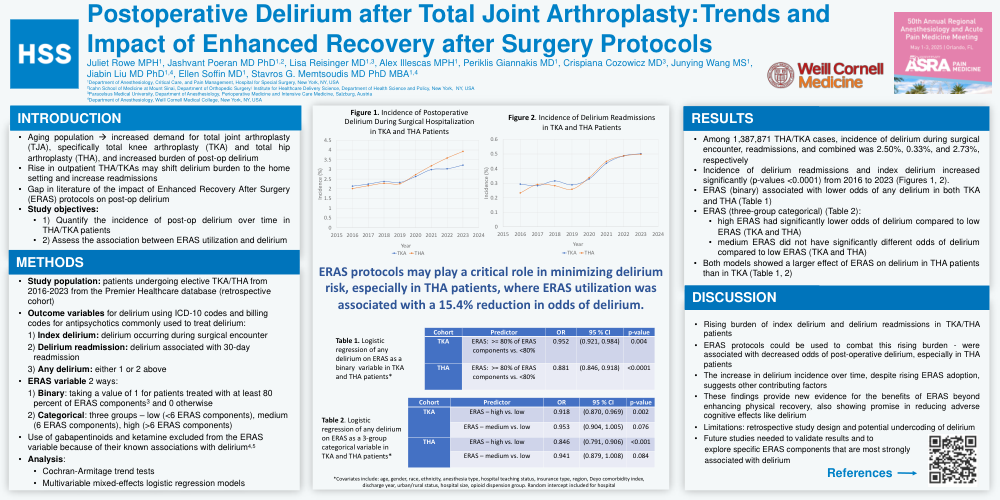
• Aging population → increased demand for total joint arthroplasty (TJA), specifically total knee arthroplasty (TKA) and total hip arthroplasty (TKA), and increased burden of post-op delirium • Rise in outpatient THA/TKAs may shift delirium burden to the home setting and increase readmissions • Gap in literature of the impact of Enhanced Recovery After Surgery (ERAS) protocols on post-op delirium • Study objectives: • 1) Quantify the incidence of post-op delirium over time in THA/TKA patients • 2) Assess the association between ERAS utilization and delirium
Methods
• Study population: patients undergoing elective TKA/THA from 2016-2023 from the Premier Healthcare database (retrospective cohort) • Outcome variables for delirium using ICD-10 codes and billing codes for antipsychotics commonly used to treat delirium: 1) Index delirium: delirium occurring during surgical encounter 2) Delirium readmission: delirium associated with 30-day readmission 3) Any delirium: either 1 or 2 above • ERAS variable 2 ways: 1) Binary: taking a value of 1 for patients treated with at least 80 percent of ERAS components3 and 0 otherwise 2) Categorical: three groups – low (<6 ERAS components), medium (6 ERAS components), high (>6 ERAS components) • Use of gabapentinoids and ketamine excluded from the ERAS variable because of their known associations with delirium4,5 • Analysis: • Cochran-Armitage trend tests • Multivariable mixed-effects logistic regression models
Results
• Among 1,387,871 THA/TKA cases, incidence of delirium during surgical encounter, readmissions, and combined was 2.50%, 0.33%, and 2.73%, respectively • Incidence of delirium readmissions and index delirium increased significantly (p-values <0.0001) from 2016 to 2023 (Figures 1, 2). • ERAS (binary) associated with lower odds of any delirium in both TKA and THA (Table 1) • ERAS (three-group categorical) (Table 2): • high ERAS had significantly lower odds of delirium compared to low ERAS (TKA and THA) • medium ERAS did not have significantly different odds of delirium compared to low ERAS (TKA and THA) • Both models showed a larger effect of ERAS on delirium in THA patients than in TKA (Table 1, 2)
Discussion
• Rising burden of index delirium and delirium readmissions in TKA/THA patients • ERAS protocols could be used to combat this rising burden - were associated with decreased odds of post-operative delirium, especially in THA patients • The increase in delirium incidence over time, despite rising ERAS adoption, suggests other contributing factors • These findings provide new evidence for the benefits of ERAS beyond enhancing physical recovery, also showing promise in reducing adverse cognitive effects like delirium • Limitations: retrospective study design and potential undercoding of delirium • Future studies needed to validate results and to explore specific ERAS components that are most strongly associated with delirium
ERAS protocols may play a critical role in minimizing delirium risk, especially in THA patients, where ERAS utilization was associated with a 15.4% reduction in odds of delirium.