Loading...

383 posters, 2 videos, 1 audios, 8 topics, 28 sessions, 328 authors, 225 institutions

ePostersLive by SciGen Technologies S.A. All rights reserved.

6716

EXCESSIVE THREADING THORACIC EPIDURAL CATHETER PLACEMENT LEADS TO CEPHALAD MIGRATION, AS CONFIRMED BY ELECTRICAL STIMULATION TEST
Part of Topic

Scientific Abstracts > Regional Anesthesia


    Excessive Threading Thoracic Epidural Catheter Placement Leads to Cephalad Migration, as Confirmed by Electrical Stimulation Test

 Kamonchanok Tengwongderm1, Jean Louis Horn1 , Ban Tsui1, 2


Thoracic Epidural Analgesia and Catheter Insertion

•Thoracic epidural analgesia is crucial for managing perioperative pain during surgeries.
•Catheter insertion into the epidural space is recommended at 4–5 cm to avoid complications.
•The Electrical Stimulation Test (EST) confirms catheter placement by applying a low-voltage current.
•Excessive lumbar epidural catheters migrate in the caudad direction, while thoracic catheters hypothesis  to migrate cephalad due to unique anatomical and physiological factors.
•Hypothesis: Excessive thoracic insertion leads to cephalad migration.
 
•Retrospective analysis of data from 97 thoracic epidural procedures from December 2023 to February 2024.
•32 patients EST confirmed epidural space.
•Catheters inserted 10-20 cm into the skin, then withdrawn.
•Myotomal activity levels were recorded at different depths to determine the catheter's direction.
•Catheter's path is categorized into upper thoracic, lower thoracic, and lower cervical regions.
•Muscle twitching responses compared across insertion depths using Fisher’s exact test.
 

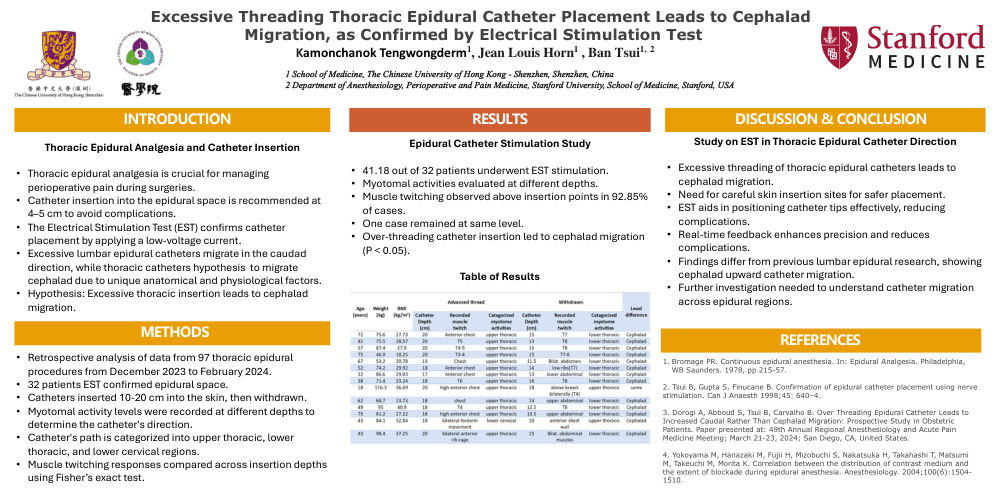
Epidural Catheter Stimulation Study


•41.18 out of 32 patients underwent EST stimulation.
•Myotomal activities evaluated at different depths.
•Muscle twitching observed above insertion points in 92.85% of cases.
•One case remained at same level.
•Over-threading catheter insertion led to cephalad migration (P < 0.05).
 

Study on EST in Thoracic Epidural Catheter Direction

•Excessive threading of thoracic epidural catheters leads to cephalad migration.
•Need for careful skin insertion sites for safer placement.
•EST aids in positioning catheter tips effectively, reducing complications.
•Real-time feedback enhances precision and reduces complications.
•Findings differ from previous lumbar epidural research, showing cephalad upward catheter migration.
•Further investigation needed to understand catheter migration across epidural regions.
 
1.Bromage PR. Continuous epidural anesthesia. In: Epidural Analgesia. Philadelphia, WB Saunders. 1978, pp 215-57.

2. Tsui B, Gupta S, Finucane B. Confirmation of epidural catheter placement using nerve stimulation. Can J Anaesth 1998;45: 640–4.

3. Dorogi A, Abboud S, Tsui B, Carvalho B. Over Threading Epidural Catheter Leads to Increased Caudal Rather Than Cephalad Migration: Prospective Study in Obstetric Patients. Paper presented at: 49th Annual Regional Anesthesiology and Acute Pain Medicine Meeting; March 21-23, 2024; San Diego, CA, United States.

4. Yokoyama M, Hanazaki M, Fujii H, Mizobuchi S, Nakatsuka H, Takahashi T, Matsumi M, Takeuchi M, Morita K. Correlation between the distribution of contrast medium and the extent of blockade during epidural anesthesia. Anesthesiology. 2004;100(6):1504-1510.

 
asraspring2025 banner
Copyright © 2015-2026, ePostersLive® SciGen is a registered trademark of SciGen Technologies S.A. Patent pending.

This website and third-party tools we use rely on cookies for the best user experience. By selecting "I agree", you agree to cookie usage as described in our Privacy Policy.
