383 posters, 2 videos, 1 audios, 8 topics, 28 sessions, 328 authors, 225 institutions
ePostersLive by SciGen Technologies S.A. All rights reserved.
50th Annual Regional Anesthesiology and Acute Pain Medicine Meeting
May 1 - 3, 2025 | Orlando, Florida

6785
A DESCRIPTIVE ANALYSIS OF PERIOPERATIVE METHADONE USE IN PATIENTS UNDERGOING ORTHOPEDIC PROCEDURES IN THE UNITED STATES
Poster Presenter
Authors
Affiliations
Part of Topic
Scientific Abstracts > Acute Pain
Introduction
Methadone is increasingly used in perioperative settings
This study examines the current patterns of perioperative methadone use in the United States
Methadone is increasingly used in perioperative settings
This study examines the current patterns of perioperative methadone use in the United States
Methods
Premier Healthcare database
Institutions conducting at least 10 of the following procedures annually: spinal fusions, primary THA, revision THA, primary TKA, and revision TKA.
We report the proportion of patients (%) receiving perioperative methadone per procedure group.
Hospital-level procedure-specific utilization was reported grouped by surgery type and categorized into
Results
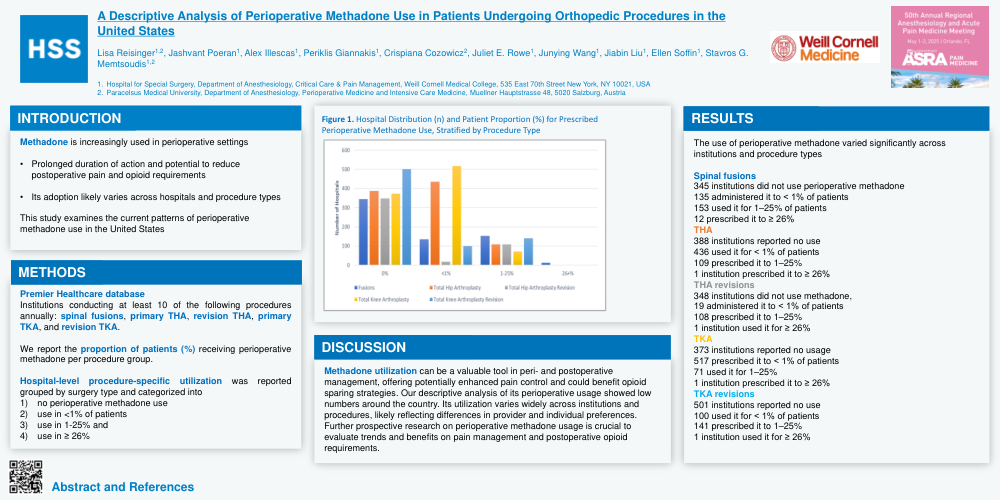
The use of perioperative methadone varied significantly across institutions and procedure types
Spinal fusions
345 institutions did not use perioperative methadone
135 administered it to ˂ 1% of patients
153 used it for 1–25% of patients
12 prescribed it to ≥ 26%
THA
388 institutions reported no use
436 used it for ˂ 1% of patients
109 prescribed it to 1–25%
1 institution prescribed it to ≥ 26%
THA revisions
348 institutions did not use methadone,
19 administered it to ˂ 1% of patients
108 prescribed it to 1–25%
1 institution used it for ≥ 26%
TKA
373 institutions reported no usage
517 prescribed it to ˂ 1% of patients
71 used it for 1–25%
1 institution prescribed it to ≥ 26%
TKA revisions
501 institutions reported no use
100 used it for ˂ 1% of patients
141 prescribed it to 1–25%
1 institution used it for ≥ 26%
Discussion
Methadone utilization can be a valuable tool in peri- and postoperative management, offering potentially enhanced pain control and could benefit opioid sparing strategies. Our descriptive analysis of its perioperative usage showed low numbers around the country. Its utilization varies widely across institutions and procedures, likely reflecting differences in provider and individual preferences. Further prospective research on perioperative methadone usage is crucial to evaluate trends and benefits on pain management and postoperative opioid requirements.