383 posters, 2 videos, 1 audios, 8 topics, 28 sessions, 328 authors, 225 institutions
ePostersLive by SciGen Technologies S.A. All rights reserved.
50th Annual Regional Anesthesiology and Acute Pain Medicine Meeting
May 1 - 3, 2025 | Orlando, Florida

6442
POINT-OF-CARE ULTRASOUND ASSESSMENT OF DIAPHRAGMATIC FUNCTION AFTER PROXIMAL BRACHIAL PLEXUS BLOCK FOR SHOULDER SURGERY.
Poster Presenter
Authors
Affiliations
Part of Topic
Scientific Abstracts > Regional Anesthesia
Point-of-care ultrasound assessment of diaphragmatic function after proximal brachial plexus block for shoulder surgery
A prospective observational study
Kim, Seung Cheol (Paul); Chong, Michelle; Girón-Arango, Laura; Wild, Kim; Li, Qixuan; Huszti, Ella; Chowdhury, Jayanta; Chan, Vincent WS; Perlas, Anahi
BACKGROUND
PoCUS is a useful tool to detect phrenic nerve palsy following brachial plexus blocks (BPB). It is, however, challenging to assess the diaphragm using traditional methods. We recently characterized an alternative method to consistently measure the diaphragmatic function.
The aim of this study is to evaluate the diaphragm before and after a BPB using three different methods of sonographic assessment.
METHODS
- Prospective, double-blind, non-randomized study conducted at two tertiary academic health sciences centers
- Patients: Age > 18 years, ASA I-III, BMI <35 kg/m2, undergoing elective shoulder surgery with a proximal BPB
- BPB: Interscalene block (ISB) or superior trunk block (STB) with 15-20 mL of ropivacaine 0.5% or bupivacaine 0.25% with 1:400,000 epinephrine
- Sonographic assessment: Performed prior to and within 30 minutes of BPB using three methods:
- Excursion of the Dome of Diaphragm (DOD)
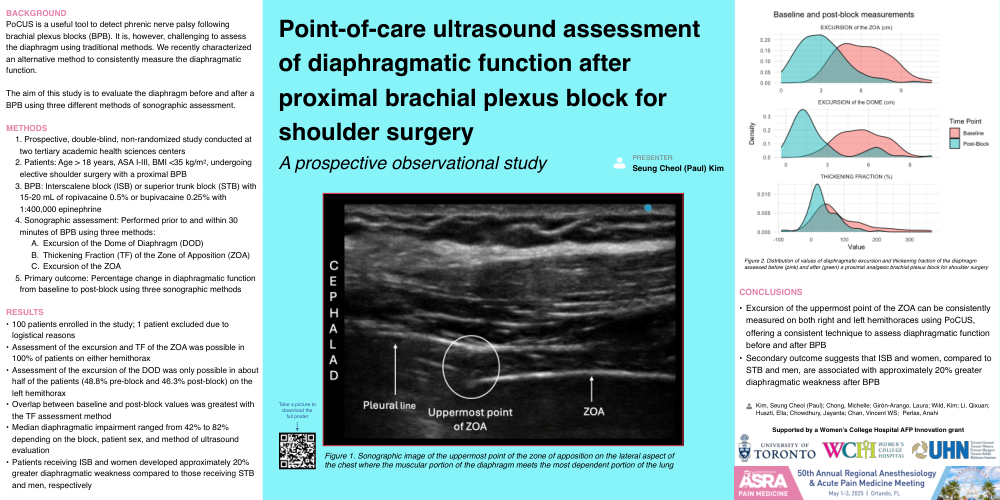
- Thickening Fraction (TF) of the Zone of Apposition (ZOA)
- Excursion of the ZOA
- Primary outcome: Percentage change in diaphragmatic function from baseline to post-block using three sonographic methods
RESULTS
- 100 patients enrolled in the study; 1 patient excluded due to logistical reasons
- Assessment of the excursion and TF of the ZOA was possible in 100% of patients on either hemithorax
- Assessment of the excursion of the DOD was only possible in about half of the patients (48.8% pre-block and 46.3% post-block) on the left hemithorax
- Overlap between baseline and post-block values was greatest with the TF assessment method
- Median diaphragmatic impairment ranged from 42% to 82% depending on the block, patient sex, and method of ultrasound evaluation
- Patients receiving ISB and women developed approximately 20% greater diaphragmatic weakness compared to those receiving STB and men, respectively
CONCLUSIONS
- Excursion of the uppermost point of the ZOA can be consistently measured on both right and left hemithoraces using PoCUS, offering a consistent technique to assess diaphragmatic function before and after BPB
- Secondary outcome suggests that ISB and women, compared to STB and men, are associated with approximately 20% greater diaphragmatic weakness after BPB