383 posters, 2 videos, 1 audios, 8 topics, 28 sessions, 328 authors, 225 institutions
ePostersLive by SciGen Technologies S.A. All rights reserved.
50th Annual Regional Anesthesiology and Acute Pain Medicine Meeting
May 1 - 3, 2025 | Orlando, Florida

6490
RADIOFREQUENCY STIMULATION FOR REGIONAL ANALGESIA AFTER TOTAL KNEE ARTHROPLASTY
Poster Presenter
Authors
Affiliations
Part of Topic
Scientific Abstracts > Regional Anesthesia
INTRODUCTION
Knee arthroplasty is painful and the most effective pain management technique is peripheral nerve blocks. Nerve blocks are limited by their duration even when peripheral nerve catheters are used. An ideal analgesic after major surgery would provide prolonged duration for weeks without a motor block and eliminate problems like rebound pain. A new technology radiofrequency stimulation has been developed and can provide prolonged regional analgesia for 20 days, without motor block, respiratory depression, or the worry of addiction.
METHODS
Following IRB approval subjects were assigned to either a sham or active group. All subjects were stimulated within 3 days prior to a primary TKA procedure. Two needle-like electrodes were placed beside the femoral nerve at the crease, and secondly the sciatic nerve 1cm proximal to the popliteal bifurcation. A 4-minute electrical stimulation was delivered to each nerve. The active group received the radiofrequency stimulation (RF Stim) treatment. Sham subjects received an ordinary electrical stimulation that is known to be non-therapeutic (biphasic pulses,1 ms pulse width, 2 Hz). After treatment, the electrodes were removed. A TKA was performed using general anesthesia, multimodal analgesia, including surgical periarticular infiltration with local anesthetic. Routine postoperative care was undertaken including oral opioids, acetaminophen, and NSAIDs. Subjects returned for evaluation up to 45 days. Pain (Brief Pain Inventory- Short Form [BPI]), opioid consumption, and function (Knee injury & Osteoarthritis Outcome Score [KOOS]) were assessed at each session. All subjects performed PT, and used analgesics per usual care. Pain scores were reported on an 11-point scale. Descriptive statistics, parametric, and non-parametric tests were employed appropriately, with P < 0.05 considered significant.
RESULTS
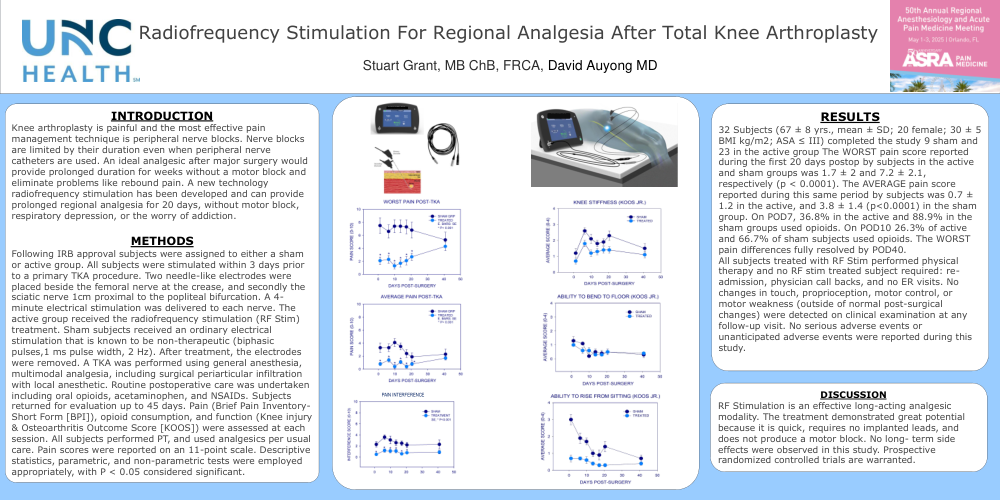
32 Subjects (67 ± 8 yrs., mean ± SD; 20 female; 30 ± 5 BMI kg/m2; ASA ≤ III) completed the study 9 sham and 23 in the active group The WORST pain score reported during the first 20 days postop by subjects in the active and sham groups was 1.7 ± 2 and 7.2 ± 2.1, respectively (p < 0.0001). The AVERAGE pain score reported during this same period by subjects was 0.7 ± 1.2 in the active, and 3.8 ± 1.4 (p<0.0001) in the sham group. On POD7, 36.8% in the active and 88.9% in the sham groups used opioids. On POD10 26.3% of active and 66.7% of sham subjects used opioids. The WORST pain differences fully resolved by POD40.
All subjects treated with RF Stim performed physical
therapy and no RF stim treated subject required: re-admission, physician call backs, and no ER visits. No changes in touch, proprioception, motor control, or motor weakness (outside of normal post-surgical changes) were detected on clinical examination at any follow-up visit. No serious adverse events or unanticipated adverse events were reported during this study.
DISCUSSION
RF Stimulation is an effective long-acting analgesic modality. The treatment demonstrated great potential because it is quick, requires no implanted leads, and does not produce a motor block. No long- term side effects were observed in this study. Prospective randomized controlled trials are warranted.