383 posters, 2 videos, 1 audios, 8 topics, 28 sessions, 328 authors, 225 institutions
ePostersLive by SciGen Technologies S.A. All rights reserved.
50th Annual Regional Anesthesiology and Acute Pain Medicine Meeting
May 1 - 3, 2025 | Orlando, Florida

6689
UTILIZATION OF PERIPHERAL NERVE BLOCK FOR AMBULATORY SHOULDER SURGERY IN THE U.S.
Poster Presenter
Authors
Affiliations
Part of Topic
Scientific Abstracts > Regional Anesthesia
Utilization of peripheral nerve block for ambulatory shoulder surgery in the U.S.
Minghui Chen, M.D., Ph.D. 1, Tao Li, M.D., Ph.D. 2
1 Department of Anesthesiology, Boston Medical Center, Boston, MA
2 Health Policy, College of Health, Oregon State University, Corvallis, OR
Introduction
Benefits of peripheral nerve block (PNB) includes improving postoperative pain relief 1, reducing postoperative opioid consumption 2, decreasing unplanned admission 3,4, shorter post-anesthesia care unit stay 3, and earlier rehabilitation. However, implementing this technique can not only incur financial barriers for patients of vulnerable socio-economic status, but also demand substantial resources that are challenging for some facilities 1. Our research aims to provide national estimates of access to PNB, either via single shot or as continuous PNB via catheter (CPNB). Specifically, we focused on ambulatory shoulder surgery, for which PNB has become a common component of multimodal analgesia. We expect evidence from our study will aid providers, researchers and policymakers in improving equal access to this important technique to benefit more patients.
Material and methods
We performed a retrospective study using data from the 2019-2020 Nationwide Ambulatory Surgery Sample (NASS), Healthcare Cost and Utilization Project (HCUP), Agency for Healthcare Research and Quality (AHRQ). The NASS is the largest all-payer ambulatory surgery database in the United States. To construct our study sample, we extracted discharge data for adults who underwent major shoulder surgery (e.g., total shoulder arthroplasty, hemiarthroplasty of shoulder, rotator cuff repair, shoulder fusion, etc.), and had general and/or regional anesthesia in the record. As our main interest in this study, our dependent variable was whether patients received any PNB (i.e., interscalene brachial plexus block, suprascapular nerve block, axillary nerve block) in form of single shot or CPNB for these surgeries. To examine our hypothesis on the impacts of patients’ socio-economic status, we analyzed patients’ insurance status and median household income at zip code from the NASS data. To investigate effects of hospital features, we also included hospital size, rural location, teaching status, and region.
We conducted a weighted logistic regression model to yield nationally representative estimates on how patient and hospital characteristics can affect access to PNB. Our control variables included patients’ demographic characteristics (age, gender, race) and medical conditions that may affect the clinical decision for PNB utilization (chronic pain and opioid use). We used SAS version 9.4 (SAS Institute) for statistical analyses. Statistical significance was defined as p < 0.05. Our study received IRB exemption.
Results
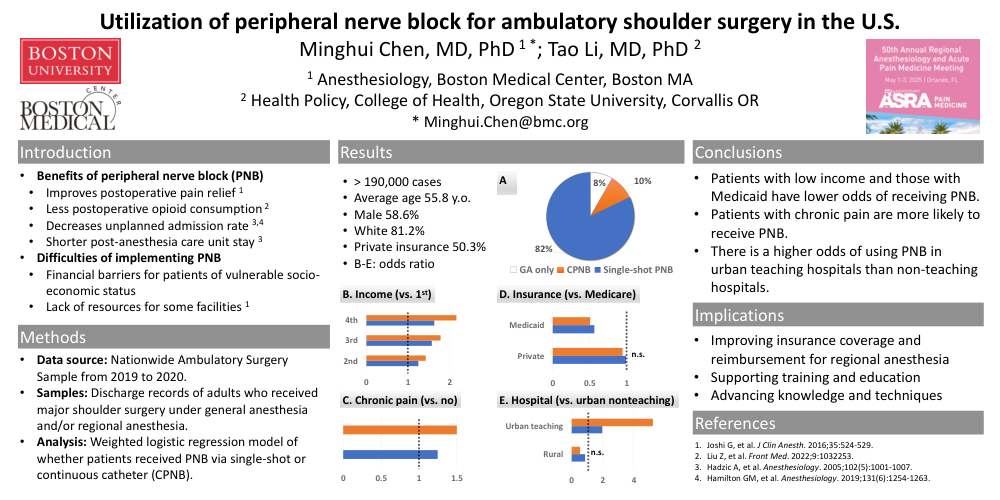
More than 190,000 cases of major shoulder surgeries that were estimated in hospital-owned facilities in the United States between 2019 and 2020, of which over 90% implemented PNB (82.2% single shot PNB and ~9.5% CPNB). Average age was 55.8 years old. Most cases were males (58.6%), white (81.2%) and had private insurance as primary payer (50.3%). More than half were performed in facilities owned by urban teaching hospitals (56.5%).
Our analytical results were shown in Table 1. Patients with higher incomes were more likely to receive PNB as either single shot or continuous catheter. Odds ratio of the patients with income in the 2nd, 3rd and 4th quarter percentile receiving PNB are 1.3, 1.6 and 1.6 for single shot and 1.4, 1.8 and 2.2 for CPNB, when comparing to the patients with income in the 1st quarter percentile. In addition, patients with Medicaid insurance are less likely to receive PNB when compared to patients with Medicare (odds ratio: 0.6 for single shot, 0.5 for CPNB). PNB was also more likely to be used for patients with chronic pain (OR: 1.2 for single shot and 1.5 for CPNB). Preexisting chronic opioid prescription did not significantly change the likelihood of implementing CPNB or single-shot PNB. Regarding the impact of hospital features, our results showed that shoulder surgeries performed in urban teaching hospitals (v.s. urban non-teaching hospitals, OR: 2.0 for single shot PNB and 5.2 for CPNB) and in hospitals in Southern region (v.s. Northeast region, OR: 1.9 for single shot and 6.4 for CPNB) had higher odds of utilizing PNB.
Discussion
This study is a follow up study from the presentation at ASRA last year, which provides nationally representative evidence identifying barriers to PNB in the United States. In this study, we analysis PNB for shoulder surgeries as single shot versus CPNB. Further supporting our previous findings, we found that low income was associated with lower likelihood of receiving PNB as either single shot or CPNB, and teaching hospitals are more likely to utilizing PNB in both single shot and CPNB for major ambulatory surgeries. By separating CPNB from single shot PNB, we found that patients with chronic opioid prescription are more likely to receive CPNB, but not single shot PNB.
Our study highlights the need for improving coverage and reimbursement to promote the utilization of regional anesthesia, which will be particularly important to overcome financial barriers for patients with socio-economic disparities. With national estimates, our current study further sheds light on the importance of provider education and training of regional anesthesia in the United States. Therefore, supporting professional training and development and increasing resources at rural hospital are essential to address access disparities.
References
1. Joshi G, Gandhi K, Shah N, Gadsden J, Corman SL. Peripheral nerve blocks in the management of postoperative pain: challenges and opportunities. J Clin Anesth. 2016;35:524-529. doi:10.1016/j.jclinane.2016.08.041
2. Liu Z, Li YB, Wang JH, Wu GH, Shi PC. Efficacy and adverse effects of peripheral nerve blocks and local infiltration anesthesia after arthroscopic shoulder surgery: A Bayesian network meta-analysis. Front Med. 2022;9:1032253. doi:10.3389/fmed.2022.1032253
3. Hadzic A, Williams BA, Karaca PE, et al. For Outpatient Rotator Cuff Surgery, Nerve Block Anesthesia Provides Superior Same-day Recovery over General Anesthesia. Anesthesiology. 2005;102(5):1001-1007. doi:10.1097/00000542-200505000-00020
4. Hamilton GM, Ramlogan R, Lui A, et al. Peripheral Nerve Blocks for Ambulatory Shoulder Surgery: A Population-based Cohort Study of Outcomes and Resource Utilization. Anesthesiology. 2019;131(6):1254-1263. doi:10.1097/ALN.0000000000002865