383 posters, 2 videos, 1 audios, 8 topics, 28 sessions, 328 authors, 225 institutions
ePostersLive by SciGen Technologies S.A. All rights reserved.
50th Annual Regional Anesthesiology and Acute Pain Medicine Meeting
May 1 - 3, 2025 | Orlando, Florida

6645
OUTPATIENT CONTINUOUS ADDUCTOR CANAL BLOCK IN TOTAL KNEE ARTHROPLASTY: A DOUBLE BLINDED RANDOMIZED CONTROLLED TRIAL
Poster Presenter
Authors
Affiliations
Part of Topic
Scientific Abstracts > Regional Anesthesia
Outpatient Continuous Adductor Canal Block in Total Knee Arthroplasty:
A Double Blinded Randomized Controlled Trial
Authors: Yehoshua Gleicher, Hermann Dos Santos, Sharon Peacock, Javiera Vargas, Andrés Merchan, Carlson Asanghanwa, Fernanda Oliveira,
Dyvia Mahahan, Christine Ma, Harmsinran Kaur, Naveed Siddiqui.
INTRODUCTION
• Pain recovery following total knee arthroplasty (TKA) delays mobilization and
remains a significant barrier for patient recovery.
• Continuous adductor canal blocks (CACB) using a catheter-based technique
can increase the duration of ACB analgesia
• The benefit of CACB in an outpatient setting has yet to be investigated.
METHODS
• Outpatient or short stay primary TKA going home with a CACB (Ropivacaine
0.2% vs Normal saline 0.9%).
• Catheters tunneled using ISAFE technique: Inter-fascial space between the
Sartorius muscle and Femoral artery1
• Primary outcome was total opioid consumption at 48 hours, Secondary
outcomes were: Quality of Recovery (QoR-15) scores, numerical rating scale
(NRS) for pain at rest and movement, hospital length-of-stay (LOS), and CACB
catheter-related complications .
RESULTS
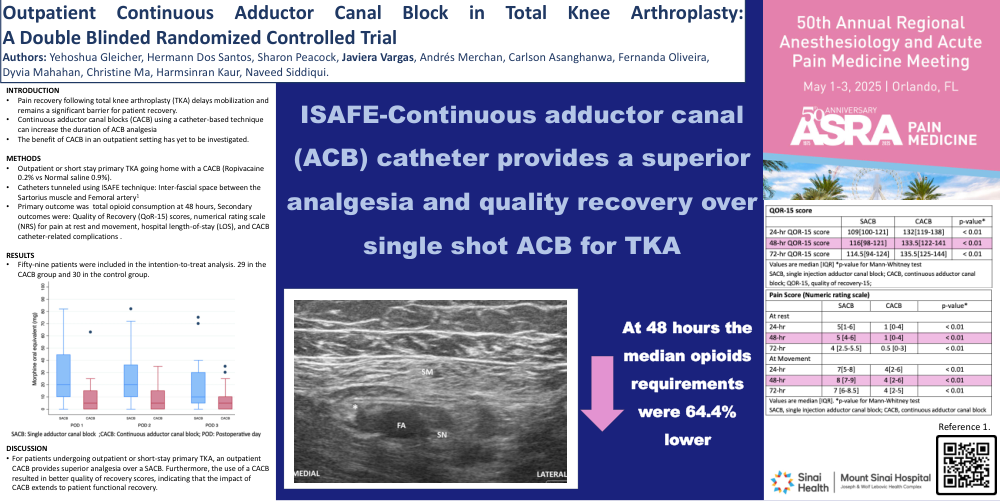
• Fifty-nine patients were included in the intention-to-treat analysis. 29 in the
CACB group and 30 in the control group.
DISCUSSION
• For patients undergoing outpatient or short-stay primary TKA, an outpatient
CACB provides superior analgesia over a SACB. Furthermore, the use of a CACB
resulted in better quality of recovery scores, indicating that the impact of
CACB extends to patient functional recovery.