343 posters, 5 videos, 2 audios, 18 topics, 33 sessions, 263 authors, 202 institutions
ePostersLive by SciGen Technologies S.A. All rights reserved.
24th Annual Pain Medicine Meeting 2025
November 13-15, 2025| JW Marriott Austin, Austin, Texas

2179744
Optimization of Facet-Mediated Procedure Workflows
Poster Presenter
Authors
Affiliations
Part of Topic
Safety/QA/QI Projects
Optimization of Facet-Mediated Procedure Workflows
Swathi Rayasam MD, Brooke Hays MSN APRN ANGP-C, Daltry Dott MD CHCQM FABQUARP
University of Texas Medical Center Frisco Multidisciplinary Spine Center
Introduction
•Facet-mediated pain can be treated with Medial Branch Blocks (MBBs) and Radiofrequency Ablations (RFAs) with specified workflow.
•In June 2023, Medicare implemented new policies for coverage of MBBs and RFAs, requiring prior authorization, 4-week global period between each procedure when performed in a hospital, and specified documentation [1].
•With these policies, the series of MBBs and RFAs took 3+ months to complete with our workflow.
•Our clinic faced obstacles including non-billable and incomplete post-procedure follow-ups and denials by insurance due to inadequate documentation.
Goal
•An intervention was created to standardize an optimized workflow for this series of procedures, minimize insurance denials, increase revenue and slot utilization, and improve patient outcomes.
Methodology
•Originally, staff contacted patients informally for post-procedural evaluation. At times, incomplete evaluation necessitated additional communication between physician and patient before proceeding with the next step.
•These follow-ups were unpaid, time-consuming, and conducted outside of formal appointment times.
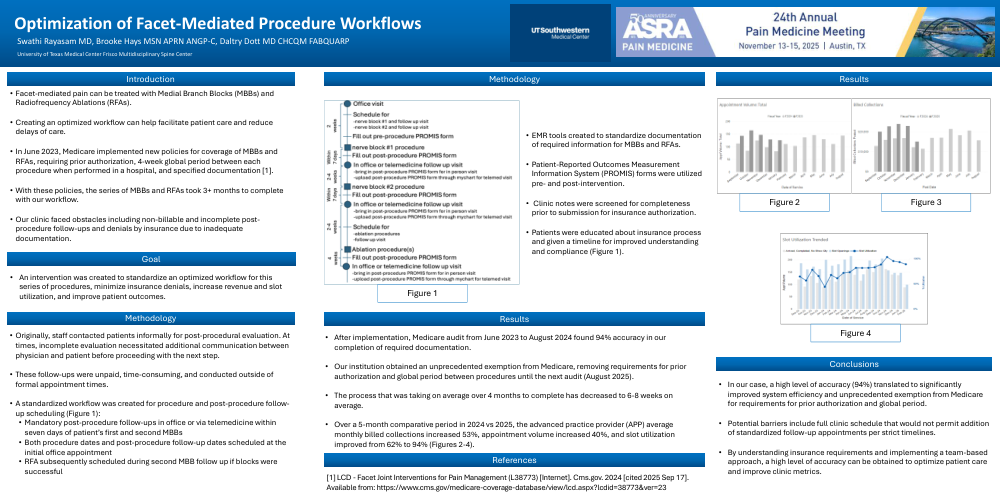
•A standardized workflow was created for procedure and post-procedure follow-up scheduling (Figure 1):
•Mandatory post-procedure follow-ups in office or via telemedicine within seven days of patient’s first and second MBBs
•Both procedure dates and post-procedure follow-up dates scheduled at the initial office appointment
•RFA subsequently scheduled during second MBB follow up if blocks were successful
•EMR tools created for standardized documentation of required information for MBBs and RFAs.
•Patient-Reported Outcomes Measurement Information System (PROMIS) forms were utilized pre- and post-intervention.
• Clinic notes were screened for completeness prior to submission for insurance authorization. Patients were educated about insurance process and given a timeline for improved understanding and compliance.
Results
•After implementation, Medicare audit from June 2023 to August 2024 found 94% accuracy in our completion of required documentation.
•Our institution obtained an unprecedented exemption from Medicare, removing requirements for prior authorization and global period between procedures until the next audit (August 2025)
•This process that was taking on average over 4 months to complete has decreased to 6-8 weeks on average .
•Over a 5-month comparative period in 2024 vs 2025, the advanced practice provider (APP) average monthly billed collections increased 53%, appointment volume increased 40%, and slot utilization improved from 62% to 94% (Figures 2-4).
Conclusions
•In our case, a high level of accuracy (94%) translated to significantly improved system efficiency and unprecedented exemption from Medicare for requirements for prior authorization and global period.
•Potential barriers include full clinic schedule that would not permit addition of standardized follow-up appointments per strict timelines.
•By understanding insurance requirements and implementing a team-based approach, a high level of accuracy can be obtained to optimize patient care.