343 posters, 5 videos, 2 audios, 18 topics, 33 sessions, 263 authors, 202 institutions
ePostersLive by SciGen Technologies S.A. All rights reserved.
24th Annual Pain Medicine Meeting 2025
November 13-15, 2025| JW Marriott Austin, Austin, Texas

2165699
Resident-Led Implementation of Continuous Non-Opioid IV Analgesia to Reduce Chronic Post-Surgical Pain
Poster Presenter
Authors
Affiliations
Part of Topic
Safety/QA/QI Projects
Resident-Led Implementation of Continuous Non-Opioid IV Analgesia to Reduce Chronic Post-Surgical Pain
Yash Shah, MD, Cheryl Prignano, MS, ACNP-BC, Joshua Potvin, MD, Mark Kendall, MD, Vendhan Ramanujam, MD
Department of Anesthesiology, The Warren Alpert Medical School of Brown University, Providence, Rhode Island
Introduction
•Continuous intravenous infusions of non-opioid analgesics can augment patient recovery in the perioperative period [1, 2, 3].
•Perioperative multimodal analgesic regimens help reduce adverse events, such as chronic post-surgical pain (CPSP) [4].
•Dexmedetomidine, lidocaine, and ketamine are popular choices as they have different mechanisms of action for analgesia.
•Dexmedetomidine stimulates α2 receptors and exerts both supraspinal and spinal mechanisms of analgesia [1].
•Lidocaine can affect NMDA, muscarinic M1/M3, and 5-HT3 receptors, voltage-gated calcium channels, and may possess other anti-inflammatory properties [2].
•Ketamine inhibits NMDA receptors, but may also affect μ-opioid, muscarinic, and γ-aminobutyric acid receptors [3].
•We present a QI project where we surveyed anesthesiology residents at our institution to evaluate their knowledge regarding clinical use of these infusions and perceived barriers.
Methodology
•The Plan-Do-Study-Act (PDSA) model was utilized [5].
•As the study is devoid of patient-identifiable information, it is exempt from IRB review requirements as per Brown University Health policy.
•A pre-intervention survey was conducted to obtain baseline data.
•Education was performed through written materials and oral presentations.
•A post-intervention survey was conducted for further analysis.
Results
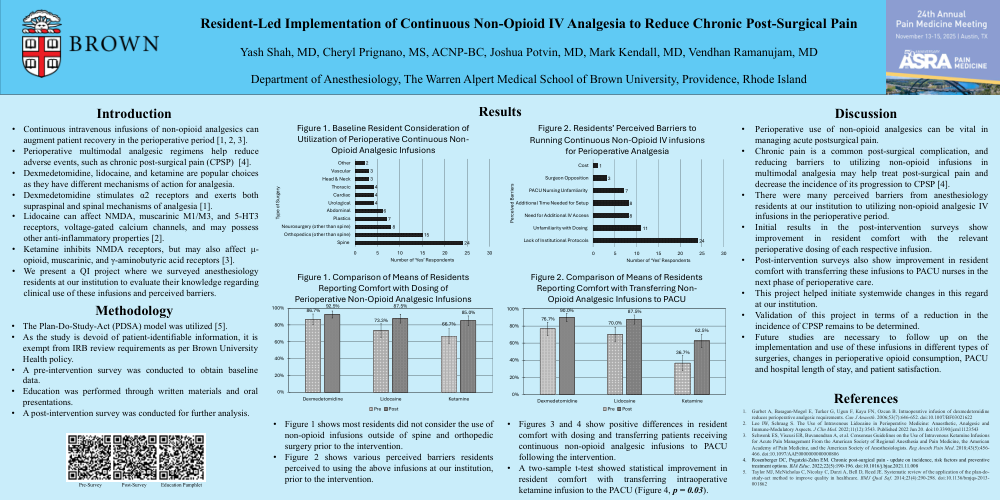
•Figure 1 shows most residents did not consider the use of non-opioid infusions outside of spine and orthopedic surgery prior to the intervention.
•Figure 2 shows various perceived barriers residents perceived to using the above infusions at our institution, prior to the intervention.
•Figures 3 and 4 show positive differences in resident comfort with dosing and transferring patients receiving continuous non-opioid analgesic infusions to PACU following the intervention.
•A two-sample t-test showed statistical improvement in resident comfort with transferring intraoperative ketamine infusion to the PACU (Figure 4, p = 0.03).
Discussion
•Perioperative use of non-opioid analgesics can be vital in managing acute postsurgical pain.
•Chronic pain is a common post-surgical complication, and reducing barriers to utilizing non-opioid infusions in multimodal analgesia may help treat post-surgical pain and decrease the incidence of its progression to CPSP [4].
•There were many perceived barriers from anesthesiology residents at our institution to utilizing non-opioid analgesic IV infusions in the perioperative period.
•Initial results in the post-intervention surveys show improvement in resident comfort with the relevant perioperative dosing of each respective infusion.
•Post-intervention surveys also show improvement in resident comfort with transferring these infusions to PACU nurses in the next phase of perioperative care.
•This project helped initiate systemwide changes in this regard at our institution.
•Validation of this project in terms of a reduction in the incidence of CPSP remains to be determined.
•Future studies are necessary to follow up on the implementation and use of these infusions in different types of surgeries, changes in perioperative opioid consumption, PACU and hospital length of stay, and patient satisfaction.
References
1.Gurbet A, Basagan-Mogol E, Turker G, Ugun F, Kaya FN, Ozcan B. Intraoperative infusion of dexmedetomidine reduces perioperative analgesic requirements. Can J Anaesth. 2006;53(7):646-652. doi:10.1007/BF03021622
2.Lee IW, Schraag S. The Use of Intravenous Lidocaine in Perioperative Medicine: Anaesthetic, Analgesic and Immune-Modulatory Aspects. J Clin Med. 2022;11(12):3543. Published 2022 Jun 20. doi:10.3390/jcm11123543
3.Schwenk ES, Viscusi ER, Buvanendran A, et al. Consensus Guidelines on the Use of Intravenous Ketamine Infusions for Acute Pain Management From the American Society of Regional Anesthesia and Pain Medicine, the American Academy of Pain Medicine, and the American Society of Anesthesiologists. Reg Anesth Pain Med. 2018;43(5):456-466. doi:10.1097/AAP.0000000000000806
4.Rosenberger DC, Pogatzki-Zahn EM. Chronic post-surgical pain - update on incidence, risk factors and preventive treatment options. BJA Educ. 2022;22(5):190-196. doi:10.1016/j.bjae.2021.11.008
5.Taylor MJ, McNicholas C, Nicolay C, Darzi A, Bell D, Reed JE. Systematic review of the application of the plan-do-study-act method to improve quality in healthcare. BMJ Qual Saf. 2014;23(4):290-298. doi:10.1136/bmjqs-2013-001862