425 posters, 1 videos, 9 audios, 8 topics, 53 sessions, 340 authors, 286 institutions
ePostersLive by SciGen Technologies S.A. All rights reserved.
22nd Annual Pain Medicine Meeting 2023
November 10 - 11, 2023 | New Orleans Marriott | New Orleans, Louisiana, USA

4610
EFFECTIVENESS OF SMARTPHONE-BASED APPLICATIONS FOR SELF-MANAGEMENT OF CHRONIC PAIN: A SYSTEMATIC REVIEW AND META-ANALYSIS
Poster Presenter
Authors
Affiliations
Part of Topic
Chronic Pain
Effectiveness of smartphone-based applications for self-management of chronic pain: a systematic review and meta-analysis
Daniel Wang, DO 1,2 George Chang Chien, DO 3
1MedStar Health, Baltimore, MD
2 Georgetown University Medical Center, Washington, District of Columbia
3 Ventura County Medical Center, Ventura, CA
Introduction
There are millions of individuals worldwide suffering from chronic pain. For patients, this can be extremely debilitating and thus affect their daily lives. In recent years, smartphone-based applications (apps) have emerged as possible options for self-management of chronic pain. This systematic review and meta-analysis aims to assess the effectiveness of smartphone-based apps in managing chronic pain with a special focus on pain intensity, functional outcomes, and quality of life.
Materials and Methods
A comprehensive literature search was conducted across multiple databases including PubMed, Embase, Scopus, and Web of Science. Studies published from inception up to July 2023 were included. Keywords of "pain" and "smartphone OR phone or mobile" were used to search. Studies evaluated smartphone-based applications for the treatment of chronic pain. Case reports, case series, cohort studies, and randomized controlled trials were eligible for inclusion. The study evaluated factors including functional outcomes, pain intensity, and quality of life (QoL). As the systematic review and meta-analysis is devoid of patient-identifiable information, it is exempt from IRB review requirements as per MedStar Health policy.
Results
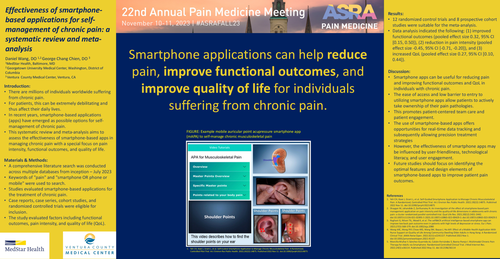
The initial search identified 21 eligible studies for inclusion in the systematic review. Of these, 12 randomized control trials and 8 prospective cohort studies were suitable for the meta-analysis. Data analysis indicated the following: (1) improved functional outcomes (pooled effect size 0.32, 95% CI [0.15, 0.50]), (2) reduction in pain intensity (pooled effect size -0.45, 95% CI [-0.71, -0.20]), and (3) increased QoL (pooled effect size 0.27, 95% CI [0.10, 0.44]).
Discussion
Chronic pain is one of the most common patient presenting complaints in the world. There are many modalities of treatment for it. With healthcare technology on the rise, smartphone apps provide a potentially useful tool for treating chronic pain. This study's findings suggest that these apps can be useful for reducing pain and improving functional outcomes and QoL in individuals with chronic pain. The ease of access and low barrier to entry to utilizing smartphone apps allow patients to actively take ownership of their pain pathologies. This promotes patient-centered team care and patient engagement. Moreover, the use of smartphone-based apps offers opportunities for real-time data tracking. This includes but is not limited to real-time pain grading, iterative adjustments, and more data analysis. This allows for precision treatment strategies. However, the effectiveness of smartphone apps may be influenced by a few factors. This can include user-friendliness, level of technological literacy, and user engagement among patients. Future studies should focus on identifying the optimal features and design elements of smartphone-based apps to improve patient pain outcomes.
References
1. Yeh CH, Kawi J, Grant L, et al. Self-Guided Smartphone Application to Manage Chronic Musculoskeletal
Pain: A Randomized, Controlled Pilot Trial. Int J Environ Res Public Health. 2022;19(22):14875. Published
2022 Nov 11. doi:10.3390/ijerph192214875
2. Shaygan M, Jahandide Z, Zarifsanaiey N. An investigation of the effect of smartphone-based pain
management application on pain intensity and the quality-of-life dimensions in adolescents with chronic
pain: a cluster randomized parallel-controlled trial. Qual Life Res. 2021;30(12):3431-3442.
doi:10.1007/s11136-021-02891-5 2023;10.1007/s10865-023-00429-3. doi:10.1007/s10865-023-
00429-3
3. Rughani G, Nilsen TIL, Wood K, et al. The selfBACK artificial intelligence-based smartphone app can
improve low back pain outcome even in patients with high levels of depression or stress. Eur J Pain.
2023;27(5):568-579. doi:10.1002/ejp.2080
4. Wong AKC, Wong FKY, Chow KKS, Wong SM, Bayuo J, Ho AKY. Effect of a Mobile Health Application
With Nurse Support on Quality of Life Among Community-Dwelling Older Adults in Hong Kong: A
Randomized Clinical Trial. JAMA Netw Open. 2022;5(11):e2241137. Published 2022 Nov 1.
doi:10.1001/jamanetworkopen.2022.41137
5. Morcillo-Muñoz Y, Sánchez-Guarnido AJ, Calzón-Fernández S, Baena-Parejo I. Multimodal Chronic Pain
Therapy for Adults via Smartphone: Randomized Controlled Clinical Trial. J Med Internet Res.
2022;24(5):e36114. Published 2022 May 11. doi:10.2196/36114