425 posters, 1 videos, 9 audios, 8 topics, 53 sessions, 340 authors, 286 institutions
ePostersLive by SciGen Technologies S.A. All rights reserved.
22nd Annual Pain Medicine Meeting 2023
November 10 - 11, 2023 | New Orleans Marriott | New Orleans, Louisiana, USA

4595
CHRONIC PAIN DISPARITIES BASED ON INSURANCE PAYOR
Poster Presenter
Authors
Affiliations
Part of Topic
Chronic Pain
Chronic Pain Disparities
Title: Chronic Pain Disparities Based on Insurance Payor
Introduction:
Recent data now suggests that social disadvantage is associated with chronic opioid use (Cheng 2021). Whether the association is due to severity of pain, lack of treatment options, or another reason for those who are socially disadvantaged remains unknown. In addition, most studies have used race or ethnicity to investigate disparities. One study found that disparities in pain-related disability between racial groups may be at least partially mediated by neighborhood socioeconomic status (Fuentes 2007). This study evaluates disparities relating to insurance payor, which is one marker of social disadvantage.
Setting:
Academic medical center, tertiary care center
Methods:
This is a cross-sectional, survey- based study. Patients presenting to a chronic pain clinic at an academic tertiary care center were recruited randomly. A total of 152 subjects were included in the analysis, with half of the subjects having either commercial insurance or Medicare, and the other half with Medicaid, dual Medicare + Medicaid, or no insurance. Participants were given a survey, and demographic data including age, sex, race, and insurance were recorded from the electronic medical record. Prior to data collection, this study received institutional IRB approval.
Results:
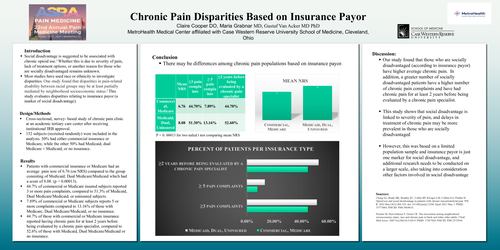
Regarding average pain scores on a Numeric Rating Scale (0-10; 0= no pain, 10 = worst pain), the group consisting of commercial insurance or Medicare had an average of 6.76, compared to 8.08 the group consisting of Medicaid, Dual Medicare/Medicaid, showing statistical significance with p = 0.00013. For number of pain complaints, 44.7% of commercial or Medicare insured subjects reported 3 or more, compared to 51.3% of Medicaid, Dual Medicare/Medicaid, or uninsured subjects reporting 3 or more pain complaints; 7.89% of commercial or Medicare subjects reports 5 or more complaints compared to 13.16% of those with Medicare, Dual Medicare/Medicaid, or no insurance. For length of time with chronic pain, 44.7% of those with commercial or Medicare insurance reported having chronic pain for at least 2 years before being evaluated by a chronic pain specialist, compared to 52.6% of those with Medicaid, Dual Medicare/Medicaid or no insurance.
Based on a limited population sample, those who are socially disadvantaged according to insurance payor have higher average pain. In addition, a greater number of socially disadvantaged patients have a higher number of chronic pain complaints, and have chronic pain for at least 2 years before being evaluated by a chronic pain specialist. However, insurance payor is just one marker for social disadvantage, and additional research needs to be conducted on a larger scale, also taking into consideration other factors involved in social disadvantage.
Conclusion:
There may be differences among chronic pain populations based on insurance payor
Sources:
Cheng AL, Brady BK, Bradley EC, Calfee RP, Klesges LM, Colditz GA, Prather H. Opioid use and social disadvantage in patients with chronic musculoskeletal pain. PM R. 2022 Mar;14(3):309-319. doi: 10.1002/pmrj.12596. Epub 2021 May 3. PMID: 33773068; PMCID: PMC8464618.
Fuentes M, Hart-Johnson T, Green CR. The association among neighborhood socioeconomic status, race and chronic pain in black and white older adults. J Natl Med Assoc. 2007 Oct;99(10):1160-9. PMID: 17987920; PMCID: PMC2574394.