425 posters, 1 videos, 9 audios, 8 topics, 53 sessions, 340 authors, 286 institutions
ePostersLive by SciGen Technologies S.A. All rights reserved.
22nd Annual Pain Medicine Meeting 2023
November 10 - 11, 2023 | New Orleans Marriott | New Orleans, Louisiana, USA

4580
INTRANASAL KETAMINE FOR CANCER RELATED PAIN: NAVIGATING THE DUAL EFFECTS OF ANALGESIA AND ADDICTION
Poster Presenter
Part of Topic
Chronic Pain
INTRO
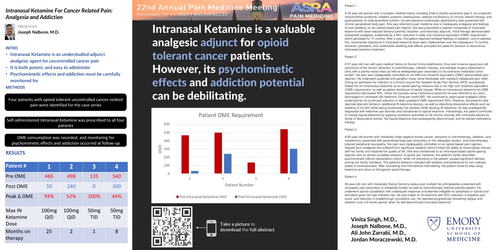
Self-administered Intranasal Ketamine was prescribed to all four patients
OME consumption was recorded, and monitoring for psychomimetic effects and addiction occurred at follow-up
Intranasal Ketamine is a valuable analgesic adjunct for opioid tolerant cancer patients. However, its psychomimetic effects and addiction potential can be debilitating.
Patient 1
A 33-year-old woman with a complex medical history including Ehler’s-Danlos syndrome type 3, an unspecific mitochondrial syndrome, indolent systemic mastocytosis, adrenal insufficiency on chronic steroid therapy, and gastroparesis on total parenteral nutrition via percutaneous endoscopic gastrostomy tube presented with chronic generalized body pain. She was referred to pain medicine due to inadequate analgesia and feelings of over-sedation on her opioid-based pain regime, she was prescribed a regimen comprised of intranasal ketamine with dose-reduced fentanyl patches, baclofen, and ketorolac adjuncts. Initial therapy demonstrated substantial analgesia, evidenced by a 90% reduction in daily oral morphine equivalent (OME) requirement which persisted for 12 months. After a year, the patient reported renewed feelings of sedation, and to address this, incremental reductions in intranasal ketamine dose were implemented over the subsequent 13 months. However, persistent, and undesirable sedating side effects prompted the patient’s decision to discontinue intranasal ketamine treatment.
Patient 2
A 57-year-old man with past medical history of Human Immunodeficiency Virus and invasive squamous cell carcinoma of the rectum refractory to chemotherapy, radiation therapy, and salvage surgery presented to clinic with a painful rectal mass as well as widespread pain secondary to his extensive metastatic tumor burden. His pain was inadequately controlled on his 498 oral morphine equivalent (OME) opioid-based pain regimen. He underwent pudendal and ganglion impar nerve blockades with resultant inadequate pain relief. During an admission for infection of a chronic wound the inpatient Acute Pain Service (APS) successfully trialed him on intravenous ketamine as an opioid sparing measure due to his high oral morphine equivalent (OME) requirement, as well as patient disclosure of opioid misuse. While on intravenous ketamine his OME requirement decreased 50%. Given his success using intravenous ketamine he was referred to our clinic, discharged on intranasal (IN) ketamine 10mg per nostril BID. He continued to report good analgesic effect evidenced by his continued reduction in daily outpatient OME requirement 50%. However, the patient's wife reported aberrant behavior (additional IN ketamine dosing), as well as disturbing dissociative effects such as scalding of his skin while taking excessively hot showers while abusing IN ketamine, he was subsequently diagnosed with ketamine use disorder and transitioned to topical ketamine. Interestingly, the patient continued to misuse topical ketamine by applying excessive quantities to his chronic wounds with continued reports by family of dissociative events. His topical ketamine was subsequently discontinued, and he started methadone therapy.
Patient 3
A 60-year-old woman with metastatic triple negative breast cancer, refractory to chemotherapy, radiation, and mastectomy, presented with generalized body pain secondary to her metastatic burden, and chemotherapy-induced peripheral neuropathy. Her pain was inadequately controlled on an opioid-based pain regimen. Despite poor analgesia she suffered from significant sedation which limited her ability to meaningfully interact with her family and impaired her quality of life. She was transitioned to an intranasal-based opioid-sparing regimen with an almost complete cessation of opioid use. However, the patient's family described psychomimetic effects (dissociation) which, while not disturbing to the patient, caused significant distress among her family members. The patient's behavior included self-isolation and preference for non-ordinary states of consciousness. After counseling and motivational interviewing, the patient chose to stop using ketamine and return to full-agonist opioid therapy.
Patient 4
26-year-old man with metastatic Ewing Sarcoma status post multiple hip arthroplasties presented with nociceptor pain secondary to metastatic burden as well as chemotherapy induced polyneuropathy. He underwent sacral cryoablation with inadequate response and deemed ineligible for peripheral or spinal cord stimulator given his high infection risk. He was trialed on IN ketamine with 50% reduction in baseline pain score, and reduction in breakthrough oxycodone use. He reported progressively worsening fatigue and sedation over a 6-month period, when he self-discontinued intranasal ketamine.