425 posters, 1 videos, 9 audios, 8 topics, 53 sessions, 340 authors, 286 institutions
ePostersLive by SciGen Technologies S.A. All rights reserved.
22nd Annual Pain Medicine Meeting 2023
November 10 - 11, 2023 | New Orleans Marriott | New Orleans, Louisiana, USA

4570
CANCER PAIN SURVIVORS: AN INCREASING POPULATION IN CANCER PAIN CENTERS
Poster Presenter
Authors
Affiliations
Part of Topic
Chronic Pain
Cancer Pain Survivors: An Increasing Population in Cancer Pain Centers
Grimmer JE1, Bentley-McLachlan MJ1, Bazil, T 1,2,3, Sarwan, G 1,2,3 , Liu, Q1, Wen, C1, Matson, B1,2, de Leon-Casasola O1,2
1Roswell Park Comprehensive Cancer Center | 2University at Buffalo | 3Buffalo Veteran Affairs Medical Center
BACKGROUND
Cancer survivors have a significant impact in the workflow of pain clinics. The American Association for Cancer Research estimates that there are over 18 million children and adults living with a history of cancer as of January 2022.1 The incidence of persistent post-surgical pain is 50% or greater after lung resections, breast surgery with axillary node dissection, or even just sentinel node biopsy only, and limb amputations2. Moreover, 20–40% of patients who receive taxanes, platinums, vinca alkaloids, and bortezomib will develop painful chemotherapy-induced peripheral neuropathy (CIPN)3. Chemotherapy, aromatase inhibitors, targeted therapy with trastuzumab – among others, radiation, immunotherapy (interferons, interleukins, etc.), and white blood cell growth factors may also lead to chronic myalgias and arthralgias. These patients are adding to the growing number of individuals who are now managed in cancer pain centers. Thus, we evaluated the proportion of individuals treated for cancer tumor pain and those who were tumor free but were left with chronic pain after their cancer treatments.
METHODS
We reviewed the charts of all of patients treated in our clinic from January to March of 2022. The cancer status is a binary outcome with 2 levels, “has cancer or does not have cancer” where the numbers would follow a binomial distribution. In statistical testing, the null hypothesis is that no difference exists between the two groups. We used Binomial Test to test the numbers in each level within each of the 3 months and an overall 3 months. Analyses were conducted using SAS v9.4 (Cary, NC).
RESULTS
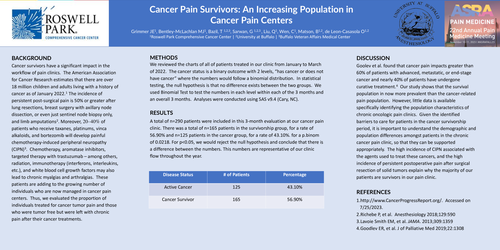
A total of n=290 patients were included in this 3-month evaluation at our cancer pain clinic. There was a total of n=165 patients in the survivorship group, for a rate of 56.90% and n=125 patients in the cancer group, for a rate of 43.10%. for a p.binom of 0.0218. For p<0.05, we would reject the null hypothesis and conclude that there is a difference between the numbers. This numbers are representative of our clinic flow throughout the year.
DISCUSSION
Goolev et al. found that cancer pain impacts greater than 60% of patients with advanced, metastatic, or end-stage cancer and nearly 40% of patients have undergone curative treatment.4 Our study shows that the survival population in now more prevalent than the cancer-related pain population. However, little data is available specifically identifying the population characteristics of chronic oncologic pain clinics. Given the identified barriers to care for patients in the cancer survivorship period, it is important to understand the demographic and population differences amongst patients in the chronic cancer pain clinic, so that they can be supported appropriately. The high incidence of CIPN associated with the agents used to treat these cancers, and the high incidence of persistent postoperative pain after surgical resection of solid tumors explain why the majority of our patients are survivors in our pain clinic.
REFERENCES