425 posters, 1 videos, 9 audios, 8 topics, 53 sessions, 340 authors, 286 institutions
ePostersLive by SciGen Technologies S.A. All rights reserved.
22nd Annual Pain Medicine Meeting 2023
November 10 - 11, 2023 | New Orleans Marriott | New Orleans, Louisiana, USA

4536
SMALL MUSCLES, BIG CURVES: RELATIONSHIP OF SPINAL EXTENSOR MUSCLES AND LUMBAR CURVATURE IN PATIENTS WITH CHRONIC LOW BACK PAIN
Poster Presenter
Authors
Affiliations
Part of Topic
Chronic Pain
Audio
Small Muscles, Big Curves: Relationship of Spinal Extensor Muscles and Lumbar Curvature in Patients with Chronic Low Back Pain
INTRODUCTION
•Chronic nonspecific low back pain remains the leading cause of disability worldwide necessitating ongoing research to identify targets for treatment and preventative strategies (1).
•One potential target of both treatment and preventative strategies are the extensor muscles of the back.
•In a prior study of healthy patients, a direct relationship was seen between extensor muscle volume and lumbar curvature (2).
•Extensor muscle volume has previously been shown to be smaller in patients with low back pain compared to healthy controls (4).
•This project sought to assess the relationship between extensor muscle mass, fatty atrophy of those muscles and lumbar curvature in patients with chronic low back pain.
METHODS
•Retrospective chart review (approved by MGB IRB) of all new patients evaluated by the senior author for chronic low back pain between Jan 2021 and Feb 2022.
•Inclusion criteria: MRI and lumbar XR within 2 years of visit.
•Exclusion criteria: history of lumbar spine surgery, known neurodegenerative diagnosis, MRIs without inclusion of entire erector spinae and multifidus at levels L1-S1.
•Imaging measurements were obtained as described in Figure 1 and Figure 2.
•Fatty fraction was calculated as total cross-sectional area with fat included subtracting the cross-sectional area without fat divided by the total cross-sectional area of the muscle with fat included.
•Linear regression or ANOVA were performed to assess for correlation between variables as appropriate.
Figure 1
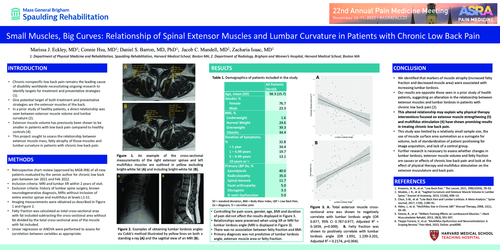
An example of the cross-sectional measurements of the right extensor spinae and left multifidus muscles are outlined in yellow excluding bright-white fat (A) and including bright-white fat (B).
Figure 2
Examples of obtaining lumbar lordosis angles via Cobb’s method illustrated by yellow lines on both a standing x-ray (A) and the sagittal view of an MRI (B).
Table 1. Demographics of patients included in teh study
Figure 3
A. Total extensor muscle cross-sectional area was shown to negatively correlate with lumbar lordosis angle (OR 0.877, 95% CI 0.787-0.977, Adjusted R2 = 0.1859, p=0.009). B. Fatty fraction was shown to positively correlate with lumbar lordosis angle (OR 1.991, 1.239-3.201, Adjusted R2 = 0.2174, p=0.004).
CONCLUSION
•We identified that markers of muscle atrophy (increased fatty fraction and decreased muscle area) were associated with increasing lumbar lordosis.
•Our results are opposite those seen in a prior study of health patients, suggesting an alteration in the relationship between extensor muscles and lumbar lordosis in patients with chronic low back pain (2).
•This altered relationship may explain why physical therapy interventions focused on extensor muscle strengthening (5) and multifidus stimulation (6) have shown promising results in treating chronic low back pain.
•This study was limited by a relatively small sample size, the use of muscle surface area summation as a surrogate for volume, lack of standardization of patient positioning for image acquisition, and lack of a control group.
•Further research is necessary to assess whether changes in lumbar lordosis, extensor muscle volume and fatty fraction are causes or effects of chronic low back pain and look at the effect of physical therapy and multifidus stimulation on the extensor musculature and back pain.