425 posters, 1 videos, 9 audios, 8 topics, 53 sessions, 340 authors, 286 institutions
ePostersLive by SciGen Technologies S.A. All rights reserved.
22nd Annual Pain Medicine Meeting 2023
November 10 - 11, 2023 | New Orleans Marriott | New Orleans, Louisiana, USA

4922
A REVIEW OF THE FACTORS AND OUTCOMES OF INSTITUTIONAL INTERDISCIPLINARY NEUROMODULATION COMMITTEES: A MULTI-CENTER EXPERIENCE
Poster Presenter
Authors
Affiliations
Part of Topic
Chronic Pain
A Review of the Factors and Outcomes of Institutional Interdisciplinary Neuromodulation Committees: A Multi-Center Experience
Mohan Ravi MD1, Scott Pritzlaff MD2, Michael Jung MD MBA2, Vafi Salmasi MD1, Michael Leong MD1
1Department of Anesthesia, Perioperative, and Pain Medicine, Stanford University School of Medicine
2Department of Anesthesia & Pain Medicine, UC Davis School of Medicine
Introduction:
-
Neuromodulation represents the most advanced pain therapies for some of the most complex pain patients. To optimize neuromodulation patient selection and management, an institutional interdisciplinary Neuromodulation Committee was created at each of two academic medical centers (University of California, Davis (UCD) and Stanford University).
-
The committee at each institution is composed of physicians focused on advanced interventional treatments, a pain psychologist, and trainees including residents and pain fellows in an ACGME-accredited training program, a nurse practitioner or physician assistant, and a patient service representative.
-
The committee aims to collaboratively optimize neuromodulation candidates, assess medical and psychological risks, and select the best device given a patient’s pain condition. In this study, we present the methodology and outcome data of the Neuromodulation Committee at the two institutions.
-
After IRB approval, we included all adult patients who were evaluated by the Neuromodulation Committee between 2017-2020 at two academic pain clinics. Patients with insufficient data were excluded from the study.
-
A retrospective chart review was completed on 385 UCD and Stanford University patient committee reviews. Data collected from the chart review included demographics (age, gender, race, ethnicity, height, weight, BMI), committee meeting results (proceed with trial/implant or decline), and trial success and implant rate.
-
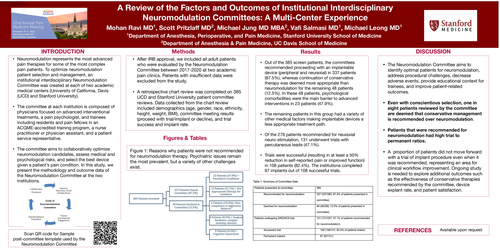
Out of the 385 screen patients, the committees recommended proceeding with an implantable device (peripheral and neuraxial) in 337 patients (87.5%), whereas continuation of conservative therapy was deemed more appropriate than neuromodulation for the remaining 48 patients (12.5%). In these 48 patients, psychological comorbidities were the main barrier to advanced interventions in 23 patients (47.9%).
-
The remaining patients in this group had a variety of other medical factors making implantable devices a less appropriate treatment path.
-
Of the 278 patients recommended for neuraxial neuro-stimulation, 131 underwent trials with percutaneous leads (47.1%).
-
Trials were successful (resulting in at least a 50% reduction in self-reported pain or improved function) in 108 patients (82.4%). The institutions completed 87 implants out of 108 successful trials.
-
The Neuromodulation Committee aims to identify optimal patients for neuromodulation, address procedural challenges, decrease adverse events, provide educational context for trainees, and improve patient-related outcomes.
-
Even with conscientious selection, one in eight patients reviewed by the committee are deemed that conservative management is recommended over neuromodulation.
-
Patients that were recommended for neuromodulation had high trial to permanent ratios.
-
A proportion of patients did not move forward with a trial of implant procedure even when it was recommended, representing an area for clinical workflow improvement. Ongoing study is needed to explore additional outcomes such as the effectiveness of conservative therapies recommended by the committee, device explant rate, and patient satisfaction.