425 posters, 1 videos, 9 audios, 8 topics, 53 sessions, 340 authors, 286 institutions
ePostersLive by SciGen Technologies S.A. All rights reserved.
22nd Annual Pain Medicine Meeting 2023
November 10 - 11, 2023 | New Orleans Marriott | New Orleans, Louisiana, USA

4897
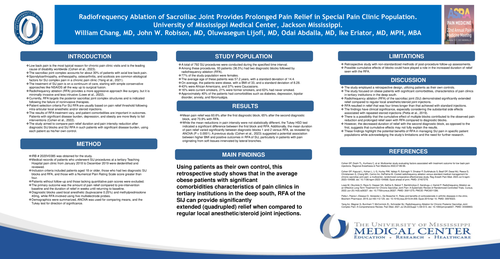
RADIOFREQUENCY ABLATION OF SACROILIAC JOINT PROVIDES PROLONGED PAIN RELIEF IN SPECIAL PAIN CLINIC POPULATION.
Poster Presenter
Authors
Affiliations
Part of Topic
Chronic Pain
Radiofrequency Ablation of Sacroiliac Joint Provides Prolonged Pain Relief in Special Pain Clinic Population.
University of Mississippi Medical Center, Jackson, Mississippi.
William Chang, MD, John W. Robison, MD, Oluwasegun Lijofi, MD, Odai Abdalla, MD, Ike Eriator, MD, MPH, MBA
MAIN FINDING:
Using patients as their own control, this retrospective study shows that in the average obese patients with significant comorbidities characteristics of pain clinics in tertiary institutions in the deep south, RFA of the SIJ can provide significantly extended (quadrupled) relief when compared to regular local anesthetic/steroid joint injections.
INTRODUCTION:
Low back pain is the most typical reason for chronic pain clinic visits and is the leading cause of disability worldwide (Cohen et al., 2023).
The sacroiliac joint complex accounts for about 30% of patients with axial low back pain.
Spondyloarthropathy, enthesopathy, osteoarthritis, and scoliosis are common etiological factors for SIJ complex pain in a chronic pain clinic (Yang et al., 2021).
The treatment of SIJ pain is on a continuum of care, starting with simple conservative approaches like NSAIDS all the way up to surgical fusion.
Radiofrequency ablation (RFA) provides a more aggressive approach like surgery, but it is minimally invasive and less intrusive (Lowe et al., 2022).
Currently, RFA targets the posterior sacroiliac joint complex structures and is indicated following the failure of noninvasive therapies.
Patient selection criteria For SIJ RFA are usually based on pain relief threshold following intra-articular local anesthetic and/or steroid injections.
The results of RFA treatment vary, and patient comorbidities are important in outcomes. Patients with significant disease burden, depression, and obesity are more likely to fail interventions (Cohen et al., 2022).
The study aimed to compare pain relief duration and pain intensity reduction after diagnostic SIJ blocks and SIJ RFA in such patients with significant disease burden, using each patient as his/her own control.
METHOD:
IRB # 2020V0385 was obtained for the study.
Medical records of patients who underwent SIJ procedures at a tertiary Teaching Hospital pain clinic from January 2018 to December 2019 were deidentified and reviewed.
Inclusion criteria included patients aged 18 or older, those who had two diagnostic SIJ blocks and RFA, and those with a Numerical Pain Rating Scale score greater than four.
Patients without follow-up and those lacking quantitative pain scores were excluded.
The primary outcome was the amount of pain relief compared to pre-intervention baseline and the duration of relief in weeks until returning to baseline.
Diagnostic blocks used local anesthetic (bupivacaine 0.25%) and methylprednisolone 40mg, while RFA involved using five multielectrode probes.
Demographics were summarized, ANOVA was used for comparing means, and the Tukey test for direction of significance.
STUDY POPULATION:
A total of 792 SIJ procedures were conducted during the specified time interval.
Among these procedures, 93 patients (36.5%) had two diagnostic blocks followed by radiofrequency ablation (RFA).
77% of the study population were females.
The average age of these patients was 57.2 years, with a standard deviation of 14.4.
On average, the patients were obese, with a BMI of 33, and a standard deviation of 8.28.
43% were African Americans, and 37% were Caucasians.
16% were current smokers, 21% were former smokers, and 63% had never smoked.
Approximately 40% of the patients had comorbidities such as diabetes, depression, bipolar disorder, anxiety, and fibromyalgia.
RESULTS:
Mean pain relief was 60.6% after the first diagnostic block, 65% after the second diagnostic block, and 70.9% with RFA.
While the mean reductions in pain intensity were not statistically different, the Tukey HSD test indicated a significant difference between the first block and RFA. Additionally, the mean duration of pain relief varied significantly between diagnostic blocks 1 and 2 versus RFA, as revealed by ANOVA (P < 0.0001). A previous study (Cohen et al., 2023) suggested a potential association between higher BMI and positive outcomes in RFA of SIJ, particularly in patients with pain originating from soft tissues innervated by lateral branches.
LIMITATIONS:
Retrospective study with non-standardized methods of post-procedure follow-up assessments.
Possible cumulative effects of blocks could have played a role in the increased duration of relief seen with the RFA.
DISCUSSION:
The study employed a retrospective design, utilizing patients as their own controls.
The study focused on obese patients with significant comorbidities, characteristics of pain clinics in tertiary institutions in the deep south.
Radiofrequency ablation (RFA) of the sacroiliac joint (SIJ) demonstrated significantly extended relief compared to regular local anesthetic/steroid joint injections.
RFA resulted in relief that was four times longer than that achieved with standard injections.
The findings have clinical significance, especially considering the substantial side effects associated with repeated steroid injections (Petta et al., 2019).
There is a possibility that the cumulative effect of multiple blocks contributed to the observed pain reduction and prolonged relief seen with RFA compared to diagnostic blocks.
However, the decreased duration of relief with the second diagnostic block, as opposed to the first, suggests that cumulative effects may not fully explain the results.
These findings highlight the potential benefits of RFA in managing SIJ pain in specific patient populations while acknowledging the study's limitations and the need for further research.
REFERENCES:
Cohen SP, Doshi TL, Kurihara C, et al. Multicenter study evaluating factors associated with treatment outcome for low back pain injections. Regional Anesthesia & Pain Medicine 2022;47:89-99.
Cohen SP, Kapural L, Kohan L, Li S, Hurley RW, Vallejo R, Eshraghi Y, Dinakar P, Durbhakula S, Beall DP, Desai MJ, Reece D, Christiansen S, Chang MH, Carinci AJ, DePalma M. Cooled radiofrequency ablation versus standard medical management for chronic sacroiliac joint pain: a multicenter, randomized comparative effectiveness study. Reg Anesth Pain Med. 2023 Jul 5:rapm-2023-104568. doi: 10.1136/rapm-2023-104568. Epub ahead of print. PMID: 37407279.
Lowe M, Okunlola O, Raza S, Osasan SA, Sethia S, Batool T, Bambhroliya Z, Sandrugu J, Hamid P. Radiofrequency Ablation as an Effective Long-Term Treatment for Chronic Sacroiliac Joint Pain: A Systematic Review of Randomized Controlled Trials. Cureus. 2022 Jun 25;14(6):e26327. doi: 10.7759/cureus.26327. PMID: 35911275; PMCID: PMC9311336.
Petta I, Peene I, Elewaut D, Vereecke L, De Bosscher K. Risks and benefits of corticosteroids in arthritic diseases in the clinic. Biochem Pharmacol. 2019 Jul;165:112-125. doi: 10.1016/j.bcp.2019.04.009. Epub 2019 Apr 10. PMID: 30978323.
Yang AJ, Wagner G, Burnham T, McCormick ZL, Schneider BJ. Radiofrequency Ablation for Chronic Posterior Sacroiliac Joint Complex Pain: A Comprehensive Review. Pain Med. 2021 Jul 25;22(Suppl 1):S9-S13. doi: 10.1093/pm/pnab021. PMID: 34308953.