425 posters, 1 videos, 9 audios, 8 topics, 53 sessions, 340 authors, 286 institutions
ePostersLive by SciGen Technologies S.A. All rights reserved.
22nd Annual Pain Medicine Meeting 2023
November 10 - 11, 2023 | New Orleans Marriott | New Orleans, Louisiana, USA

4841
CERVICAL SIDEBENDING “ DISTRACTION” TECHNIQUE TO HELP DISTINGUISH BETWEEN CERVICAL RADICULOPATHY AND GLENOHUMERAL ARTHROPATHY
Poster Presenter
Authors
Affiliations
Part of Topic
Chronic Pain
Modified cervical sidebending “Distraction” technique to help distinguish between cervical radiculopathy and glenohumeral arthropathy
40 year old male with no significant past medical history presents to a pain
management clinic with right sided neck and shoulder pain. His pain has been
present for 3 months and started suddenly after playing golf. It has worsened after
getting rear-ended in a car accident 1 month ago. The pain in the neck is sharp
and stabbing in nature, and most bothersome when turning his head to the right.
Patient denies relief from over the counter patches and has not tried any other
medications. Extending the neck worsens his pain. X-rays of the neck show
moderate facet arthropathy of the cervical spine. On physical exam, cervical
facetogenic pain is present along with pain-limited right rotation and right
sidebending of the neck. Right sided spurling test elicits anterior shoulder pain.
Patient denies radiating or shooting pain down the arm. With the patient supine in
a head-neutral position, right shoulder abduction is limited past 90 degrees
secondary to 10/10 pain in the shoulder. Cervical sidebending to the left
immediately relieves pain and allows the patient to further abduct the shoulder to
140 degrees.
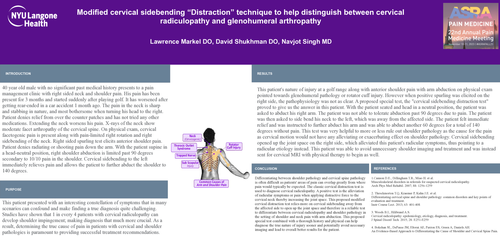
This patient's nature of injury at a golf range along with anterior shoulder pain with arm abduction on physical exam
pointed towards glenohumeral pathology or rotator cuff injury. However when positive spurling was elicited on the
right side, the pathophysiology was not as clear. A proposed special test, the "cervical sidebending distraction test"
proved to give us the answer in this patient. With the patient seated and head in a neutral position, the patient was
asked to abduct his right arm. The patient was not able to tolerate abduction past 90 degrees due to pain. The patient
was then asked to side bend his neck to the left, which was away from the affected side. The patient felt immediate
relief and was instructed to further abduct his arm and was able to abduct another 60 degrees for a total of 140
degrees without pain. This test was very helpful to more or less rule out shoulder pathology as the cause for the pain
as cervical motion would not have any alleviating or exacerbating effect on shoulder pathology. Cervical sidebending
opened up the joint space on the right side, which alleviated this patient's radicular symptoms, thus pointing to a
radicular etiology instead. This patient was able to avoid unnecessary shoulder imaging and treatment and was instead
sent for cervical MRI with physical therapy to begin as well.
Differentiating between shoulder pathology and cervical spine pathology
is often difficult as patients' areas of pain can overlap greatly from where
pain would typically be expected. The classic cervical distraction test is
used to diagnose cervical radiculopathy. A positive test is the alleviation
of radicular symptoms or pain when applying distractive force to the
cervical neck thereby increasing the joint space. This proposed modified
cervical distraction test relies more on cervical sidebending away from
the affected side to open up the joint space and therefore is a reliable test
to differentiate between cervical radiculopathy and shoulder pathology in
the setting of shoulder and neck pain with arm abduction. This proposed
special test combined with a thorough history and physical can help
diagnose the true nature of injury sooner and potentially avoid necessary
imaging and lead to overall better results for the patient.