425 posters, 1 videos, 9 audios, 8 topics, 53 sessions, 340 authors, 286 institutions
ePostersLive by SciGen Technologies S.A. All rights reserved.
22nd Annual Pain Medicine Meeting 2023
November 10 - 11, 2023 | New Orleans Marriott | New Orleans, Louisiana, USA

4648
GENERAL SENSORY SENSITIVITY AND PRIMARY PAIN APPRAISALS: EXPLORING ASSOCIATIONS AND IMPLICATIONS FOR A NOCIPLASTIC PAIN PHENOTYPE
Poster Presenter
Authors
Affiliations
Part of Topic
Chronic Pain
GENERALIZED SENSORY SENSITIVITY AND PRIMARY PAIN APPRAISALS: EXPLORING ASSOCIATIONS AND IMPLICATIONS FOR NOCIPLASTIC PAIN PHENOTYPES
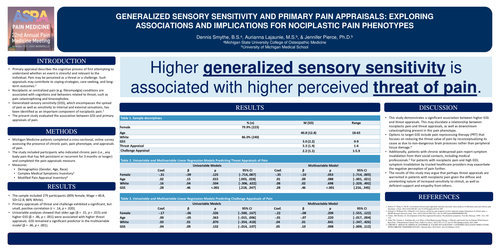
Higher generalized sensory sensitivity is associated with higher perceived threat of pain.
Introduction
•Primary appraisal describes the cognitive process of first attempting to understand whether an event is stressful and relevant to the individual. Pain may be perceived as a threat or a challenge. Such appraisals may contribute to coping strategies, care-seeking, and long-term outcomes.1
•Nociplastic or centralized pain (e.g. fibromyalgia) conditions are associated with cognitions and behaviors related to threat, such as pain catastrophizing and kinesiophobia.
•Generalized sensory sensitivity (GSS), which encompasses the spread of pain as well as sensitivity to internal and external sensations, has been identified as an important component of nociplastic pain.2
•The present study evaluated the association between GSS and primary appraisals of pain.
Methods
•Michigan Medicine patients completed a cross-sectional, online survey assessing the presence of chronic pain, pain phenotype, and appraisals of pain.
•The study included participants who indicated chronic pain (i.e., any body pain that has felt persistent or recurrent for 3 months or longer) and completed the pain appraisals measure.
•Measures:
•Demographics (Gender, Age, Race)
•Complex Medical Symptoms Inventory2
•Modified Pain Appraisal Inventory4
Results
•The sample included 279 participants (80% female; Mage = 40.8, SD=12.8; 86% White).
•Primary appraisals of threat and challenge exhibited a significant, but small, positive correlation (r = .14, p = .020).
•Univariable analyses showed that older age (β = .15, p = .015) and higher GSS (β = .46, p < .001) were associated with higher threat appraisals. GSS remained a significant predictor in the multivariable model (β = .46, p < .001).
Discussion
•This study demonstrates a significant association between higher GSS and threat appraisals. This may elucidate a relationship between nociplastic pain and threat appraisals, as well as downstream catastrophizing present in this pain phenotype.
•Options to target GSS include pain reprocessing therapy (PRT) that focuses on reducing the threat value of pain by reconceptualizing its cause as due to non-dangerous brain processes rather than peripheral tissue damage.4
•Additionally, patients with chronic widespread pain report symptom invalidation from their social contacts, including medical professionals.5 For patients with nociplastic pain and high GSS, symptom invalidation by trusted healthcare providers may exacerbate the negative perception of pain further.
•The results of this study may argue that perhaps threat appraisals are warranted in patients with nociplastic pain given the diffuse and unrelenting nature of increased sensitivity to stimuli, as well as deficient support and empathy from others.
References
1.Jackson T, Wang Y, Fan H. Associations between pain appraisals and pain outcomes: meta-analyses of laboratory pain and chronic pain literatures. J Pain. 2014;15(6):586-601. doi:10.1016/j.jpain.2014.01.499
2.Schrepf A, Williams DA, Gallop R, et al. Sensory sensitivity and symptom severity represent unique dimensions of chronic pain: a MAPP Research Network study. Pain. 2018;159(10):2002-2011. doi:10.1097/j.pain.0000000000001299
3.Unruh, AM, Ritchie, JA. Development of the Pain Appraisal Inventory: Psychometric properties. Pain Res Manage. 1998; 3(2), 105-110.
4.Ashar YK, Gordon A, Schubiner H, et al. Effect of Pain Reprocessing Therapy vs Placebo and Usual Care for Patients With Chronic Back Pain: A Randomized Clinical Trial. JAMA Psychiatry. 2022;79(1):13-23. doi:10.1001/jamapsychiatry.2021.2669
5.JÄREMO P, ARMAN M, GERDLE B, GOTTBERG K. FACING INVALIDATION: A FURTHER CHALLENGE WHEN LIVING WITH CHRONIC WIDESPREAD PAIN. J Rehabil Med. 2022;54:67. doi:10.2340/jrm.v54.67