425 posters, 1 videos, 9 audios, 8 topics, 53 sessions, 340 authors, 286 institutions
ePostersLive by SciGen Technologies S.A. All rights reserved.
22nd Annual Pain Medicine Meeting 2023
November 10 - 11, 2023 | New Orleans Marriott | New Orleans, Louisiana, USA

4615
THE EFFICACY OF RADIOFREQUENCY NEUROTOMY IN THE TREATMENT OF THORACIC T4-T8 FACET-RELATED PAIN.
Poster Presenter
Authors
Affiliations
Part of Topic
Chronic Pain
The efficacy of radiofrequency neurotomy in the treatment of thoracic T4-T8 facet-related pain
Jazmin Belton, M.S.2, Yeng F. Her, M.D., Ph.D.1
1Department of Anesthesiology and Perioperative Medicine, 2Mayo Clinic Summer Research Fellowship Program
INTRODUCTION
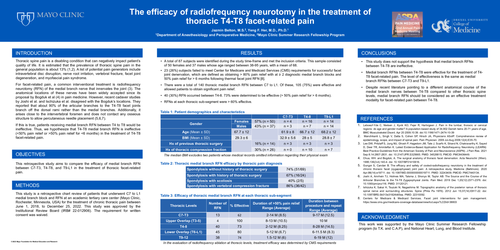
Thoracic spine pain is a disabling condition that can negatively impact patient’s quality of life. It is estimated that the prevalence of thoracic spine pain in the general population is about 13% (1,2). A list of potential pain generators include intravertebral disc disruption, nerve root irritation, vertebral fracture, facet joint degeneration, and myofascial pain syndrome.
For facet-related pain, a common interventional treatment is radiofrequency neurotomy (RFN) of the medial branch nerve that innervates the joint (3). The anatomical locations of these nerves have been widely accepted since its proposal by Bogduk et al (4) in pain medicine. However, recent cadaver studies by Joshi et al. and Ischizuka et al. disagreed with the Bogduk’s locations. They reported that about 90% of the articular branches to the T4-T8 facet joints branch off the dorsal rami rather than the medial branches. Additionally, it arises close to the intervertebral foramen and does not contact any osseous structure to allow percutaneous needle placement (5,6,7).
If this is true, patients receiving medial branch RFN between T4 to T8 would be ineffective. Thus, we hypothesize that T4-T8 medial branch RFN is ineffective (<50% pain relief or >50% pain relief for <6 months) in the treatment of T4-T8 facet-related pain.