425 posters, 1 videos, 9 audios, 8 topics, 53 sessions, 340 authors, 286 institutions
ePostersLive by SciGen Technologies S.A. All rights reserved.
22nd Annual Pain Medicine Meeting 2023
November 10 - 11, 2023 | New Orleans Marriott | New Orleans, Louisiana, USA

5049
AN IMPLANTABLE SCS SYSTEM WITH AUTOMATIC DAILY REMOTE MONITORING AND REMOTE PROGRAMMING: FIRST-IN-HUMAN EXPERIENCE
Poster Presenter
Authors
Affiliations
Part of Topic
Chronic Pain
An Implantable SCS System With Automatic Daily Remote Monitoring and Remote Programming: First-In-Human Experience
Marc Russo MD,1 James Yu MD,2 Vahid Mohabbati MD,3 Kasra Amirdelfan MD,4 Leonardo Kapural MD PhD,5 Paul Verrills MBBS6
1Hunter Pain Specialists, Broadmeadow NSW, Australia; 2Sydney Spine and Pain, Hurstville NSW, Australia; 3Sydney Pain Management Centre, Parramatta NSW, Australia; 4Boomerang Healthcare, Walnut Creek, CA; 5Carolinas Pain Institute, Winston-Salem, NC; 6Monash House Private Hospital, Metro Pain Group, Clayton VIC, Australia
INTRODUCTION
- Most spinal cord stimulation (SCS) systems require frequent in-person reprogramming to optimize stimulation and promote optimal management of chronic pain:
- A real-world cross-sectional cohort study found clinic visits were commonly required to address SCS issues and wait times negatively impacted patients1,2
- Recent technological advances in SCS device capabilities have presented the opportunity to provide remote SCS management and support,3 intended to improve patient outcomes via timely identification and resolution of device and therapy-related issues; however, more clinical evidence is needed beyond data from 2 pilot studies3-5
- To our knowledge, BENEFIT-03 is the world’s first long-term study of an SCS system with automatic daily transmission of objective device monitoring data and remote programming capabilities
- In March 2023, the US Food and Drug Administration approved the ProsperaTMSCS System* as an aid in the management of chronic, intractable pain in the trunk and/or limbs (BIOTRONIK SE & Co. KG, Berlin, Germany)
- The system features RESONANCETM, the first and only multiphase stimulation paradigm, paired with proactive care, a patient-centric care model made possible by offering automatic, objective, daily remote monitoring, remote programming, and ongoing management and support
OBJECTIVE
- To report on an interim analysis of remote device management outcomes from BENEFIT-03 (NCT04683718), an ongoing, first-in-human, 2-year study of an implantable SCS system with multiphase stimulation, automatic daily remote monitoring, and remote programming
METHODS
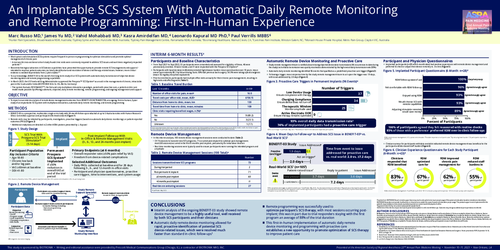
- BENEFIT-03 is a prospective, multicenter, single-arm study with 24-month follow-up conducted at up to 5 Australian sites with Human Research Ethics Committee approval and participant informed consent (Figure 1)
- Remote visits may be initiated by participants, investigators, proactive triggers (based on automatic daily device monitoring), or patient-reported outcomes (PROs) (Figure 2)
- Additional study data are detailed in 2 other ASRA posters presented by L. Kapural
INTERIM 6-MONTH RESULTS†
Participants and Baseline Characteristics
- From Sept 2021 to Sept 2022, 55 participants were consented and assessed for eligibility; of these, 46 were provisionally enrolled, 34 were trialed, and 31 were implanted with the Prospera SCS System*
- Participants with baseline data (n=46) demonstrated high disease burden: mean pain duration over 10 years; mean overall pain intensity 80.3 by Visual Analog Scale; 50% had previous back surgery; 56.5% were taking opioid analgesics (mean: 42 mg/day morphine equivalent)
- Prior to enrollment, participants had multiple office visits annually for their chronic pain management, resulting in high costs and affecting work (Table 1)
Remote Device Management
- In this interim analysis, 100 remote device management sessions were conducted to date (Table 2)
- Of 73 sessions to transmit new SCS programs, 71 occurred post-implant to optimize pain management; most (60 sessions) occurred in the first 6-months post implant, presumably for initial dose titration
- Real-time monitoring sessions were typically used to ensure participants were running the intended program and amplitude
Automatic Remote Device Monitoring and Proactive Care
- Study remote management team is notified about missing objective device data transmissions (96 occurrences to date during the study); lack of data transmission was quickly resolved as demonstrated by the high overall daily transmission rate (93%)
- Automatic daily remote monitoring identified 96 events that qualified as a predefined proactive care trigger (Figure 3)
- Following a trigger, mean response time by the study remote management team to act upon the trigger was 1.9 days, with issue addressed by 2.0 days (Figure 4)
Participant and Physician Questionnaires
- Implanted participants (n=28 with 6-month data) had positive experiences with remote device management and preferred to check or adjust their device remotely vs. in-clinic (Figure 5)
- Clinician surveys for participants with data available indicated remote device management was beneficial to the participant and decreased staff burden (Figure 6)
CONCLUSIONS
- Interim analysis of the ongoing BENEFIT-03 study showed remote device management to be a highly useful tool, well received by both SCS participants and their clinicians
- Automatic daily remote device monitoring allowed for rapid, proactive identification of potential SCS device-related issues, which were resolved much faster than standard in-clinic follow-ups1
- Remote programming was successfully used to optimize participant’s SCS therapy, with most sessions occurring postimplant; this was in part due to trial responders staying with the first program an average of 88% of the trial duration
- This first-in-human implementation of automatic daily remote device monitoring and programming with proactive care establishes a new opportunity to promote optimization of SCS therapy to improve patient care
Proactive Care: BIOTRONIK Neuro’s remote support team may reach out to patients to ensure proper usage of the spinal cord stimulator based on remotely monitored data. BIOTRONIK Neuro does not provide health advice or clinical actions outside the scope of spinal cord stimulator proper usage. This product support is not a replacement for the patient’s responsibility to communicate any medical questions or concerns with the physician’s office.
*Approved in the US only; not commercially available outside the US.
†At the time of this interim analysis not all participants had completed 3- and 6-month follow-ups. Outcomes may change as additional participant data are collected.
AUTHOR DISCLOSURES
M. Russo has historical minor equity holding in SPR Therapeutics and options in Saluda Medical and Presidio Medical. J. Yu has consulted for Abbott, Nevro, Medtronic, Boston Scientific and participated in research for Nevro, Boston Scientific, Medtronic, Saluda, Biotronik, and Nalu. V. Mohabbati has consulted for Medtronic, Abbott, Saluda, Nevro, and participated in research for Nevro, Medtronic, Abbott, Nalu, and Saluda. K. Amirdelfan has consulted for Medtronic, Boston Scientific, Nevro, Biotronik, and Nalu (minor options). L. Kapural has consulted for Nevro, Abbott, Medtronic, Nalu, Saluda, and Biotronik and participated in research for Nevro, Medtronic, Gimer Medical, Neuros, Saluda, Biotronik, and SPR Therapeutics. P. Verrills has consulted for Presidio, Biotronik, Saluda, and Nalu and has participated in research with Biotronik and Presidio.
REFERENCES
1. Amirdelfan K, et al. Patient Burdens Associated with Spinal Cord Stimulation: Impact of Wait Times to Address Device-Related Issues in a Real-World Cohort with Chronic Back and Leg Pain [WIP abstract P-136]. PAIN Pract. 2022;22(S1):25-27.
2. Amirdelfan K, et al. Health-related and Economic Impacts of Clinic Visit Burdens for Spinal Cord Stimulation Patients and Caregivers. Poster presented at PSPS; September 16-18, 2022; Las Vegas, NV.
3. Staats P, et al. Neuromod. Online ahead of print Aug 25, 2023. doi:10.1016/j.neurom.2023.07.003.
4. Deer TR, Esposito MF, Cornidez EG, et al. J Pain Res. 2021;14:3259-3265.
5. Lu Y, Xie D, Zhang X, et al. Front Neurosci. 2020;14:594696.
This study is sponsored by BIOTRONIK • Writing and editorial assistance were provided by Prescott Medical Communications Group (Chicago, IL), a contractor of BIOTRONIK NRO, INC.
Presented at the American Society of Regional Anesthesia 22nd Annual Pain Medicine Meeting • November 10–11, 2023 • New Orleans, LA