Loading...

425 posters, 1 videos, 9 audios, 8 topics, 53 sessions, 340 authors, 286 institutions

ePostersLive by SciGen Technologies S.A. All rights reserved.

22nd Annual Pain Medicine Meeting 2023

November 10 - 11, 2023 | New Orleans Marriott | New Orleans, Louisiana, USA

22nd Annual Pain Medicine Meeting 2023 banner

4757

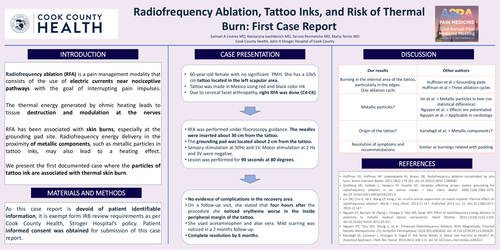
RADIOFREQUENCY ABLATION, TATTOO INKS, AND RISK OF THERMAL BURN: FIRST CASE REPORT
Part of Topic

Chronic Pain

INTRODUCTION

Radiofrequency ablation (RFA) is a pain management modality that consists of the use of electric currents near nociceptive pathways with the goal of interrupting pain impulses.

The thermal energy generated by ohmic heating leads to tissue destruction and modulation at the nerves

RFA has been associated with skin burns, especially at the grounding pad site. Radiofrequency energy delivery in the proximity of metallic components, such as metallic particles in tattoo inks, may also lead to a heating effect.

We present the first documented case where the particles of tattoo ink are associated with thermal skin burn.

MATERIALS AND METHODS

 As this case report is devoid of patient-identifiable information, it is exempt form IRB review requirements as per Cook County Health, Stroger Hospital’s policy. Patient informed consent was obtained for the submission of this case report.


CASE PRESENTATION

•60-year-old female with no significant  PMH. She has a 10x5 cm tattoo located in the left scapular area.
•Tattoo was made in Mexico using red and black color ink
Due to cervical facet arthropathy, right RFA was done (C4-C6
•RFA was performed under fluoroscopy guidance. The needles were inserted about 30 cm from the tattoo.
•The grounding pad was located about 2 cm from the tattoo.
•Sensory stimulation at 50Hz and 1V. Motor stimulation at 2 Hx and 3V were negative.
•Lesion was performed for 90 seconds at 80 degrees.
•No evidence of complications in the recovery area.
•On a follow-up visit, she stated that four hours after the procedure she noticed erythema worse in the inside peripheral margin of the tattoo.
•She used acetaminophen and aloe vera. Mild scarring was noticed in a 2 months follow-up.
•Complete resolution by 6 months.

22nd Annual Pain Medicine Meeting 2023 » banner
Copyright © 2015-2026, ePostersLive® SciGen is a registered trademark of SciGen Technologies S.A. Patent pending.

This website and third-party tools we use rely on cookies for the best user experience. By selecting "I agree", you agree to cookie usage as described in our Privacy Policy.