425 posters, 1 videos, 9 audios, 8 topics, 53 sessions, 340 authors, 286 institutions
ePostersLive by SciGen Technologies S.A. All rights reserved.
22nd Annual Pain Medicine Meeting 2023
November 10 - 11, 2023 | New Orleans Marriott | New Orleans, Louisiana, USA

4984
LOWER BACK PAIN SECONDARY TO INCIDENTAL DISCITIS AND VERTEBRAL OSTEOMYELITIS.
Poster Presenter
Authors
Affiliations
Part of Topic
Chronic Pain
Abstract
Case
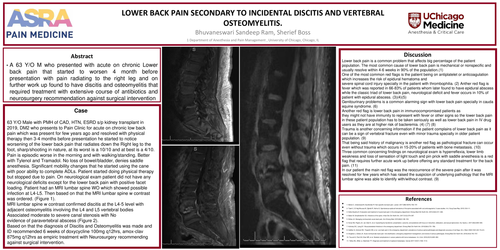
63 Y/O Male with PMH of CAD, HTN, ESRD s/p kidney transplant in 2019, DM2 who presents to Pain Clinic for acute on chronic low back pain which was present for few years ago and resolved with physical therapy then 3-4 months before presentation he started to notice worsening of the lower back pain that radiates down the Right leg to the foot, sharp/shooting in nature, at its worst is a 10/10 and at best is a 4/10. Pain is episodic worse in the morning and with walking/standing. Better with Tylenol and Tramadol. No loss of bowel/bladder, denies saddle anesthesia. Significant mobility changes that he started using the cane with poor ability to complete ADLs. Patient started doing physical therapy but stopped due to pain. On neurological exam patient did not have any neurological deficits except for the lower back pain with positive facet loading. Patient had an MRI lumbar spine WO which showed possible infection at L4-L5. Then based on that the MRI lumbar spine w contrast was ordered. (Figure 1).
MRI lumbar spine w contrast confirmed discitis at the L4-5 level with adjacent osteomyelitis involving the L4 and L5 vertebral bodies Associated moderate to severe canal stenosis with No
evidence of paravertebral abscess (Figure 2).
Based on that the diagnosis of Discitis and Osteomyelitis was made and ID recommended 6 weeks of doxycycline 100mg q12hrs, amox-clav 875mg q12hrs as empiric treatment with Neurosurgery recommending against surgical intervention.
Discussion
Lower back pain is a common problem that affects big percentage of the patient population. The most common cause of lower back pain is mechanical or nonspecific and usually resolve within 4-6 weeks in 90% of the population.(1)
One of the most common red flags is the patient being on antiplatelet or anticoagulation which increases the risk of epidural hematoma and
severe spinal cord injury specially in the patient with thrombophilia. (2) Anther red flag is fever which was reported in 66-83% of patients whom later found to have epidural abscess while the classic triad of lower back pain, neurological deficit and fever occurs in 10% of patient with epidural abscess. (3)(4)(5)
Genitourinary problems is a common alarming sign with lower back pain specially in cauda equine syndrome. (6)
Another red flag is lower back pain in immunocompromised patients as
they might not have immunity to represent with fever or other signs so the lower back pain in these patient population has to be taken seriously as well as lower back pain in IV drug users as they are at higher risk of bacteremia. (4) (7) (8)
Trauma is another concerning information if the patient complains of lower back pain as it can be a sign of vertebral fracture even with minor trauma specially in older patient population. (9)
That being said history of malignancy is another red flag as pathological fracture can occur even without trauma which occurs in 15-20% of patients with bone metastasis. (10)
Three common concerning findings on neurological exam is hyperreflexia, lower limb weakness and loss of sensation of light touch and pin prick with saddle anesthesia is a red flag that requires further acute work up before offering any standard treatment for the back pain. (11)
In our patient the main red flag was the reoccurrence of the severe pain after it was resolved for few years which has raised the suspicion of underlying pathology that the MRI lumbar spine was able to identify with/without contrast. (9)
References