425 posters, 1 videos, 9 audios, 8 topics, 53 sessions, 340 authors, 286 institutions
ePostersLive by SciGen Technologies S.A. All rights reserved.
22nd Annual Pain Medicine Meeting 2023
November 10 - 11, 2023 | New Orleans Marriott | New Orleans, Louisiana, USA

4836
ANTIHISTAMINES AS SOLE ANALGESIC THERAPY FOR CHRONIC REFRACTORY PAIN: A CASE REPORT
Poster Presenter
Authors
Affiliations
Part of Topic
Chronic Pain
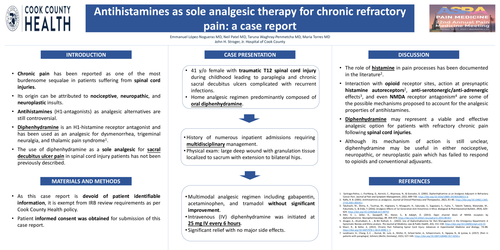
Antihistamines as sole analgesic therapy for chronic refractory pain: a case report
Authors:
Emmanuel López-Nogueras MD, Neil Patel MD, Taruna Waghray-Penmetcha MD, Maria Torres MD
Introduction:
•Chronic pain has been reported as one of the most burdensome sequalae in patients suffering from spinal cord injuries.
•Its origin can be attributed to nociceptive, neuropathic, and neuroplastic insults.
•Antihistamines (H1-antagonists) as analgesic alternatives are still controversial.
•Diphenhydramine is an H1-histamine receptor antagonist and has been used as an analgesic for dysmenorrhea, trigeminal neuralgia, and thalamic pain syndrome1.
•The use of diphenhydramine as a sole analgesic for sacral decubitus ulcer pain in spinal cord injury patients has not been previously described.
Materials and Methods:
•As this case report is devoid of patient identifiable information, it is exempt from IRB review requirements as per Cook County Health policy.
•Patient informed consent was obtained for submission of this case report.
Case Presentation:
•41 y/o female with traumatic T12 spinal cord injury during childhood leading to paraplegia and chronic sacral decubitus ulcers complicated with recurrent infections.
•Home analgesic regimen predominantly composed of oral diphenhydramine.
•History of numerous inpatient admissions requiring multidisciplinary management.
•Physical exam: large deep wound with granulation tissue localized to sacrum with extension to bilateral hips.
•Multimodal analgesic regimen including gabapentin, acetaminophen, and tramadol without significant improvement.
•Intravenous (IV) diphenhydramine was initiated at 25 mg IV every 6 hours.
•Significant relief with no major side effects.
Discussion:
•The role of histamine in pain processes has been documented in the literature2.
•Interaction with opioid receptor sites, action at presynaptic histamine autoreceptors2, anti-serotonergic/anti-adrenergic effects3, and even NMDA receptor antagonism4 are some of the possible mechanisms proposed to account for the analgesic properties of antihistamines.
•Diphenhydramine may represent a viable and effective analgesic option for patients with refractory chronic pain following spinal cord injuries.
•Although its mechanism of action is still unclear, diphenhydramine may be useful in either nociceptive, neuropathic, or neuroplastic pain which has failed to respond to opioids and conventional adjuvants.
References:
1. Santiago-Palma, J., Fischberg, D., Kornick, C., Khjainova, N., & Gonzales, G. (2001). Diphenhydramine as an Analgesic Adjuvant in Refractory Cancer Pain. Journal of Pain and Symptom Management, 22(2), 699–703. https://doi.org/10.1016/s0885-3924(01)00311-6
2.Raffa, R. B. (2001). Antihistamines as analgesics. Journal of Clinical Pharmacy and Therapeutics, 26(2), 81–85. https://doi.org/10.1046/j.1365-2710.2001.00330.x
3.Takahashi, M., Shima, K., Tsuchiya, M., Hagiwara, Y., Mizoguchi, H., Sakurada, S., Sugawara, S., Fujita, T., Takeshi Tadano, Watanabe, M., Fukumoto, S., & Endo, Y. (2016). Analgesic Effects of 1st Generation Anti-histamines in Mice. Biological & Pharmaceutical Bulletin, 39(4), 620–624. https://doi.org/10.1248/bpb.b15-00755
4.Föhr, K. J., Zeller, K., Georgieff, M., Köster, S., & Adolph, O. (2015). Open channel block of NMDA receptors by diphenhydramine. Neuropharmacology, 99, 459–470. https://doi.org/10.1016/j.neuropharm.2015.08.021
5.Alsager, A., Alsuhaibani, A. ., & Bin Nafisah, S. . (2022). Use of Diphenhydramine for Pain Management in the Emergency Department: A Systematic Review and Meta-analysis. The Journal of Medicine, Law & Public Health, 2(3), 151–158. https://doi.org/10.52609/jmlph.v2i3.55
6.Masri, R., & Keller, A. (2012). Chronic Pain Following Spinal Cord Injury. Advances in Experimental Medicine and Biology, 74–88. https://doi.org/10.1007/978-1-4614-4090-1_5
7.Landmann, G., Chang, E.-C. ., Dumat, W., Lutz, A., Müller, R., Scheel-Sailer, A., Schwerzmann, K., Sigajew, N., & Ljutow, A. (2017). [Pain in patients with paraplegia]. Schmerz (Berlin, Germany), 31(5), 527–545. https://doi.org/10.1007/s00482-017-0250-x