Loading...

425 posters, 1 videos, 9 audios, 8 topics, 53 sessions, 340 authors, 286 institutions

ePostersLive by SciGen Technologies S.A. All rights reserved.

22nd Annual Pain Medicine Meeting 2023

November 10 - 11, 2023 | New Orleans Marriott | New Orleans, Louisiana, USA

22nd Annual Pain Medicine Meeting 2023 banner

4905

USE OF ABSORBABLE ANTIMICROBIAL ENVELOPES IN HIGH-RISK SPINAL CORD STIMULATION IMPLANT PATIENTS: A LITERATURE REVIEW
Part of Topic

Chronic Pain

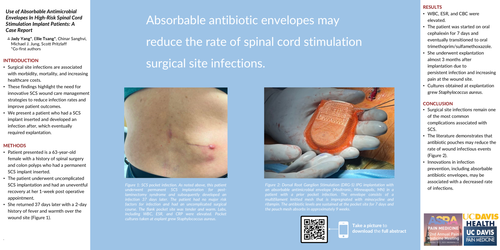
Use of Absorbable Antimicrobial Envelopes In High-Risk Spinal Cord Stimulation Implant Patients: A Case Report

INTRODUCTION

- Surgical site infections are associated with morbidity, mortality, and increasing healthcare costs. 
- These findings highlight the need for innovative SCS wound care management strategies to reduce infection rates and improve patient outcomes. 
- We present a patient who had a SCS implant inserted and developed an infection after, which eventually required explantation.
 
 
METHODS
- Patient presented is a 63-year-old female with a history of spinal surgery and colon polyps who had a permanent SCS implant inserted. 
- The patient underwent uncomplicated SCS implantation and had an uneventful recovery at her 1-week post operative appointment. 
- She returned 37 days later with a 2-day history of fever and warmth over the wound site (Figure 1). 

Figure 1: SCS pocket infection. As noted above, this patient underwent permanent SCS implantation for post-laminectomy syndrome and subsequently developed an infection 37 days later. The patient had no major risk factors for infection and had an uncomplicated surgical course. The flank pocket site was tender and warm. Labs, including WBC, ESR, and CRP were elevated. Pocket cultures taken at explant grew Staphylococcus aureus.


RESULTS

- WBC, ESR, and CBC were elevated. 
- The patient was started on oral cephalexin for 7 days and eventually transitioned to oral trimethoprim/sulfamethoxazole. 
- She underwent explantation almost 3 months after implantation due to persistent infection and increasing pain at the wound site. 
- Cultures obtained at explantation grew Staphylococcus aureus. 


CONCLUSION

- Surgical site infections remain one of the most common complications associated with SCS. 
- The literature demonstrates that antibiotic pouches may reduce the rate of wound infectious events (Figure 2). 
- Innovations in infection prevention, including absorbable antibiotic envelopes, may be associated with a decreased rate of infections.

Figure 2: Dorsal Root Ganglion Stimulation (DRG-S) IPG implantation with an absorbable antimicrobial envelope (Medtronic, Minneapolis, MN) in a patient with a prior pocket infection. The envelope consists of a multifilament knitted mesh that is impregnated with minocycline and rifampin. The antibiotic levels are sustained at the pocket site for 7 days and the pouch mesh absorbs in approximately 9 weeks.

22nd Annual Pain Medicine Meeting 2023 » banner
Copyright © 2015-2026, ePostersLive® SciGen is a registered trademark of SciGen Technologies S.A. Patent pending.

This website and third-party tools we use rely on cookies for the best user experience. By selecting "I agree", you agree to cookie usage as described in our Privacy Policy.