425 posters, 1 videos, 9 audios, 8 topics, 53 sessions, 340 authors, 286 institutions
ePostersLive by SciGen Technologies S.A. All rights reserved.
22nd Annual Pain Medicine Meeting 2023
November 10 - 11, 2023 | New Orleans Marriott | New Orleans, Louisiana, USA

4706
A TRANSCRIPTOMIC STUDY OF THE L5-DRG IN THE SPARED NERVE INJURY MODEL OF NEUROPATHIC PAIN
Poster Presenter
Authors
Affiliations
Part of Topic
Chronic Pain
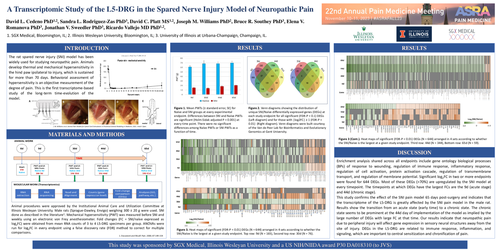
The rat spared nerve injury (SNI) model has been widely used for studying neuropathic pain. Animals develop thermal and mechanical hypersensitivity in the hind paw ipsilateral to injury, which is sustained for more than 70 days. Behavioral assessment of hypersensitivity is an objective measurement of the degree of pain. This is the first transcriptome-based study of the long-term time-evolution of the model.
Animal procedures were approved by the Institutional Animal Care and Utilization Committee at Illinois Wesleyan University. Male rats (Sprague-Dawley, Envigo) weighing 300 ± 20 g were used. SNI done as described in the literature1. Mechanical hypersensitivity (PWT) was measured before SNI and weekly using an electronic von Frey anesthesiometer. Fold changes (FC = SNI/naïve expressed as log2FC) were obtained from mean RNA counts of 3 to 4 L5-DRG specimens per group. ANOVAs were run for log2FC in every endpoint using a false discovery rate (FDR) method to correct for multiple comparisons.
Enrichment analysis shared across all endpoints include gene ontology biological processes (BPs) of response to wounding, regulation of immune response, inflammatory response, regulation of cell activation, protein activation cascade, regulation of transmembrane transport, and regulation of membrane potential. Significant log2FC in two or more endpoints were found for 644 DEGs. Most of these DEGs (>70%) are upregulated by the SNI model at every timepoint. The timepoints at which DEGs have the largest FCs are the 9d (acute stage) and 44d (chronic stage).
This study confirms the effect of the SNI pain model 65 days post-surgery and indicates that the transcriptome of the L5-DRG is greatly affected by the SNI pain model in the male rat. Results show the transition from an acute state (early time) to a chronic state. The chronic state seems to be prominent at the 44d day of implementation of the model as implied by the large number of DEGs with large FC at that time. Our results indicate that neuropathic pain due to peripheral injury will affect gene expression in sensory neural structures away from the site of injury. DEGs in the L5-DRG are related to immune response, inflammation, and signaling, which are important to central sensitization and chronification of pain.
1. Decosterd and Woolf. Pain. 2000; 87:149-154