425 posters, 1 videos, 9 audios, 8 topics, 53 sessions, 340 authors, 286 institutions
ePostersLive by SciGen Technologies S.A. All rights reserved.
22nd Annual Pain Medicine Meeting 2023
November 10 - 11, 2023 | New Orleans Marriott | New Orleans, Louisiana, USA

4656
TARGETING RISK REDUCTION: EXPLORING NON-MODIFIABLE AND MODIFIABLE RISK FACTORS IN A SPINAL CORD STIMULATION POPULATION
Poster Presenter
Authors
Affiliations
Part of Topic
Chronic Pain
Authors: Robin Mata, DO MPH, Christian Diaz, MD, Lorenzo Diaz DO, Shemar Crawford, MD, Chane Price MD
Abstract Title: Targeting Risk Reduction: Exploring Non-Modifiable and Modifiable Risk Factors in a Spinal Cord Stimulation Population
Introduction:
Spinal cord stimulation (SCS) is an emerging option for treating intractable pain with implantation success as high as 83% at 12 months. (1) Proper patient selection increases the chances of success with SCS implantation and should include identifying potential risk factors that could lead to complications and failures. The aim of our study was to determine the rates of complications and failures in SCS patients with non-modifiable risk factors (age, ethnicity) and modifiable risk factors such as impaired glucose control (Pre-Diabetes and Type 2 Diabetes Mellitus), obesity (Body Mass Index or (BMI) ≥30), and active smoking.
Material and Methods:
Approval was obtained for the study from the Institutional Review Board of the University of Miami. We conducted a retrospective chart review in 116 patients with refractory chronic pain who underwent SCS implantation at a single academic center from 2017-2023. Records were identified using Current Procedural Terminology (CPT) code 63650 for Percutaneous Implantation of Neurostimulator Electrode Array, Epidural which was performed by the principal investigator. A variety of brands, implantable pulse generators (rechargeable/primary cell), and frequencies (tonic/burst/high) were included. Inclusion criteria were at least age 18, clinical criteria for SCS, and consent for procedure. Exclusion Criteria was the presence of other implantable devices such as Dorsal Root Ganglion Stimulation (DRG). Demographic information and medical history were obtained and outcomes were recorded post-trial, post-implantation, and at all follow-up visits. Complications that resulted in explant were considered a failure.
Results:
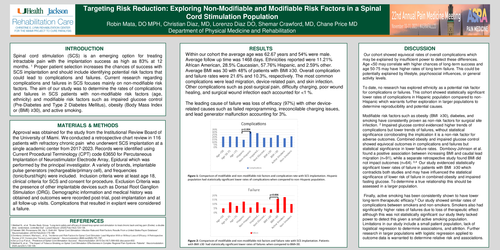
Within our cohort, the average age was 62.67 years and 54% were male. Average follow-up time was 1468 days. Ethnicities reported were 11.21% African American, 28.5% Caucasian, 57.76% Hispanic, and 2.59% other. Average BMI was 30 with 48% of patients with BMI ≥30. Overall complication and failure rates were 21.6% and 10.3%, respectively. The most common complication was lead migration (11.2%), device-related pain (4.3%), and skin infection (4%). Other complications such as post-surgical pain, difficulty charging, poor wound healing, and surgical wound infection each accounted for <1 %. The leading cause of failure was loss of efficacy (97%) with other device-related causes such as failed reprogramming, irreconcilable charging issues, and lead generator malfunction accounting for 3%.
We found no difference in overall complication rates for age <50, ages 50-75, and age >75. Patients > 75 years had equivocal failure rates compared to patients <75 years. Patients <50 years had lower trends of failure ( 5.3%) compared with those >50 years (11%). Patients aged 50-75 had higher trends of failure (12.3%) when compared to patients aged <50 and aged >75 (7%). Comparing Hispanic and non-Hispanic populations, Hispanic patients evidenced statistically significant lower rates of complications compared to all other ethnicities, with 14.9% and 30.6%, respectively ( p=0.004). Paradoxically, Hispanic patients showed higher trends of failure (13.4%) without statistical significance when compared to all other ethnicities (6.1%).
Patients with impaired glucose control (Pre-Diabetic and Type 2 Diabetes Mellitus) had higher trends of complications overall ( 28.1%) when compared to those with normal glucose control (19.3%). However, failure rates in those with impaired glucose control trended 50% lower than the normal population, 12% vs. 6% without statistical significance. Combined risk factors of impaired glucose control and obesity evidenced equivocal rates of complications, but statistically significant lower rates of failures 12.4% and 0% respectively ( p=0.001). Modifiable risk factors such as obesity (BMI ≥30) had equivocal complication rates but statistically significantly lower rates of failure when compared to patients with BMI <30 with 3.7 and 16.1% respectively (p= 0.006). Active smokers showed equivocal rates of complications and higher trends of failures (18%) when compared to non-smokers (9%).
Discussion:
Current research regarding complications and failures in SCS focuses mainly on non-modifiable risk factors. However, in one large population study (n= 6615) they found lower rates of infection in older patients to be statistically significant. (2) Our cohort showed equivocal rates of overall complications which may be explained by insufficient power to detect these differences. Age <50 may correlate with higher chances of long-term success and age 50-75 may have higher rates of long term-failure. This could be potentially explained by lifestyle, psychosocial influences, or general activity levels. To date, no research has explored ethnicity in relation to complications or failures. This cohort showed statistically significant higher rates of failure which warrants further exploration in larger populations to determine reproducibility and potential causes.
Modifiable comorbidities such as obesity (BMI ≥30), diabetes, and smoking have consistently proven not to be risk factors for surgical site infection. (2) Impaired glucose control had higher trends of complications but lower trends of failures, without statistical significance corroborating the implication it is a non-risk factor for adverse outcomes. Combined obesity and impaired glucose control showed equivocal outcomes in complications and failures but statistical significance in lower failure rates. Dombovy-Johnson et al. found a positive association between increasing BMI and caudal lead migration (n=91), while a separate retrospective study found BMI did not impact outcomes (n=64). (3,4) Our study evidenced statistically significant lower rates of failure in patients with BMI ≥30 which contradicts both studies and may have influenced the statistical significance of lower risk of failure in combined obesity and impaired fasting glucose. To determine a true relationship this should be assessed in a larger population. Finally, active smoking has been consistently shown to have lower long-term therapeutic efficacy. (5) In contrast, our study showed similar rates of complications but was congruent with significantly higher rates of failures compared to non-smokers. On further investigation, these failures were due to loss of therapeutic effect although this was not statistically significant our study likely lacked the power to detect this, given a small active smoking population.
Limitations in our study include a small patient population, a lack of logistical regression to determine associations, and attrition. Further research in larger populations with logistic regression applied to outcome data is warranted to determine relative risk and associations.
References
-
Mekhail N., et al. “Evoke Study Group. “Long-term safety and efficacy of closed-loop spinal cord stimulation to treat chronic back and leg pain (Evoke): a double-blind, randomized, controlled trial”. Lancet Neurol. (2020) Feb;19(2):123-134.
-
Falowski SM, Provenzano DA, Xia Y, Doth AH. “Spinal Cord Stimulation Infection Rate and Risk Factors: Results From a United States Payer Database”. Neuromodulation. (2019) Feb;22(2):179-189.
-
Dombovy-Johnson, Marissa L., et al., “Incidence and Risk Factors for Spinal Cord Stimulator Lead Migration With or Without Loss of Efficacy: A Retrospective Review of 91 Consecutive Thoracic Lead Implants”.Neuromodulation. 2022 Jul;25(5):731-737.
-
De La Cruz P,et al., “Predictors of Spinal Cord Stimulation Success”. Neuromodulation. 2015 Oct;18(7):599-602; discussion 602.
-
Mekhail N, et al., “The Impact of Tobacco Smoking on Spinal Cord Stimulation Effectiveness in Complex Regional Pain Syndrome Patients”. Neuromodulation. 2020 Jan;23(1):133-139.