425 posters, 1 videos, 9 audios, 8 topics, 53 sessions, 340 authors, 286 institutions
ePostersLive by SciGen Technologies S.A. All rights reserved.
22nd Annual Pain Medicine Meeting 2023
November 10 - 11, 2023 | New Orleans Marriott | New Orleans, Louisiana, USA

4640
UTILIZING A DIFFERENTIAL SPINAL BLOCKADE IN CHRONIC PELVIC PAIN TO DIFFERENTIATE NOCICEPTIVE VS. SYMPATHETIC PAIN: A CASE SERIES
Poster Presenter
Authors
Affiliations
Part of Topic
Case Series
Audio
Utilizing a differential spinal blockade in chronic pelvic pain to differentiate nociceptive vs. sympathetic pain: a case series
INTRODUCTION
-
Chronic pelvic pain syndrome (CPPS) is estimated to affect up to 24% of women of childbearing age1.
-
Due to the complexity of innervation in the pelvic region, it can be challenging to ascertain if the pain is nociceptive, visceral/sympathetic, or psychogenic2,4.
-
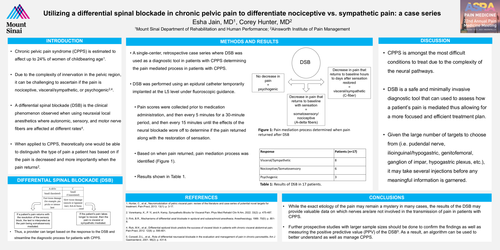
A differential spinal blockade (DSB) is the clinical phenomenon observed when using neuraxial local anesthetics where autonomic, sensory, and motor nerve fibers are affected at different rates4.
-
When applied to CPPS, theoretically one would be able to distinguish the type of pain a patient has based on if the pain is decreased and more importantly when the pain returns2.
METHODS AND RESULTS
-
A single-center, retrospective case series where DSB was used as a diagnostic tool in patients with CPPS determining the pain mediated process in patients with CPPS.
-
DSB was performed using an epidural catheter temporarily implanted at the L5 level under fluoroscopic guidance.
-
Pain scores were collected prior to medication administration, and then every 5 minutes for a 30-minute period, and then every 15 minutes until the effects of the neural blockade wore off to determine if the pain returned along with the restoration of sensation.
-
DISCUSSION
-
CPPS is amongst the most difficult conditions to treat due to the complexity of the neural pathways.
-
DSB is a safe and minimally invasive diagnostic tool that can used to assess how a patient’s pain is mediated thus allowing for a more focused and efficient treatment plan.
-
Given the large number of targets to choose from (i.e. pudendal nerve, ilioinguinal/hypogastric, genitofemoral, ganglion of impar, hypogastric plexus, etc.), it may take several injections before any meaningful information is garnered.
CONCLUSIONS
While the exact etiology of the pain may remain a mystery in many cases, the results of the DSB may provide valuable data on which nerves are/are not involved in the transmission of pain in patients with CPPS.
Further prospective studies with larger sample sizes should be done to confirm the findings as well as measuring the positive predictive value (PPV) of the DSB5. As a result, an algorithm can be used to better understand as well as manage CPPS.