425 posters, 1 videos, 9 audios, 8 topics, 53 sessions, 340 authors, 286 institutions
ePostersLive by SciGen Technologies S.A. All rights reserved.
22nd Annual Pain Medicine Meeting 2023
November 10 - 11, 2023 | New Orleans Marriott | New Orleans, Louisiana, USA

4643
LIDOCAINE INFUSION IN ONCOLOGIC PATIENTS FOR CHRONIC PAIN MANAGEMENT POST CANCER TREATMENT
Poster Presenter
Authors
Affiliations
Part of Topic
Case Series
Lidocaine infusion in oncologic patients for chronic pain management post cancer treatment. A case series.
PRESENTER:
Maria Lia
Furlani
Anesthesiology and Pain Medicine,
Instituto do Câncer do Estado de
São Paulo (ICESP)
BACKGROUND
Pain is ubiquitous and often challenging in cancer patients Pain might be related to cancer itself, treatment and miscellaneous Lidocaine is a well known adjuvant in pain management and might be helpful in treatment related cancer pain
METHODS
1. Clinical data of five patients with non tumor related chronic pain were collected.
2. We registered gender, age, type of pain, type of cancer, dose of lidocaine, Numeric Pain Intensity (NPI) before and after drug infusion, and the time of pain relief
3. Patients signed informed consent forms and the reports were approved by the hospital committee .
RESULTS
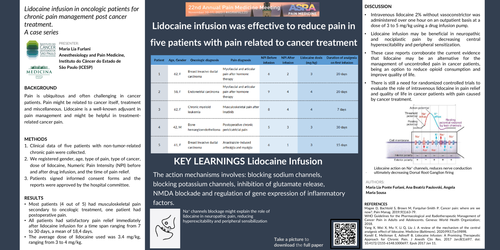
• Most patients 4 out of 5 had musculoskeletal pain secondary to oncologic treatment, one patient had postoperative pain
•All patients had satisfactory pain relief immediately after lidocaine infusion for a time span ranging from 7 to 30 days, a mean of 18 4 days
• The average dose of lidocaine used was 3 4 mg/kg, ranging from 3 to 4 mg/kg
DISCUSSION
• Intravenous lidocaine 2 without vasoconstrictor was administered over one hour on an outpatient basis at a dose of 3 to 5 mg/kg using a drug infusion pump
• Lidocaine infusion may be beneficial in neuropathic and nociplastic pain by decreasing central hyperexcitability and peripheral sensitization
• These case reports corroborate the current evidence that lidocaine may be an alternative for the management of uncontrolled pain in cancer patients, being an option to reduce opioid consumption and improve quality of life
• There is still a need for randomized controlled trials to evaluate the role of intravenous lidocaine in pain relief and quality of life in cancer patients with pain caused by cancer treatment
Lidocaine infusion was effective to reduce pain in five patients with pain related to cancer treatment
KEY LEARNINGS Lidocaine Infusion:
The action mechanisms involves: blocking sodium channels, blocking potassium channels, inhibition of glutamate release, NMDA blockade and regulation of gene expression of inflammatory factors.
AUTHORS: Maria Lia Ponte Furlani , Ana Beatriz Paulovski , Angela Maria Sousa
REFERENCES
Magee D, Bachtold S, Brown M, Farquhar Smith P Cancer pain where are we now? Pain Manag. 2019;9(1):63-79.
WHO Guidelines for the Pharmacological and Radiotherapeutic Management of Cancer Pain in Adults and Adolescents Geneva World Health Organization 2018
Yang X, Wei X, Mu Y, Li Q, Liu J A review of the mechanism of the central analgesic effect of lidocaine Medicine (Baltimore). 2020;99(17):e19898.
Kandil E, Melikman E, Adinoff B. Lidocaine Infusion: A Promising Therapeutic Approach for Chronic Pain. J Anesth Clin Res. 2017 Jan;8(1):697. doi: 10.4172/2155-6148.1000697. Epub 2017 Jan 11.