425 posters, 1 videos, 9 audios, 8 topics, 53 sessions, 340 authors, 286 institutions
ePostersLive by SciGen Technologies S.A. All rights reserved.
22nd Annual Pain Medicine Meeting 2023
November 10 - 11, 2023 | New Orleans Marriott | New Orleans, Louisiana, USA

4621
OSCILLATORY CHANGES IN DISTINCT CORTICAL AREAS ARE ASSOCIATED WITH ACUTE PAIN RESPONSES IN CHRONIC PAIN PATIENTS
Poster Presenter
Authors
Affiliations
Part of Topic
Chronic Pain
Audio
Abstract 4621: Oscillatory Changes in Distinct Cortical Areas are Associated with Acute Pain Responses in Chronic Pain Patients
Introduction, methods, and results:
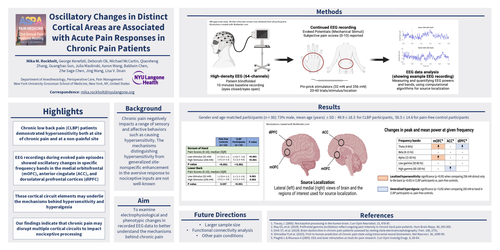
Chronic pain negatively impacts a range of sensory and affective behaviors, such as causing hypersensitivity at the site of injury as well as being associated with more intense pain-aversive experiences at anatomically unrelated sites. As the mechanisms distinguishing hypersensitivity from generalized site-nonspecific enhancement in the aversive response to nociceptive inputs are not well-known, we conducted this study to evaluate the electrophysiological and phenotypic changes in recorded electroencephalographic (EEG) data, with the overarching goal to better understand the mechanisms behind chronic pain. In this IRB-approved study, a total of 30 age and gender-matched participants – 15 with chronic low back pain and 15 pain-free controls, were included for high-density EEG recordings. EEG was recorded during resting state and while applying mechanical stimuli to the lower back and the dorsum of the hand. We analyzed all data and compared groups using the non-parametric Mann-Whitney U Test for hypothesis testing. In summary, our results showed that participants with chronic low back pain reported significantly higher scores than control participants for both stimuli at both the lower back and hand. Cortical activity analysis, focusing on the anterior cingulate cortex (ACC), the dorsolateral prefrontal cortex (dlPFC), and the orbitofrontal cortex (OFC), showed that chronic pain subjects, compared with control participants, demonstrated a statistically significant increase in the peak and mean power at the alpha and theta frequencies in the medial OFC, as well as in the high gamma frequency bands in the ACC and the theta frequency bands in the dlPFC.
Discussion and Significance:
Our data indicate that chronic low back pain participants demonstrated hypersensitivity both at the site of chronic pain and at a non-painful site. Source localized EEG data, meanwhile, suggest distinct cortical mechanisms that underlie hypersensitivity to painful and non-painful sites in these patients.
The changes in the oscillatory activities in the frequency ranges identified in this study have been repeatedly shown to play important roles in previous studies on pain. However, one key finding in this study is that whereas hypersensitivity at the site of injury – the back - is associated with enhanced theta and alpha oscillations in the contralateral OFC, more generalized, anatomically-nonspecific enhancement in nociceptive response is seen with increased gamma oscillations in the ACC and increased theta oscillations in the contralateral dlPFC. To our knowledge, this is the first report to distinguish between the locations of peripheral noxious stimuli, which is of importance, as there is a need to separate between peripheral hypersensitivity from a more generalized anatomically diffuse enhancement for pain sensitivity, as treatments often differ. Moreover, peripheral and spinal mechanisms as well as mechanisms in the brain may contribute to hypersensitivity at the site of injury, whereas the brain likely plays a more dominant role in a more generalized form of hyperalgesia.
Our results are compatible with findings from multiple animal studies that specifically investigated hyperalgesia of diffuse distribution, where enhancement in high gamma oscillatory activities in the ACC has been shown to be important and likely to play a causal role. The dlPFC, meanwhile, is known to produce top-down pain regulation, and its activation in response to nociceptive inputs has been widely reported in both human and animal literature. Interestingly, it has been shown that sustained power changes from the OFC can be used to detect the presence of chronic pain, whereas transient, evoked pain processing may be found in the ACC. It is possible that peripheral hypersensitivity serves as an index of chronic pain, and that OFC, which has prominent roles in reward processing as well as placebo analgesia, may integrate multiple cognitive functions including disease-threat assessment to process allodynic-type of experiences. Due to the lack of threat at the non-injured site, OFC activity may play a more minor role, as shown by results on cortical response to hand stimulation in our study.
Conclusions:
We identified multiple cortical circuit elements that may underlie potential mechanisms on how chronic pain not only confers hypersensitivity at the site of injury but also induces a more anatomically nonspecific form of generalized hypersensitivity. Future studies of larger sample sizes utilizing more detailed analysis, including functional connectivity analysis, will provide further insights on how chronic pain alters normal nociceptive functions in the brain, where source localized EEG data representing abnormal circuit mechanisms for central nociceptive processing in combination with clinical, pain and mood predictors for chronic pain and hyperalgesia, might serve to further develop and explore the potential of using EEG as a potential biomarker for chronic pain.