425 posters, 1 videos, 9 audios, 8 topics, 53 sessions, 340 authors, 286 institutions
ePostersLive by SciGen Technologies S.A. All rights reserved.
22nd Annual Pain Medicine Meeting 2023
November 10 - 11, 2023 | New Orleans Marriott | New Orleans, Louisiana, USA

4688
STELLATE GANGLION BLOCKS TO TREAT CRPS AND NEUROPATHY OF THE UPPER EXTREMITY CAUSED BY THE BITE OF A BROWN RECLUSE SPIDER
Poster Presenter
Authors
Affiliations
Part of Topic
Chronic Pain
Category: Chronic Pain
Stellate Ganglion Blocks to Treat Complex Regional Pain Syndrome and Neuropathy of the Upper Extremity Caused by the Bite of a Brown Recluse Spider
Brock Marrs MD, Morgan Cassidy DO, Justin Craig MD
Introduction
The venom of the brown recluse spider (Loxosceles reclusa) contains enzymes, including sphingomyelinase1, that are known to cause soft tissue necrosis. Dermonecrotic arachnidism, the term given to the localized breakdown of tissues secondary to the spider bite, is not widely known to result in damage to peripheral nerves. There are, however, cases of complex regional pain syndrome (CRPS II, causalgia) resulting from the bite of the brown recluse spider2. In such cases (mostly in the lower extremities) lumbar sympathetic blocks were used to mitigate symptoms. Stellate ganglion blocks are often used to treat the symptoms of CRPS II in the upper extremity; however, little is known about the effect of a stellate ganglion block in the treatment CRPS II in the setting of dermonecrotic arachnidism. This report highlights the benefits of stellate ganglion blocks in such a case.
Case Description
In June 2021, 76-year-old male sustained a spider bite on the right hand. He identified the spider as a brown recluse. Over the course of the following weeks, the patient developed swelling, erythema, and petechiae of the hand along with skin blistering and sloughing. The patient’s symptoms evolved to including loss of sensation, strength, and range of motion in his right hand/wrist. Electrodiagnostic evaluation of his right arm revealed neuronal injury to the ulnar and median nerves. Entrapment mononeuropathy, radiculopathy, and brachial plexopathy were ruled out as etiologies. With all other explanations eliminated, these symptoms were attributed to the venom of the spider bite. After several months, he developed persistent swelling, trophic changes, hyperesthesia, and neuropathic pain to the elbow, consistent with complex regional pain syndrome, type II.
Materials and Methods
Patient informed consent was obtained for submission of a case report.
All patient protected health information has been de-identified
Results/Case Report
Early treatments included:
- Tylenol, NSAIDs, topical analgesics
- Physical and Occupational Therapies including passive ROM, desensitization, and strengthening
- Gabapentin
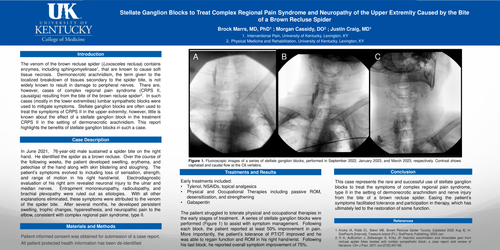
The patient struggled to tolerate physical and occupational therapies in the early stages of treatment. A series of stellate ganglion blocks were performed (Figure 1) to assist with symptom management. Following each block, the patient reported at least 50% improvement in pain. More importantly, the patient’s tolerance of PT/OT improved and he was able to regain function and ROM in his right hand/wrist. Following his last block, he reported overall symptom improvement of 75%.
Conclusion
This case represents the rare and successful use of stellate ganglion blocks to treat the symptoms of complex regional pain syndrome, type II in the setting of dermonecrotic arachnidism and nerve injury from the bite of a brown recluse spider. Easing the patient’s symptoms facilitated tolerance and participation in therapy, which has ultimately led to the restoration of some function.
References
- Anoka IA, Robb EL, Baker MB. Brown Recluse Spider Toxicity. [Updated 2022 Aug 8]. In: StatPearls [Internet]. Treasure Island (FL): StatPearls Publishing; 2023 Jan.
- Yi X, AuBuchon J, Zeltwanger S, Kirby JP. Necrotic arachnidism and intractable pain from recluse spider bites treated with lumbar sympathetic block: a case report and review of literature. Clin J Pain. 2011 Jun;27(5):457-60.