425 posters, 1 videos, 9 audios, 8 topics, 53 sessions, 340 authors, 286 institutions
ePostersLive by SciGen Technologies S.A. All rights reserved.
22nd Annual Pain Medicine Meeting 2023
November 10 - 11, 2023 | New Orleans Marriott | New Orleans, Louisiana, USA

4833
XRAY GUIDED DRAINAGE OF A TARLOV CYST
Poster Presenter
Authors
Affiliations
Part of Topic
Chronic Pain
XRAY GUIDED DRAINAGE OF A TARLOV CYST
Mahmoud Morsi, MD1. (Abed Rahman, MD)1. Elena Hernandez1. Dean Hernandez1.
(1) Department of Anesthesiology, John H. Stroger, Jr Cook County Hospital
Introduction: Tarlov cysts, also known as perineural cysts, are fluid-filled sacs located between the perineurium and endoneurium. These cysts are typically found near the base of the spine (the sacrum) and develop around the spinal nerve roots. The exact etiology of these cysts is not fully understood, but it is believed that they result from a weakening of the nerve sheath covering the nerve roots. This weakening may be predisposed by trauma or exertion, leading to the accumulation of spinal fluid within the cysts. Women are at a higher risk of developing these cysts compared to men. Although the majority of Tarlov cysts are asymptomatic, approximately 20% of cases become symptomatic when these cysts exert pressure on the nerve roots. This pressure can result in lower back pain, sciatica/radiculopathy, bowel and bladder dysfunction, sexual dysfunction, and headaches (caused by changes in spinal fluid pressure). Shrinking these cysts is challenging, and they typically do not resolve on their own. If left untreated, nerve root compression can lead to permanent damage to the nervous system. For some individuals, Tarlov cysts causing long-term (chronic) symptoms can even lead to depression. 1-3
Case Presentation: A 68-year-old female, who works as a housekeeper, presented to our clinic with chronic back pain radiating to the buttock and posterior thigh. The pain was exacerbated by prolonged walking. She was referred to our clinic after completing physical therapy, conservative medications, acupuncture, and chiropractic treatment, all of which resulted in minimal pain relief. She had been assessed by a neurosurgeon and was considered ineligible for surgical intervention. The patient reported attempting multiple interventions, including fluoroscopy-guided drainage, caudal epidurals, sacroiliac joint injections, and lumbar epidural steroid injections, with only limited relief.
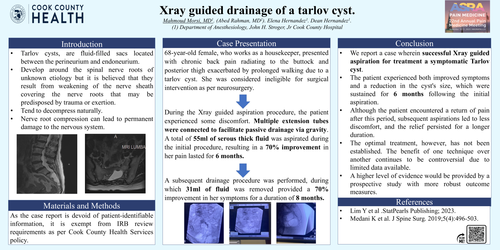
Reviewing her imaging, it was determined that a guided X-ray drainage of her Tarlov cyst would be pursued. During the aspiration procedure, the patient experienced some discomfort. Multiple extension tubes were connected to facilitate passive drainage via gravity. A total of 55ml of serous thick fluid was aspirated during the initial procedure, resulting in a 70% improvement in her pain and symptoms, which lasted for 6 months before sensation returned. A subsequent drainage procedure was performed, during which 31ml of fluid was removed. This provided a 70% improvement in her symptoms for a duration of 8 months.
Materials and Methods: As the case reports are devoid of patient-identifiable information, it is exempt from IRB review requirements as per Cook County Health Services policy.
Discussion: We report a case wherein successful X-ray-guided aspiration was employed to treat a symptomatic Tarlov cyst. The patient experienced both improved symptoms and a reduction in the cyst's size, which were sustained for 6 months following the initial aspiration. Although the patient encountered a return of pain after this period, subsequent aspirations led to less discomfort, and the relief persisted for a longer duration. The choice of treatment for Tarlov cysts hinges on the severity of the symptoms. When the cyst is asymptomatic, a conservative approach involving pain management, physical therapy, and lifestyle adjustments might be recommended. In cases where symptoms are severe and significantly impact the patient's quality of life, more aggressive treatment options could be explored. Surgical intervention may encompass cyst drainage, cyst wall removal, or an attempt to seal the connection between the cyst and the nerve root. However, it's important to acknowledge that surgical procedures to address Tarlov cysts are intricate and come with inherent risks, including potential nerve damage, cerebrospinal fluid leaks, or infections. Consequently, the decision to undergo surgery should be carefully deliberated, considering the potential benefits. The optimal treatment, however, has not been established. The benefit of one technique over another continues to be controversial due to limited data available. A higher level of evidence would be provided by a prospective study with more robust outcome measures.
Reference:
1. Lim Y, Selbi WT. Tarlov Cyst. . In: StatPearls [Internet] Treasure Island (FL): StatPearls Publishing; 2023 Jan. [Updated 2023 Feb 8].
2. Medani K, Lawandy S, Schrot R, Binongo JN, Kim KD, Panchal RR. Surgical management of symptomatic Tarlov cysts: cyst fenestration and nerve root imbrication-a single institutional experience. J Spine Surg. 2019;5(4):496-503.
3. Sahin E, Lee SH, Eun SS. CT-guided percutaneous aspiration of Tarlov cyst: a case report of 2-year follow up. AME Case Rep. 2020;4:11.