425 posters, 1 videos, 9 audios, 8 topics, 53 sessions, 340 authors, 286 institutions
ePostersLive by SciGen Technologies S.A. All rights reserved.
22nd Annual Pain Medicine Meeting 2023
November 10 - 11, 2023 | New Orleans Marriott | New Orleans, Louisiana, USA

4675
STELLATE GANGLION BLOCK IN A CIVILIAN WITH POST-TRAUMATIC STRESS DISORDER : A SUCCESSFUL CASE REPORT
Poster Presenter
Authors
Affiliations
Part of Topic
Chronic Pain
Stellate ganglion block in a civilian with post- traumatic stress disorder : a successful case report
Ken-Yi Lui, Philip Peng
Department of Anesthesia and Pain Medicine, Toronto Western Hospital, University Health Network.
Introduction :
Post-traumatic stress disorder (PTSD) is a chronic disabling psychiatric disorder that develop following exposure to a traumatic incident. The incidence of PTSD in military settings in U.S.ranged from 4.5% to 9.3%, depending on the exposure to combat. The incidence of PTSD in the general population is approximately 3.6%.
The pathophysiology of PTSD is postulated to be related to the hypo-responsive hypothalamic-pituitary-adrenal axis and hyper-responsive catecholamine system, with high norepinephrine, epinephrine levels but low cortisol levels. In view of these mechanisms, stellate ganglion block (SGB) have been described for the management of PTSD.
While the efficacy of SGB in PTSD has been well described in millitary population, the use of this in civillian is scant. Furthermore, the improvment is rarely documented with validated questionnaire. This report describes the effectiveness of SGB for the management of PTSD in a civilian patient documented by a validated questionnaire the PTSD Checklist for DSM-5 (PCL-5). This report adheres to the applicable EQUATOR guideline.
Materials & methods :
As the case report is devoid of patient identifiable information, it is exempt from IRB review requirements as per University Health Network (UHN) policy. Written consent was obtained from the patient.
Case description :
A 43-year-old gentleman with a history of PTSD stemmed from childhood sexual abuse. No one knew of the abuse until he attempted suicide. With the help of his psychotherapist, he was able to return to school. When entering adulthood, the patient unfortunately became the target of psychological and physical harassment by a coworker. He thereafter underwent intensive psychotherapy , which resulted in significant improvement. He subsequently worked as an aircraft engineer, when he got assaulted at work, resulting in re-aggravation of his PTSD. He was also diagnosed with right upper limb complex regional pain syndrome following a head-on collision in the summer of 2018.
He was evaluated by a psychiatrist with the following diagnosis according: PTSD with dissociative symptoms, depersonalization and derealization; major depressive disorder, recurrent and severe. He was started on: duloxetine 90 mg daily, venlafaxine 40 mg daily, fluoxetine 40 mg daily and nabilone 4mg daily.
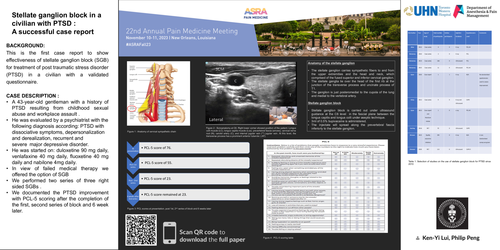
The psychiatrist referred him to us because of the poor control of symptoms despite pharmacological therapy. We performed two series of three right sided SGBs . The first series of three was performed on a weekly basis. The right SGB was performed under aseptic technique with ultrasound guidance at the level of C6 in the fascial plane between the longus capitis and longus colli. The injectate consisted of 3 ml of bupivacaine 0.5%. The patient developed Horner’s syndrome following each procedure. In the fourth week follow-up after the third SGB, the patient reported that his PTSD symptoms had significantly improved.
We documented the PTSD improvement with PCL-5, which is a 20-item self-report measure that assesses the 20 symptoms of PTSD according to DSM-5. The PCL-5 has a variety of purposes, including monitoring symptom change during and after treatment and screening individuals for PTSD. The self-report rating scale ranges from 0 to 4 for each symptom. Summing all 20 items (range 0-80), literature suggests that a total score of 31-33 or higher meets the criteria for PTSD.
The pre-procedural PCL-5 score of 76 dropped to 55 after the first series of SGB. He reported that his hypervigilance has significantly improved. Due to the good response, we were encouraged to complete the series with another 3 more SGB (our practice was to perform a series of 6 SGB but the fourth to sixth blocks were contingent on positive response of the first three blocks). Post-procedure PCL-5 score at four weeks after the second series was 23 and he reported an overall and significant improvement in his quality of life and the improvement was sustained at the last 6-month follow up.
Discussion
To our knowledge, this is the first case report to show effectiveness of SGB for treatment of PTSD symptoms in a civilian documented by a validated questionnaire to account for clinical improvement. Lipov et al. described a 48-year-old male victim of armed robbery who developed PTSD symptoms and underwent a right-sided C6 SGB with 7 mL of 0.5% bupivacaine. They reported improvement in his symptoms for 32 days. When his symptoms returned, he underwent a pulsed radiofrequency ablation of the right stellate ganglion, which resulted in 90% improvement at a 3-month follow-up visit. Unfortunately, this study did not report the use of a recognized validated questionnaire to gauge the improvement of symptoms while PTSD affects different dimensions of the individual’s affect and well-being.
In contrast, the efficacy of SGB in the treatment of PTSD in the military personnel is well supported by case reports, case series and randomized controlled trials. In 2014 Mulvaney et al published a large case series that examined 166 active-duty service members with PTSD over a 6-month period. All 166 patients received a right- sided C6 SGB, with more than 70% showing clinically significant improvement in a PTSD symptom checklist.
Olmested et al conducted a multi-center, blinded, sham-procedure, randomized controlled trial using a 2:1 SGB:sham ratio in 3 US Army Interdisciplinary Pain Management Centers. A total of 113 active-duty service members who had a PTSD Checklist–Civilian Version (PCL-C) score of 32 or more at screening were included. The patients were randomized into the SBG group (74 patients) and in the sham-procedure group (39 patients). The adjusted mean symptom change was −12.6 points for the group receiving stellate ganglion blocks, compared with −6.1 points for those receiving sham treatment, which was described as a significant difference. Unfortunately, no civilians were included.
Good clinical care requires a reliable assessment tool to monitor the progress. In PTSD, PCL-5 is a well-recognized tool for such purpose. This case report serves to stimulate the interest of intervention specialist to management patients with PTSD with poor response to medications. More research is needed to determine the efficacy of SGB in the overall treatment algorithm of PTSD, the optimal frequency of SGB and the timing of intervention.