425 posters, 1 videos, 9 audios, 8 topics, 53 sessions, 340 authors, 286 institutions
ePostersLive by SciGen Technologies S.A. All rights reserved.
22nd Annual Pain Medicine Meeting 2023
November 10 - 11, 2023 | New Orleans Marriott | New Orleans, Louisiana, USA

5023
BERTOLOTTI SYNDROME, PAIN MANAGEMENT AND ANESTHETIC CONSIDERATIONS
Poster Presenter
Authors
Affiliations
Part of Topic
Chronic Pain
Introduction
Non-specific low back pain has a vast array of etiologies. A rare causes is Bertolotti Syndrome.
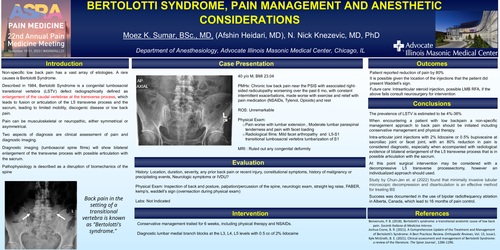
Described in 1984, Bertolotti Syndrome is a congenital lumbosacral transitional vertebra (LSTV) defect radiographically defined as enlargement of the caudal vertebrae at the transverse process, which leads to fusion or articulation of the L5 transverse process and the sacrum, leading to limited mobility, discogenic disease or low back pain.
Pain can be musculoskeletal or neuropathic, either symmetrical or asymmetrical.
Two aspects of diagnosis are clinical assessment of pain and diagnostic imaging.
Diagnostic imaging (lumbosacral spine films) will show bilateral enlargement of the transverse process with possible articulation with the sacrum.
Pathophysiology is described as a disruption of biomechanics of the spine
Back pain in the setting of a transitional vertebra is known as "Bertolotti's
syndrome."
Case Presentation
40 y/o M, BMI 23.04
PMHx: Chronic low back pain near the PSIS with associated right- sided radiculopathy worsening over the past 6 mo, with constant intermittent exacerbations, made worse with exercise and relief with pain medication (NSAIDs, Tylenol, Opioids) and rest
ROS: Unremarkable Physical Exam:
oPain worse with lumbar extension , Moderate lumbar paraspinal tenderness and pain with facet loading
oRadiological films: Mild facet arthropathy and L5-S1 transitional lumbosacral vertebra lumbarization of S1
MRI : Ruled out any congenital deformity
Evaluation
History: Location, duration, severity, any prior back pain or recent injury, constitutional symptoms, history of malignancy or precipitating events, Neurologic symptoms or IVDU?
Physical Exam: Inspection of back and posture, palpation/percussion of the spine, neurologic exam, straight leg raise, FABER, kemp’s, waddell’s sign (overreaction during physical exam)
Labs: Not Indicated
Intervention
Conservative management trailed for 6 weeks, including physical therapy and NSAIDs.
Diagnostic lumbar medial branch blocks at the L3, L4, L5 levels with 0.5 cc of 2% lidocaine
Outcomes
Patient reported reduction of pain by 80%
It is possible given the location of the injections that the patient did present Waddell’s sign.
Future care: Intraarticular steroid injection, possible LMB RFA, if the above fails consult neurosurgery for intervention
Conclusions
The prevalence of LSTV is estimated to be 4%-36%
When encountering a patient with low backpain a non-specific management approach to back pain should be initiated including conservative management and physical therapy.
Intra-articular joint injections with 2% lidocaine or 0.5% bupivacaine at sacroiliac joint or facet joint, with an 80% reduction in pain is considered diagnostic, especially when accompanied with radiological evidence of bilateral enlargement of the L5 transverse process that is in possible articulation with the sacrum.
At this point surgical intervention may be considered with a decompressive L5 transverse processectomy, however an individualized approach should used.
Study by Chun-Jen et. al (2022) found that minimally invasive tubular microscopic decompression and disarticulation is an effective method for treating BS
Success was documented in the use of bipolar radiofrequency ablation in Alberta, Canada, which lead to 16 months of pain control.
References
Benvenuto, P. B. (2018). Bertolotti’s syndrome: a transitional anatomic cause of low back pain. Società Italiana di Medicina Interna.
Joshua Crane, B. R. (2021). A Comprehensive Update of the Treatment and Management of Bertolotti’s Syndrome: A Best Practices Review. Orthopedic Reviews, Vol. 13, Issue1.
Kyle McGrath, B. E. (2021). Clinical assessment and management of Bertolotti Syndrome: a review of the literature. The Spine Journal , 1286-1296.