425 posters, 1 videos, 9 audios, 8 topics, 53 sessions, 340 authors, 286 institutions
ePostersLive by SciGen Technologies S.A. All rights reserved.
22nd Annual Pain Medicine Meeting 2023
November 10 - 11, 2023 | New Orleans Marriott | New Orleans, Louisiana, USA

4618
BOTULINUM TOXIN INJECTION FOR THE TREATMENT OF PECTORALIS MINOR SYNDROME
Poster Presenter
Authors
Affiliations
Part of Topic
Chronic Pain
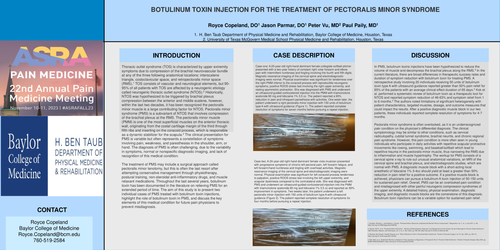
Thoracic outlet syndrome (TOS) is characterized by upper extremity symptoms due to compression of the brachial neurovascular bundle at any of the three following anatomical locations: interscalene triangle, costoclavicular space, and retropectoralis minor space (RMS).1 TOS consists of vascular and neurological elements, but 90-95% of all patients with TOS are affected by a neurogenic etiology called neurogenic thoracic outlet syndrome (NTOS).2 Historically, NTOS was hypothesized to be triggered by brachial plexus compression between the anterior and middle scalene, however, within the last two decades, it has been recognized the pectoralis minor muscle is a large contributing factor for NTOS. Pectoralis minor syndrome (PMS) is a subvariant of NTOS that involves compression of the brachial plexus at the RMS. The pectoralis minor muscle (PMM) is one of the most superficial muscles on the anterior thoracic wall, originating from the costal cartilage margin of the third through fifth ribs and inserting on the coracoid process, which is responsible as a dynamic stabilizer for the scapula.2 The clinical presentation for PMS is variable but often represents a constellation of symptoms involving pain, weakness, and paresthesias in the shoulder, arm, or hand. The diagnosis of PMS is often challenging, due to the variability in symptoms, normal or nonspecific diagnostic imaging, and lack of recognition of this medical condition.
The treatment of PMS may include a surgical approach called pectoralis minor tenotomy, but this is often the last resort after attempting conservative management through physiotherapy, postural training, non-steroidal anti-inflammatory drugs, and muscle relaxant medications. Throughout the last several years, botulinum toxin has been documented in the literature on relieving PMS for an extended period of time. The aim of this study is to present two individual cases of PMS treated with botulinum toxin injections, highlight the role of botulinum toxin in PMS, and discuss the key elements of this medical condition for future pain physicians to prevent misdiagnosis.
Case one: A 20-year-old right-hand dominant female collegiate softball pitcher presented with a two-year history of constant right volar forearm and elbow pain with intermittent numbness and tingling involving the fourth and fifth digits. Magnetic resonance imaging of the cervical spine and electrodiagnostic imaging were normal. Physical examination was significant for tenderness over the right PMM inferior to the coracoid process with reproducible neurogenic symptoms, positive ROOS stress test involving the right upper extremity, and resting asymmetric protraction. She was diagnosed with PMS and underwent an ultrasound-guided corticosteroid injection into the PMM with triamcinolone acetonide 60 mg and lidocaine 1% 3.5 cc. The patient reported a 90% reduction in pain and infrequent paresthesia with activities. One week later, the patient underwent a right pectoralis minor injection with 150 units of botulinum type A with ultrasound guidance (Figure 1). The patient reported complete resolution of symptoms for 7 months before pursuing a repeat injection.
Case 2: A 24-year-old right-hand dominant female viola musician presented with progressive symptoms of chronic left pectoral pain, left forearm fatigue, and left forearm/hand numbness and tingling with overhead activities. Magnetic resonance imaging of the cervical spine and electrodiagnostic imaging were normal. Physical examination was significant for left coracoid process tenderness to palpation, positive ROOS stress test involving the left upper extremity, and scapular dyskinesia compared to the contralateral side. She was diagnosed with PMS and underwent an ultrasound-guided corticosteroid injection into the PMM with triamcinolone acetonide 60 mg and lidocaine 1% 3.5 cc and reported an 80% improvement in symptoms. Two weeks later, the patient underwent a left pectoralis minor injection with 150 units of botulinum type A with ultrasound guidance (Figure 2). The patient reported complete resolution of symptoms for 4 months before pursuing a repeat injection.
In PMS, botulinum toxins injections have been hypothesized to reduce the volume of muscle and decompress the brachial plexus along the RMS.3 In the current literature, there are broad differences in therapeutic success rates and duration of symptom reduction with botulinum toxin for treating PMS. A retrospective study involving 20 individuals receiving 50 units of botulinum toxin type A with ultrasound guidance reported greater than 50% pain relief for 85% of the patients with an average clinical effect duration of 65 days.3 Kok et al. performed a systematic review of botulinum toxin as a therapeutic tool for NTOS and reported symptom reduction of 46-63% and symptom relief from 1 to 6 months.4 The authors noted limitations of significant heterogeneity with patient characteristics, targeted muscles, dosage, and outcome measures that could impact the results. After a positive diagnostic muscle block in our two patients, these individuals reported complete resolution of symptoms for 4-7 months.
Pectoralis minor syndrome is often overlooked, as it is underrecognized pain condition on the physician’s differential diagnosis. The clinical symptomology may be similar to other conditions such as cervical radiculopathy, cubital tunnel syndrome, brachial neuritis, and chronic regional pain syndrome. However, this pain condition is more often seen in young individuals who participate in daily activities with repetitive scapular protractive movements like rowing, swimming, and baseball/softball which lead to repetitive trauma in the pectoralis minor muscle, thus narrowing the RMS due to inflammation and muscle hypertrophy. The workup for PMS consists of a cervical spine x-ray to rule out unusual anatomical variations, an MRI of the cervical spine and brachial plexus, and electrodiagnostic studies, which are normal with PMS. A diagnostic muscle block with a short-acting local anesthetic of lidocaine 1% 3-4cc should yield at least a greater than 50% reduction in pain relief for a positive outcome. If a positive muscle block is achieved, physicians can pursue a botulinum A toxin injection of 50-150 units for sustained pain relief. Overall, PMS can be an overlooked pain condition and misdiagnosed with other painful neurogenic compression syndromes of the upper extremity. A detailed history, physical examination, diagnostic imaging, and diagnostic muscle blocks are the cornerstone of this diagnosis. Botulinum toxin injections can be a variable option for sustained pain relief.
1. Sanders, Richard J., and Stephen J. Annest. “Pectoralis Minor Syndrome: Subclavicular Brachial Plexus Compression.” Diagnostics, vol. 7, no. 3, July 2017, p. 46, https://doi.org/10.3390/diagnostics7030046.
2. Ahmed, Adil S., et al. “Pectoralis Minor Syndrome – Review of Pathoanatomy, Diagnosis, and Management of the Primary Cause of Neurogenic Thoracic Outlet Syndrome.” JSES Reviews, Reports, and Techniques, vol. 2, no. 4, Nov. 2022, pp. 469–88, https://doi.org/10.1016/j.xrrt.2022.05.008.
3. Martinez Del Carmen, Dorelly Tanayra, et al. “Role of Botulinum Toxin in Pectoralis Minor Syndrome.” Annals of Vascular Surgery, vol. 81, Apr. 2022, pp. 225–31, https://doi.org/10.1016/j.avsg.2021.09.032.
4. Kök, Mert, et al. “Systematic Review on Botulinum Toxin Injections as Diagnostic or Therapeutic Tool in Thoracic Outlet Syndrome.” Annals of Vascular Surgery, May 2023, pp. S0890-5096(23)00268-6, https://doi.org/10.1016/j.avsg.2023.05.009.