425 posters, 1 videos, 9 audios, 8 topics, 53 sessions, 340 authors, 286 institutions
ePostersLive by SciGen Technologies S.A. All rights reserved.
22nd Annual Pain Medicine Meeting 2023
November 10 - 11, 2023 | New Orleans Marriott | New Orleans, Louisiana, USA

4820
BILATERAL S3 DORSAL ROOT GANGLION STIMULATION FOR PHANTOM BLADDER AND PELVIC PAIN POST-CYSTECTOMY
Poster Presenter
Authors
Affiliations
Part of Topic
Chronic Pain
Bilateral S3 Dorsal Root Ganglion Stimulation for Phantom Bladder and Pelvic Pain Post-Cystectomy
Joe Ghorayeb, DC, MHA; Anishinder Parkash, MD; Michael Glicksman, MD; Gaurav Chauhan, MD; Suresh Srinivasan, MD
University of Medicine and Health Sciences; Tower Health Reading Hospital/Drexel University COM; University of Pittsburgh Medical Center; Trinity Health System
Introduction
Chronic perineal pain is a disabling syndrome and may occur after surgical intervention or trauma in the perineal area. Chronic postsurgical perineal pain (CPSPP) is defined as pain arising after a surgical procedure, present for at least 2 months [1].
The incidence of CPSPP is reported to be up to 38% [2,3].
We present a patient suffering from chronic postsurgical perineal pain treated with third sacral nerve root/dorsal root ganglion stimulation (3rd SNR/DRG-S) using the transforaminal approach.
Case Description
A 46-year-old man underwent a renal transplant and radical cystectomy for recurrent kidney infections and transitional cell carcinoma of the urinary bladder.
Post-transplant, the patient was on mycophenolate mofetil 50mg oral capsules 3 times daily and tacrolimus 1mg 3 times daily for immunosuppression.
The patient continued to report symptoms consistent with bladder urgency with associated tingling and numbing paresthesia and leg pain in the infraumbilical region radiating to the groin.
Relevant imaging failed to report any significant pathology and the patient was diagnosed with phantom bladder pain associated with chronic pelvic pain.
Two months after the surgery, the patient continued to report 1-3 painful episodes per month and was maintained on amitriptyline 50 mg and pregabalin 100 mg twice daily.
The patient developed suicidal ideation on amitriptyline and significant fatigue on pregabalin. These medications were discontinued.
The patient then reported worsening of symptom frequency to 1 episode per day after discontinuing the antineuropathic pain medications.
The patient presented to our clinic with refractory perineal pain.
Lumbar sympathetic block and ganglion impar block were unsuccessful.
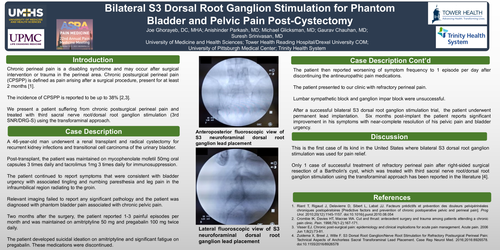
After a successful bilateral S3 dorsal root ganglion stimulation trial, the patient underwent permanent lead implantation. Six months post-implant the patient reports significant improvement in his symptoms with near-complete resolution of his pelvic pain and bladder urgency.
Discussion
This is the first case of its kind in the United States where bilateral S3 dorsal root ganglion stimulation was used for pain relief.
Only 1 case of successful treatment of refractory perineal pain after right-sided surgical resection of a Bartholin's cyst, which was treated with third sacral nerve root/dorsal root ganglion stimulation using the transforaminal approach has been reported in the literature [4].
References
-
Riant T, Rigaud J, Delavierre D, Sibert L, Labat JJ. Facteurs prédictifs et prévention des douleurs pelvipérinéales chroniques postopératoires [Predictive factors and prevention of chronic postoperative pelvic and perineal pain]. Prog Urol. 2010;20(12):1145-1157. doi:10.1016/j.purol.2010.08.054
-
Crombie IK, Davies HT, Macrae WA. Cut and thrust: antecedent surgery and trauma among patients attending a chronic pain clinic. Pain. 1998;76(1-2):167-171.
-
Visser EJ. Chronic post-surgical pain: epidemiology and clinical implications for acute pain management. Acute pain. 2006 Jun 1;8(2):73-81.
-
Zuidema X, Breel J, Wille F. S3 Dorsal Root Ganglion/Nerve Root Stimulation for Refractory Postsurgical Perineal Pain: Technical Aspects of Anchorless Sacral Transforaminal Lead Placement. Case Rep Neurol Med. 2016;2016:8926578. doi:10.1155/2016/8926578