425 posters, 1 videos, 9 audios, 8 topics, 53 sessions, 340 authors, 286 institutions
ePostersLive by SciGen Technologies S.A. All rights reserved.
22nd Annual Pain Medicine Meeting 2023
November 10 - 11, 2023 | New Orleans Marriott | New Orleans, Louisiana, USA

4920
ERECTOR SPINAE PLANE BLOCK VERSUS QUADRATUS LUMBORUM BLOCK FOR OPEN ABDOMINAL SURGERIES: A RETROSPECTIVE STUDY
Poster Presenter
Authors
Affiliations
Part of Topic
Regional Anesthesia
ERECTOR SPINAE PLANE BLOCK VERSUS QUADRATUS LUMBORUM BLOCK FOR OPEN ABDOMINAL SURGERIES: A RETROSPECTIVE STUDY
Emily Peng, BS,1,2 Joshua Yuan, MD,1,2 Wana Mathieu, MD,2 Nirav Patil, MBBS, MPH,1 Mart Maravillas, MS,1 Xueqin Ding, MD, PhD1
1University Hospitals Cleveland Medical Center, Cleveland, OH
2Case Western Reserve University, School of Medicine, Cleveland, OH
Introduction
-
Post-operative pain management for abdominal surgeries continues to be a challenge.
-
Inadequately treated abdominal pain can lead to detrimental physiological effects and may also have psychological, economic, and social adverse effects1.
-
Effective pain relief is a powerful technique to modify surgical stress responses, thereby leading to an improved outcome.
-
The utilization of regional anesthetic techniques including truncal fascial plane blocks has been shown to reduce postoperative pain and opioid requirements, which in turn decreases complications2.
-
While there is widespread use of quadratus lumborum blocks (QLB) for abdominal surgery, erector spinae plane block (ESPB) has recently become popular in its usage; however, there is a lack of published studies comparing the two techniques for open abdominal surgeries.
The objective of this study is to compare the analgesic effects of ESPB and WLB in adult open abdominal surgical cases by analyzing retrospective data from a single institution.
Methods
-
Patients aged 18 to 65 years with ASA scores of I-III scheduled for elective open abdominal surgery from 2021-2022 were included in the study.
-
Patients on chronic opioid medications at home were excluded.
-
Patients were divided into two groups: QLB and ESPB.
-
All blocks and catheter placements were done preoperatively with ultrasound guidance.
-
Both groups received 30ml of 0.5% bupivacaine before catheter placement.
-
Continuous variables are compared using independent t-test or Wilcoxon Mann-Whitney test.
-
An additional relationship between intra-op overall opioid use (morphine equivalents) and type of anesthesia is explored using linear regression analysis after including sex, ASA class, and surgery time as covariates.
Results
-
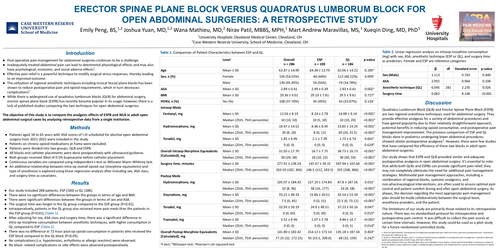
Our study included 288 patients, ESP (100) vs QL (188).
-
There were no significant differences between the groups in terms of age and BMI.
-
There were significant differences between the groups in terms of sex and ASA.
-
The surgical time was longer in the QL group compared to the ESP group (P<0.01).
-
Intraoperatively, patients in the QL group also received more pain meds than the patients in the ESP group (P<0.01) (Table 1).
-
After adjusting for sex, ASA class and surgery time, there was a significant difference in intra-op morphine consumption between anesthetic techniques, with higher consumption in QL compared to ESP (Table 2).
-
There was no difference in 72-hour post-op opioid consumption in patients who received the ESP block compared to the QL block (P>0.05).
-
No complications (i.e. hypotension, arrhythmia or allergic reaction) were observed.
-
No block- related complications or side effects were observed postoperatively.
Discussion
Quadratus Lumborum Block (QLB) and Erector Spinae Plane Block (ESPB) are two regional anesthesia techniques used for abdominal surgery. They provide effective analgesia for a variety of abdominal procedures and have gained popularity due to their relatively straightforward approach, potential benefits in reducing opioid consumption, and postoperative pain management improvement. The previous comparison of ESP and QL blocks done in pediatrics undergoing lower abdominal procedures showed similar postoperative analgesia3. However, there were few studies that have compared the efficiency of these two blocks in adult open abdominal surgeries.
Our study shows that ESPB and QLB provided similar and adequate postoperative analgesia in open abdominal surgery. It's essential to note that while both QLBs and ESPBs can provide significant pain relief, they may not completely eliminate the need for additional pain management strategies. Multimodal pain management approaches, including a combination of regional blocks, systemic analgesics, and non-pharmacological interventions, are often used to ensure optimal pain control and patient comfort during and after open abdominal surgery. As always, the decision regarding the most appropriate pain management plan should be made collaboratively between the surgical team, anesthesia providers, and the patient.
The limitations of our study are primarily those related to its retrospective nature. There was no standardized protocol for intraoperative and postoperative pain control. It was difficult to collect the pain scores at certain time intervals. However, this study could be used as a pilot study for a future randomized controlled study.