425 posters, 1 videos, 9 audios, 8 topics, 53 sessions, 340 authors, 286 institutions
ePostersLive by SciGen Technologies S.A. All rights reserved.
22nd Annual Pain Medicine Meeting 2023
November 10 - 11, 2023 | New Orleans Marriott | New Orleans, Louisiana, USA

4699
LUMBAR SYMPATHETIC NERVE BLOCKS FOR CANCER-RELATED BONE PAIN: A CASE SERIES
Poster Presenter
Authors
Affiliations
Part of Topic
Regional Anesthesia
Video
Audio
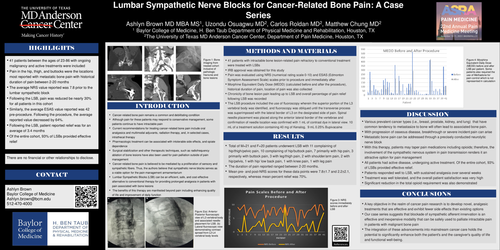
Ashlyn Brown Baylor College of Medicine Ashlyn.brown@bcm.edu 512-470-4000 Lumbar Sympathetic Nerve Blocks for Cancer-Related Bone Pain: A Case Series RRR Ashlyn Brown MD MBA MS1 , Uzondu Osuagwu MD2 , Carlos Roldan MD2 , Matthew Chung MD2 1 Baylor College of Medicine, H. Ben Taub Department of Physical Medicine and Rehabilitation, Houston, TX 2The University of Texas MD Anderson Cancer Center, Department of Pain Medicine, Houston, TX • Total of M=21 and F=20 patients underwent LSB with 11 complaining of hip/thigh/pelvic pain, 10 complaining of hip/buttock pain, 7 primarily with hip pain, 3 primarily with buttock pain, 3 with leg/thigh pain, 2 with shoulder/arm pain, 2 with hip/pelvis, 1 with hip/ low back pain, 1 with knee pain, 1 with leg pain • The duration of pain reported ranged between 2-20 months. • Mean pre- and post-NRS scores for these data points were 7.8±1.7 and 2.2±2.1, respectively, whereas mean percent relief was 70%. • Various prevalent cancer types (i.e., breast, prostate, kidney, and lung) that have common tendency to metastasize to bone will often lead to associated bone pain. • With progression of osseous disease, breakthrough or severe incident pain can arise • Metastatic bone pain can be addressed through a precisely conducted neurolytic nerve block • With this therapy, patients may taper pain medications including opioids; therefore, the involvement of the sympathetic nervous system in pain transmission renders it an attractive option for pain management • All patients had active disease, undergoing active treatment. Of the entire cohort, 93% of LSBs provided effective relief. • Patients responded well to LSB, with sustained analgesia over several weeks • Treatment was well tolerated, and the overall patient satisfaction was very high • Significant reduction in the total opioid requirement was also demonstrated • 41 patients with intractable bone lesion-related pain refractory to conventional treatment were treated with LSBs • IRB approval was obtained for this study • Pain was evaluated using NRS (numerical rating scale 0-10) and ESAS (Edmonton Symptom Assessment Scale) scales prior to procedure and immediately after • Morphine Equivalent Daily Dose (MEDD) (calculated before and after the procedure), historical duration of pain, location of pain was also collected • Chronicity of bone lesion pain leading up to LSB and overall percentage of pain relief following LSB was recorded • The LSB procedure included the use of fluoroscopy wherein the superior portion of the L3 vertebral body was identified, and fluoroscopy was obliqued until the transverse process was superimposed with the lateral border of L3 on the designated side of pain. Spinal needle placement was placed along the anterior lateral border of the vertebrae and confirmation of needle location was confirmed with 1 mL of contrast dye in lateral view. 10 mL of a treatment solution containing 40 mg of Kenalog, 9 mL 0.25% Bupivacaine • A key objective in the realm of cancer pain research is to develop novel, analgesic treatments that are effective and exhibit fewer side effects than existing options • Our case series suggests that blockade of sympathetic afferent innervation is an effective and inexpensive modality that can be safely used to palliate intractable pain in patients with malignant bone pain • The integration of these advancements into mainstream cancer care holds the potential to significantly enhance both the patient's and the caregiver's quality of life and functional well-being. • Cancer-related bone pain remains a common and debilitating condition • Although pain for these patients may respond to conservative management, some patients continue to have intractable pain • Current recommendations for treating cancer-related bone pain include oral analgesics and multimodal adjuvants, radiation therapy, and, in selected cases, intrathecal therapy • Pharmacologic treatment can be associated with intolerable side effects, and opiate dependence • Surgical stabilization and other therapeutic techniques, such as radiofrequency ablation of bone lesions have also been used for pain palliation outside of pain management • Cancer-related bone pain is believed to be mediated by a proliferation of sensory and sympathetic fibers. Thus, the authors believe that sympathetic nerve blocks serves as a viable option for the pain management armamentarium • Lumbar Sympathetic Blocks (LSB) can be an efficient, safe, and cost-effective alternative to conventional therapy for providing prolonged analgesia in patients with pain associated with bone lesions • The benefits of this therapy are manifested beyond pain including enhancing quality of life and improvement of daily function INTRODUCTION METHODS AND MATERIALS CONCLUSIONS DISCUSSION RESULTS CONTACT • 41 patients between the ages of 23-86 with ongoing malignancy and active treatments were included • Pain in the hip, thigh, and buttocks were the locations most reported with metastatic bone pain with historical duration of pain between 2-20 months • The average NRS value reported was 7.8 prior to the lumbar sympathetic block • Following the LSB, pain was reduced be nearly 30% for all patients in this cohort • Similarly, the average ESAS value reported was 42 pre-procedure. Following the procedure, the average reported value decreased by 64%. • Following the LSB, patient reported relief was for an average of 3.4 months • Of the entire cohort, 93% of LSBs provided effective relief HIGHLIGHTS Figure 2(a): Anterior Posterior fluoroscopic view of L3 vertebral body and associated needle placement for LSB. (b) Lateral fluoroscopic view demonstrating contrast spread from L2-L4 vertebral body levels Figure 3: NRS scores immediately before and after LSB Figure 4: Morphine Equivalent Daily Dose (MEDD) before and after LSB per patient. Some patients also required the use of Methadone for pain control which is not represented in calculation Figure 1: Bone imaging from treated cohort inclusive of pathologic fractures and bone lesions There are no financial or other relationships to disclose.