425 posters, 1 videos, 9 audios, 8 topics, 53 sessions, 340 authors, 286 institutions
ePostersLive by SciGen Technologies S.A. All rights reserved.
22nd Annual Pain Medicine Meeting 2023
November 10 - 11, 2023 | New Orleans Marriott | New Orleans, Louisiana, USA

4543
A STRETCHABLE WIRELESS WEARABLE SENSOR FOR REAL-TIME DETECTION OF IMPROPER ROWING FORM TO REDUCE LUMBAR INJURY
Poster Presenter
Authors
Affiliations
Part of Topic
Emerging Technology
A Stretchable Wireless Wearable Sensor for Real-Time Detection of Improper Rowing Form to Reduce Lumbar Injury
William Qian 1 , QiLiang Chen 2 , Kyun Kyu Kim1 , Zhenan Bao 1
1: Stanford Chemical Engineering 2: Stanford Department of Anesthesiology, Perioperative and Pain Medicine
Stanford Chemical Engineering
Introduction
Low back pain is a prevalent condition that affects a significant portion of the population, posing challenges to both patients and healthcare providers. Significant efforts have been invested to prevent spine injury and minimize the impact of back pain among the general population and athletes. Protective physical therapy maneuvers and posture correction are especially important for those who engage in activities or sports that are at high risk of back injury. One such sport is rowing. Rowing is a physically demanding and highly competitive sport that places significant strain on the rower's spine. The repetitive nature of rowing movements, intense pressure on the lumbar region, and the necessity to maintain proper form for peak performance expose athletes to back pain and injuries. This predisposition to back injury can also lead to long-term health issues if not addressed early and adequately. For data capturing, the sensor was integrated into a harness that securely attaches to the rower's thoracic back to detect changes in strain and curvature along the spine. A vibration mechanism would be activated when the strain gauge identifies deviations in the rower's form that might lead to potential injuries or inefficient strokes. This vibration system aims to serve as a timely alert to the rower, prompting them to make immediate corrections, thereby mitigating the risk of injuries.
Materials, Methods, and Design
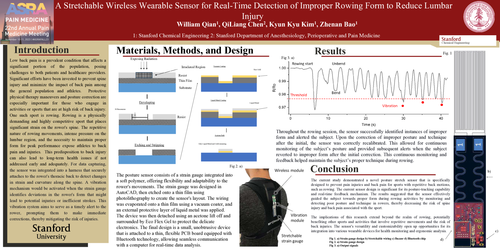
The posture sensor consists of a strain gauge integrated into a soft polymer, offering flexibility and adaptability to the rower's movements. The strain gauge was designed in AutoCAD, then etched onto a thin film using photolithography to create the sensor's layout. The wiring was evaporated onto a thin film using a vacuum coater, and an external protective layer of liquid metal was applied. The device was then detached using an acetone lift off and surrounded by Eco Flex Gel to protect the delicate electronics. The final design is a small, unobtrusive device that is attached to a thin, flexible PCB board equipped with Bluetooth technology, allowing seamless communication with a computer for real-time data analysis.
Results
Output signals Throughout the rowing session, the sensor successfully identified instances of improper form and alerted the subject. Upon the correction of improper posture and technique after the initial, the sensor was correctly recalibrated. This allowed for continuous monitoring of the subject’s posture and provided subsequent alerts when the subject reverted to improper form after the initial correction. This continuous monitoring and feedback helped maintain the subject’s proper technique during rowing. Conclusion
The current study demonstrated a novel posture stretch sensor that is specifically designed to prevent pain injuries and back pain for sports with repetitive back motions, such as rowing. The current sensor design is significant for its posture-tracking capability and real-time feedback mechanism. The results suggested that the sensor effectively guided the subject towards proper form during rowing activities by monitoring and detecting poor posture and technique in rowers, thereby decreasing the risk of spine injury and back pain associated with the sport. The implications of this research extend beyond the realm of rowing, potentially benefiting other sports and activities that involve repetitive movements and the risk of back injuries. The sensor's versatility and customizability open up opportunities for its integration into various wearable devices for health monitoring and ergonomic analysis.
Fig 1. a) Strain gauge design b) Stretchable wiring c) Buzzer d) Bluetooth chip Fig 2. a) Strain gauge design Fig 3. a)