425 posters, 1 videos, 9 audios, 8 topics, 53 sessions, 340 authors, 286 institutions
ePostersLive by SciGen Technologies S.A. All rights reserved.
22nd Annual Pain Medicine Meeting 2023
November 10 - 11, 2023 | New Orleans Marriott | New Orleans, Louisiana, USA

4540
EFFECTIVENESS OF 3D PRINTING IN CUSTOMIZING SPINAL CORD STIMULATOR LEAD PLACEMENT: A SYSTEMATIC REVIEW AND META-ANALYSIS.
Poster Presenter
Authors
Affiliations
Part of Topic
Emerging Technology
Effectiveness of 3D Printing in Customizing Spinal Cord Stimulator Lead Placement: A Systematic Review and Meta-analysis.
Daniel Wang, DO 1,2 George Chang Chien, DO 3
1MedStar Health, Baltimore, MD
2 Georgetown University Medical Center, Washington, District of Columbia
3 Ventura County Medical Center, Ventura, CA
INTRODUCTION
Spinal cord stimulation (SCS) can be an effective therapy for managing many types of pain, including chronic neuropathic pain. As such, customizing the placement of the spinal cord stimulator leads is critical to achieving optimal pain relief outcomes and minimizing complications. 3D printing has emerged as a promising modality to create patient-specific models to aid in individualized lead placement. This study aims to assess the effectiveness of 3D printing in customizing spinal cord stimulator lead placement and its impact on pain relief outcomes and procedural success.
Materials and Methods
A comprehensive literature search was conducted on multiple databases including PubMed, Embase, Scopus, and Web of Science. Relevant studies included 3D printing in customizing SCS lead placement. Studies published from inception up to July 2023 were included. The inclusion criteria encompassed studies that evaluated the use of 3D printing technology for creating patient-specific models for SCS lead placement customization. Case reports, case series, cohort studies, and randomized controlled trials were eligible for inclusion. The main outcome measures included pain relief measures (visual analog scale, numeric rating scale), procedural success rate, and complication rate.
As the systematic review and meta-analysis is devoid of patient-identifiable information, it is exempt from IRB review requirements as per MedStar Health policy.
Results
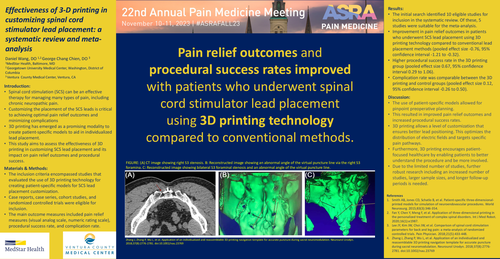
The initial search identified 10 eligible studies for inclusion in the systematic review. Of these, five studies were suitable for the meta-analysis. The pooled analysis indicated an improvement in pain relief outcomes in patients who underwent spinal cord stimulator lead placement using 3D printing technology compared to conventional lead placement methods (pooled effect size -0.76, 95% confidence interval -1.21 to -0.32). Further, there was a higher procedural success rate in the 3D printing group (pooled effect size 0.67, 95% confidence interval 0.29 to 1.06). This indicates increased accuracy in lead positioning and implantation. The complication rate was comparable between the 3D printing and control groups (pooled effect size 0.12, 95% confidence interval -0.26 to 0.50).
Discussion
This study highlights the potential benefits of 3D printing technology in customizing spinal cord stimulator lead placement. The use of patient-specific models allowed for pinpoint preoperative planning. This resulted in improved pain relief outcomes and increased procedural success rates. 3D printing allows a level of customization that ensures better lead positioning. This optimizes the distribution of electric fields and targets specific pain pathways. Furthermore, 3D printing encourages patient-focused healthcare by enabling patients to better understand the procedure and feel more involved in their treatment decision-making process. The complication rate was similar between the 3D printing and control groups. Due to the limited number of studies, further robust research including an increased number of studies, larger sample sizes, and longer follow-up periods is needed. This would aid in confirming the safety and efficacy of 3D printing technology in SCS lead placement customization.
References
- Smith AB, Jones CD, Schatlo B, et al. Patient-specific three-dimensional-printed models for simulation of neuroendovascular procedures. World Neurosurg. 2015;83(3):346-354.
- Fan Y, Chen Y, Meng F, et al. Application of three-dimensional printing in the personalized treatment of complex spinal disorders. Int J Med Robot. 2020;16(1):e1987.
- Lee JY, Kim JW, Choi JW, et al. Comparison of spinal cord stimulation parameters for back and leg pain: a meta-analysis of randomized controlled trials. Pain Physician. 2018;21(5):433-448.
- Zhang J, Zhang P, Wu L, et al. Application of an individualized and reassemblable 3D printing navigation template for accurate puncture during sacral neuromodulation. Neurourol Urodyn. 2018;37(8):2776-2781. doi:10.1002/nau.23769