425 posters, 1 videos, 9 audios, 8 topics, 53 sessions, 340 authors, 286 institutions
ePostersLive by SciGen Technologies S.A. All rights reserved.
22nd Annual Pain Medicine Meeting 2023
November 10 - 11, 2023 | New Orleans Marriott | New Orleans, Louisiana, USA

4857
SYMPTOMATIC IMPROVEMENT OF CHRONIC NEUROPATHIC PAIN AFTER ULNAR NERVE HYDRODISSECTION: A CASE REPORT
Poster Presenter
Authors
Affiliations
Part of Topic
Chronic Pain
Title: Symptomatic Improvement of Chronic Neuropathic Pain after Ulnar Nerve Hydrodissection: A Case Report
Faraz Jamal DO, Craig Van Dien MD, Lei Lin MD, Michael Galibov, Michael Chung MD
Case:
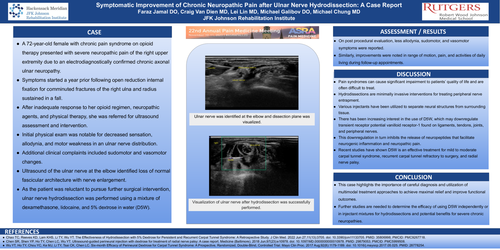
A 72-year-old female with chronic pain syndrome on opioid therapy presented with severe neuropathic pain of the right upper extremity due to an electrodiagnostically confirmed chronic axonal ulnar neuropathy. Symptoms started a year prior following open reduction internal fixation for comminuted fractures of the right ulna and radius sustained in a fall. After inadequate response to her opioid regimen, neuropathic agents, and physical therapy, she was referred for ultrasound assessment and intervention. Initial physical exam was notable for decreased sensation, allodynia, and motor weakness in an ulnar nerve distribution. Additional clinical complaints included sudomotor and vasomotor changes. Ultrasound of the ulnar nerve at the elbow identified loss of normal fascicular architecture with nerve enlargement. As the patient was reluctant to pursue further surgical intervention, ulnar nerve hydrodissection was performed using a mixture of dexamethasone, lidocaine, and 5% dextrose in water (D5W).
Assesment/Results:
On post procedural evaluation, less allodynia, sudomotor, and vasomotor symptoms were reported. Similarly, improvements were noted in range of motion, pain, and activities of daily living during follow-up appointments.
Discussion:
Pain syndromes can cause significant impairment to patients’ quality of life and are often difficult to treat. Hydrodissections are minimally invasive interventions for treating peripheral nerve entrapment. Various injectants have been utilized to separate neural structures from surrounding tissue. There has been increasing interest in the use of D5W, which may downregulate transient receptor potential vanilloid receptor-1 found on ligaments, tendons, joints, and peripheral nerves. This downregulation in turn inhibits the release of neuropeptides that facilitate neurogenic inflammation and neuropathic pain. Recent studies have shown D5W is an effective treatment for mild to moderate carpal tunnel syndrome, recurrent carpal tunnel refractory to surgery, and radial nerve palsy.
Conclusion:
This case highlights the importance of careful diagnosis and utilization of multimodal treatment approaches to achieve maximal relief and improve functional outcomes. Further studies are needed to determine the efficacy of using D5W independently or in injectant mixtures for hydrodissections and potential benefits for severe chronic neuropathies.