425 posters, 1 videos, 9 audios, 8 topics, 53 sessions, 340 authors, 286 institutions
ePostersLive by SciGen Technologies S.A. All rights reserved.
22nd Annual Pain Medicine Meeting 2023
November 10 - 11, 2023 | New Orleans Marriott | New Orleans, Louisiana, USA

4913
MECHANISMS OF AURICULAR ACUPUNCTURE IN NEUROMODULATION
Poster Presenter
Authors
Affiliations
Part of Topic
Chronic Pain
Mechanisms of Auricular Acupuncture in Neuromodulation
Trish Elliott, BA1, Maria P. Merlano1 Marisa DiMarzio, PhD1, Deborah R. Morris, PhD1, Candy Wilson PhD, APRN, WHNP-BC, FAANP, FAAN2, Julie G. Pilitsis, MD, PhD, MBA1
1Charles E. Schmidt College of Medicine, Florida Atlantic University, Boca Raton, Florida
2Christine E. Lynn College of Nursing, Florida Atlantic University, Boca Raton, Florida
Background
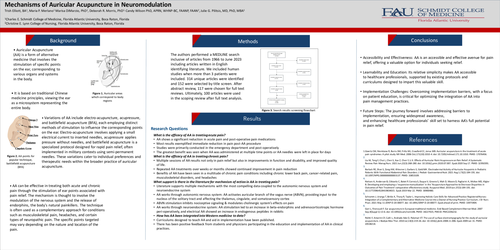
Auricular Acupuncture (AA) is a form of alternative medicine that involves the stimulation of specific points on the ear, corresponding to various organs and systems in the body. It is based on traditional Chinese medicine principles, viewing the ear as a microsystem representing the entire body. Variations of AA include electro-acupuncture, acupressure, and battlefield acupuncture (BFA), each employing distinct methods of stimulation to influence the corresponding points on the ear. Electro-acupuncture involves applying a small electrical current to inserted needles, acupressure applies pressure without needles, and battlefield acupuncture is a specialized protocol designed for rapid pain relief, often implemented in military contexts using semi-permanent needles. These variations cater to individual preferences and therapeutic needs within the broader practice of auricular acupuncture. AA can be effective in treating both acute and chronic pain through the stimulation of ear points associated with pain relief. The mechanism is thought to involve the modulation of the nervous system and the release of endorphins, the body's natural painkillers. The technique is often used as a complementary approach for conditions such as musculoskeletal pain, headaches, and certain types of neuropathic pain. The specific points targeted may vary depending on the nature and location of the pain.
Methods
The authors performed a MEDLINE search inclusive of articles from 1966 to June 2023 including articles written in English identifying literature. We included human studies when more than 3 patients were included. 314 unique articles were identified and 152 were selected by title screen. After abstract review, 117 were chosen for full text reviews. Ultimately, 112 articles were used in the scoping review after full text analysis.
Results
Research Questions
What is the efficacy of AA in treating acute pain?
-AA shows a significant reduction in acute pain and post-operative pain medications
-Most results exemplified immediate reduction in pain post-AA procedure
-Studies were primarily conducted in the emergency department and post-operatively
-The greatest benefit was seen when AA was administered at multiple time points or AA needles were left in place for days
What is the efficacy of AA in treating chronic pain?
-Multiple sessions of AA results not only in pain relief but also in improvements in function and disability, and improved quality of life.
-Repeated AA treatments over weeks or months showed continued improvement in pain reduction
-Benefits of AA have been seen in a multitude of chronic pain conditions including chronic lower back pain, cancer-related pain, musculoskeletal disorders, and headaches
What support is there in the literature for mechanism of action in AA in treating pain?
-Literature supports multiple mechanisms with the most compelling data coupled to the autonomic nervous system and neuroendocrine system
-AA works through autonomic nervous system: AA activates auricular branch of the vagus nerve (ABVN), providing input to the nucleus of the solitary tract and affecting the thalamus, cingulate, and somatosensory cortex
-ABVN stimulation inhibits nociceptive signaling & modulates cholinergic system’s effects on pain
-AA works through neuroendocrine system: AA stimulation led to an increase in beta-endorphins and adrenocorticotropic hormone peri-operatively, and electrical AA showed an increase in endogenous peptides in rabbits
How has AA been integrated into Western medicine to date?
-Curriculums designed to teach AA and aid in implementation have been published.
-There has been positive feedback from students and physicians participating in the education and implementation of AA in clinical practices.
Conclusions
Accessibility and Effectiveness: AA is an accessible and effective avenue for pain relief, offering a valuable option for individuals seeking relief.
Learnability and Education: Its relative simplicity makes AA accessible to healthcare professionals, supported by existing protocols and curriculums designed to impart this valuable skill.
Implementation Challenges: Overcoming implementation barriers, with a focus on patient education, is critical for optimizing the integration of AA into pain management practices.
Future Steps: The journey forward involves addressing barriers to implementation, ensuring widespread awareness, and enhancing healthcare professionals’ skill set to harness AA’s full potential in pain relief.
Goertz CM, Niemtzow R, Burns SM, Fritts MJ, Crawford CC, Jonas WB. Auricular acupuncture in the treatment of acute pain syndromes: A pilot study. Mil Med. 2006 Oct;171(10):1010-4. doi: 10.7205/milmed.171.10.1010. PMID: 17076456.
Liu M, Tong Y, Chai L, Chen S, Xue Z, Chen Y, Li X. Effects of Auricular Point Acupressure on Pain Relief: A Systematic Review. Pain Manag Nurs. 2021 Jun;22(3):268-280. doi: 10.1016/j.pmn.2020.07.007. Epub 2020 Sep 17. PMID: 32950391.
Borlack RE, Shan S, Zong AM, Khlevner J, Garbers S, Gold MA. Electrodermal Activity of Auricular Acupoints in Pediatric Patients With Functional Abdominal Pain Disorders. J Pediatr Gastroenterol Nutr. 2021 Aug 1;73(2):184-191. doi: 10.1097/MPG.0000000000003137. PMID: 33853109.
Nielsen A, Anderson B, Citkovitz C, Botet P, Correia S, Duque V, Greene S, Mah D, Moore D, Pagliarini A, McKee MD, Kligler B. Developing and employing a 'responsive manualization' in the 'Acupuncture Approaches to Decrease Disparities in Outcomes of Pain Treatment' comparative effectiveness study. Acupunct Med. 2019 Jun;37(3):184-191. doi: 10.1177/0964528419834015. Epub 2019 Mar 22. PMID: 30900480.
Schramm J, Uranga T, Birkle A, Thorp R, Taylor L. Improving Holistic Care Skills for Advanced Practice Registered Nurses: Integration of a Complementary and Alternative Medicine Course into a Doctor of Nursing Practice Curriculum. J Dr Nurs Pract. 2021 May 11:JDNP-D-20-00077. doi: 10.1891/JDNP-D-20-00077. Epub ahead of print. PMID: 33975904.
Gori L, Firenzuoli F. Ear acupuncture in European traditional medicine. Evid Based Complement Alternat Med. 2007 Sep;4(Suppl 1):13-6. doi: 10.1093/ecam/nem106. PMID: 18227925; PMCID: PMC2206232.
Politti F, Amorim CF, Calili L, Andrade Ade O, Palomari ET. The use of surface electromyography for the study of auricular acupuncture. J Bodyw Mov Ther. 2010 Jul;14(3):219-26. doi: 10.1016/j.jbmt.2008.11.006. Epub 2009 Jan 31. PMID: 20538218.