425 posters, 1 videos, 9 audios, 8 topics, 53 sessions, 340 authors, 286 institutions
ePostersLive by SciGen Technologies S.A. All rights reserved.
22nd Annual Pain Medicine Meeting 2023
November 10 - 11, 2023 | New Orleans Marriott | New Orleans, Louisiana, USA

4848
PERSONALIZED MEDICINE ADVANCED ANALYTICS DEMONSTRATES IMPROVED OUTCOMES IN MEDICARE BENEFICIARIES WITH CHRONIC PAIN
Poster Presenter
Authors
Affiliations
Part of Topic
Chronic Pain
PERSONALIZED MEDICINE ADVANCED ANALYTICS DEMONSTRATES IMPROVED OUTCOMES IN MEDICARE BENEFICIARIES WITH CHRONIC PAIN
Authors: Brian Meshkin1,2; Milind Patel, MD3; Helena Litvak4; Trenton Davis5; Maneesh Sharma, MD6
1 – Proove Genomics, Inc. (Irvine, CA, Dallas, TX, Houston, TX); 2 – Outcomeus, Inc. (Irvine, CA, Dallas, TX, Houston, TX); 3 - Peak Spine & Sports Medicine (Marlton, NJ); 4 – Corona Del Mar High School (Newport Beach, CA); 5 – Brigham Young University (Provo, UT); 6 – Interventional Pain Institute (Baltimore, MD)
Introduction
Unresolved pain and increased pain medication prescriptions have been driving the surge of the opioid use disorder epidemic since 1999. pain in the US is more prevalent than diabetes, heart disease, and cancer combined. It is estimated that 60% of Medicare beneficiaries experience persistent pain annually. The national cost of pain is estimated to range from $560 to $635 billion – larger than the annual costs of heart disease ($309 billion), cancer ($243 billion), and diabetes ($188 billion). Opioid abuse in chronic pain patients is a major public health issue, with rapidly increasing addiction rates and deaths from unintentional overdose more than quadrupling since 1999. There are additional costs for treating and managing the adverse events associated with poor opioid and pain management, including overdose, addiction, emergency department utilization, hospital admissions, increased risk of infectious disease transmission, falls, bone fractures, etc. If we assume approximately 20% of all healthcare coverage is from Medicare, the annual cost of pain to Medicare alone is $112- $127 billion. In this study, researchers evaluated the impact of personalized medicine analytics tools from Proove Genomics involving advanced algorithms analyzing genetic and phenotypic factors involved in pain perception, opioid risk, and treatment response.
Materials and Methods
IRB-approved, outcome monitoring study (NCT02487888). During all visits, patients assessed their pain levels using the numerical rating scale (NRS) before and after receiving care, listed their medications, and rated their response using the Medication Efficacy Differentiation scale (MED scale), which specifies how well the medication is working to treat the patients’ condition(s) and/or symptom(s). It ranges from 0-5, where 0 is “no response,” 1 is “poor,” 2 is “somewhat poor,” 3 is “fair,” 4 is “good,” and 5 is “very good.” Real-time PCR genetic analysis was performed in the CLIA-certified and CAP-accredited laboratory of the Company. Specimens were collected using buccal swab collection devices.
Results
A multi-center, longitudinal study was conducted of 6,161 Medicare beneficiaries from 158 clinics throughout the United States. DNA samples and an initial medical history, including functional and psychological assessments were collected during the initial visit. At the baseline visit, approximately 30 days after the initial visit, patients were presented with personalized analytics test results by their physicians. The physician provided care guided by test results, including changing medications or prescribing alternative therapies. A follow-up visit, approximately 30 days after the baseline visit, was conducted to investigate how well the patient was doing after receiving and implementing changes guided by test results. While an extensive patient questionnaire was completed at each visit, in this study we focus on public health issues related to pain and the health economics of treating pain.
Outcomes results revealed that when clinicians utilize the results of personalized treatment analytics, involving the evaluation of genetic and phenotypic factors, to guide clinician treatment decisions, almost 90% of patients experienced a reduction in pain. On average, patients experienced a pain reduction of 45% (3.4 points on a 10-point scale), with 39% of the population experiencing greater than 50% reduction of their pain within 60 days. Of the 5,584 patients who reported pain scores, 37.2% and 18.4% went from severe pain to moderate and mild pain, respectively. According to the National Academies' Health Division, there are significant reductions to healthcare costs when an individual’s pain is reduced from severe to moderate or mild pain. In this particular study, cost savings estimates total over $12.4 million in just the first year and greater than $62 million in five years. DNA samples and initial medical history were collected during the initial visit.
Discussion
In comparison to published studies that suggest that chronic pain persistence extends longer than other conditions, study participants realized better outcomes using personalized medicine analytics. Pain levels significantly decreased after patients received care guided by personalized medicine tests.
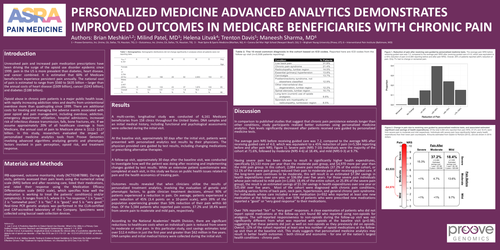
The average pain NRS before receiving guided care was 7.2, compared to the average NRS after receiving guided care of 4.0, which was equivalent to a 45% reduction of pain (n=5,584 reporting before and after pain NRS; Figure 1). Severe pain (NRS 7-10) individuals were the majority of the cohort at 71.6%, followed by moderate (NRS 4-6) at 18.4%, and mild (NRS 0-3) at 9.7%.
Having severe pain has been shown to result in significantly higher health expenditures, specifically $3,533 more per year than the moderate pain group, and $4,970 more per year than the mild pain group. In this cohort, 2,084 severe pain individuals (37.2% of the entire cohort, or 52.1% of the severe pain group) reduced their pain to moderate pain after receiving guided care. If the long-term pain continues to be moderate, this will result in an estimated $7.3M savings in health expenditures over one year, or $36.8M over five years. For those severe pain individuals whose pain reduced to mild pain (n=1,030; 18.4% of the entire cohort, or 25.8% of the severe pain group), the result is an estimated savings of $5.1M savings in health expenditures over one year or $25.6M over five years. Most of the cohort were diagnosed with chronic pain conditions, including various forms of back pain, neck pain, hypertension, and general chronic pain syndrome. For individuals whose care included a new medication (n=932 who reported at least one new medication at the follow-up visit), over 50% of patients who were prescribed new medications reported a “good” or “very good response” to their medications.
Over 76% reported “fair” to “very good” responses. A close examination of patients who did not report opioid medications at the follow-up visit found 80 who reported using non-opioids for analgesia. The self-reported responsiveness to non-opioids during the follow-up visit was not significantly different from what was reported with opioids at the baseline visit (p=0.98), suggesting that these patients did just as well on non-opioids as they previously did on opioids. Overall, 12% of the cohort reported at least one less number of opioid medications at the follow-up visit than at the baseline visit. This study suggests that personalized medicine analytics may result in better health outcomes - both clinical and economic - for one of the nation's largest health conditions - chronic pain.