425 posters, 1 videos, 9 audios, 8 topics, 53 sessions, 340 authors, 286 institutions
ePostersLive by SciGen Technologies S.A. All rights reserved.
22nd Annual Pain Medicine Meeting 2023
November 10 - 11, 2023 | New Orleans Marriott | New Orleans, Louisiana, USA

4809
LATERAL APPROACH TO GENICULAR NERVE BLOCKS IN PATIENTS WITH OSTEOARTHRITIS OF THE KNEE
Poster Presenter
Authors
Affiliations
Part of Topic
Chronic Pain
A significant portion of the chronic pain population is made up of patients with chronic knee pain. These patients often receive a variety of treatment modalities to include physical therapy, medication management, and intra-articular injections prior to nerve targeted therapies such as radiofrequency ablation (RFA) of the genicular nerves. The prognostic standard to assess a patient’s likelihood of success with an RFA is to first perform nerve blocks of the genicular nerves supplying the affected joint.
- Here, we present three cases of genicular neve blocks using novel direct approach in the lateral fluoroscopic view, with a goal of minimizing patient discomfort and radiation exposure, maintaining procedural efficacy, and reducing procedure time.
- These three patients were selected based on:
- Primary osteoarthritis pathology
- Failed recent conservative therapies
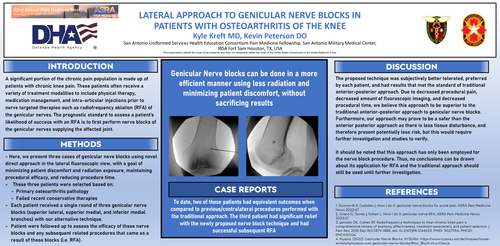
Genicular Nerve blocks can be done in a more efficient manner using less radiation and minimizing patient discomfort, without sacrificing results
To date, two of these patients had equivalent outcomes when compared to previous/contralateral procedures performed with the traditional approach. The third patient had significant relief with the newly proposed nerve block technique and had successful subsequent RFA
The proposed technique was subjectively better tolerated, preferred by each patient, and had results that met the standard of traditional anterior-posterior approach. Due to decreased procedural pain, decreased amount of fluoroscopic imaging, and decreased procedural time, we believe this approach to be superior to the traditional anterior-posterior approach to genicular nerve blocks. Furthermore, our approach may prove to be a safer than the anterior posterior approach as there is less tissue disturbance, and therefore present potentially less risk, but this would require further investigation and studies to verify.
It should be noted that this approach has only been employed for the nerve block procedure. Thus, no conclusions can be drawn about its application for RFA and the traditional approach should still be used until further investigation.