425 posters, 1 videos, 9 audios, 8 topics, 53 sessions, 340 authors, 286 institutions
ePostersLive by SciGen Technologies S.A. All rights reserved.
22nd Annual Pain Medicine Meeting 2023
November 10 - 11, 2023 | New Orleans Marriott | New Orleans, Louisiana, USA

4763
A RETROSPECTIVE STUDY EVALUATING NERVE ABLATION TO THE INFRAPATELLAR BRANCH OF THE SAPHENOUS NERVE BEFORE AND AFTER TKA
Poster Presenter
Authors
Affiliations
Part of Topic
Chronic Pain
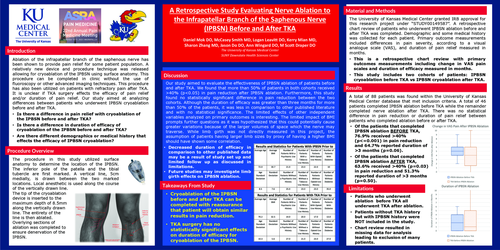
Ablation of the infrapatellar branch of the saphenous nerve has been shown to provide pain relief for some patient population. A relatively new device and procedure technique was released allowing for cryoablation of the IPBSN using surface anatomy. This procedure can be completed in clinic without the use of fluoroscopy or other advanced imaging techniques. This procedure has also been utilized on patients with refractory pain after TKA. It is unclear if TKA surgery effects the efficacy of pain relief and/or duration of pain relief. Our study aimed at analyzing differences between patients who underwent IPBSN cryoablation before and after TKA.
The procedure in this study utilized surface anatomy to determine the location of the IPBSN. The inferior pole of the patella and the tibial tubercle are first marked. A vertical line, 5cm medially, is drawn between the two marked locations. Local anesthetic is used along the course of the vertically drawn line.
The tip of the cryoablation device is inserted to the maximum depth of 8.5mm along the vertically drawn line. The entirety of the line is then ablated. Overlying sections of ablation was completed to ensure denervation of the IPBSN.
Our study aimed to evaluate the effectiveness of IPBSN ablation of patients before and after TKA. We found that more than 50% of patients in both cohorts received >40% (p<0.05) in pain reduction after IPBSN. Furthermore, this study found no statistically significant difference in pain reduction between the two cohorts. Although the duration of efficacy was greater than three months for more than 50% of the patients, it was less in comparison to other published literature and with no statistical significance. The limited effects of other independent variables analyzed on primary outcomes is interesting. The limited impact of BMI prompts further questions as it was hypothesized that this could potentially cause greater variations because of the larger volumes of space which the nerve may traverse. While limb girth was not directly measured in this project, the assumption of patients having larger limb sizes by proxy of having a higher BMI should have shown some correlation.
The University of Kansas Medical Center granted IRB approval for this research project under “STUDY00149587”. A retrospective chart review of patients who underwent IPBSN ablation before and after TKA was completed. Demographic and some medical history was collected for each patient. Primary outcome measurements included differences in pain severity, according to a visual analogue scale (VAS), and duration of pain relief measured in months.
A total of 88 patients was found within the University of Kansas Medical Center data base that met inclusion criteria. A total of 46 patients completed IPBSN ablation before TKA while the remainder completed nerve ablation after TKA. There was no statistical difference in pain reduction or duration of pain relief between patients who completed ablation before or after TKA.