425 posters, 1 videos, 9 audios, 8 topics, 53 sessions, 340 authors, 286 institutions
ePostersLive by SciGen Technologies S.A. All rights reserved.
22nd Annual Pain Medicine Meeting 2023
November 10 - 11, 2023 | New Orleans Marriott | New Orleans, Louisiana, USA

4606
PREDICTING TIMELINE OF EXPECTED POSITIVE RESPONSE TO EPIDURAL STEROID INJECTION FOR SPINE PAIN
Poster Presenter
Authors
Affiliations
Part of Topic
Chronic Pain
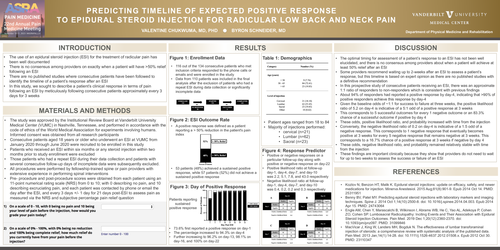
Predicting Timeline of Expected Positive Response to Epidural Steroid Injection for Radicular Low Back and Neck Pain
Introduction
The use of an epidural steroid injection (ESI) for the treatment of radicular pain has been well documented, but there is no consensus among providers on exactly when a patient will have >50% relief following an ESI. Although investigators have sought to identify factors that can predict the outcome of an ESI, there are no published studies where consecutive patients have been followed to identify the timeline of a patient’s response after an ESI. In this study, we sought to describe a patient’s clinical response in terms of pain following an ESI by meticulously following consecutive patients approximately every 3 days for 3 weeks.
Materials and Methods
The study was approved by the Institutional Review Board at Vanderbilt University Medical Center (VUMC) in Nashville, Tennessee, and performed in accordance with the code of ethics of the World Medical Association for experiments involving humans. Informed consent was obtained from all research participants. Consecutive patients aged 18 years or older who underwent an ESI at VUMC from January 2020 through June 2020 were recruited to be enrolled in this study. Patients who received an ESI within six months or any steroid injection within two months prior to study enrollment were excluded. Those patients who had a repeat ESI during their data collection and patients with several consecutive follow-up days of incomplete data were subsequently excluded. All procedures were performed by fellowship-trained spine or pain providers with extensive experience in performing spinal interventions. Pre- procedure and post-procedure scores were obtained from each patient using an 11-point numerical rating scale (NRS) from 0 to 10; with 0 describing no pain, and 10 describing excruciating pain, and each patient was contacted by phone or email the day after the ESI, and every 3 days +/- 1 day for 21 days post-ESI to assess pain as measured via the NRS and subjective percentage pain relief question. Data analysis was performed using GraphPad Prism software.
Results
116 out of the 134 consecutive patients who met inclusion criteria responded to the phone calls or emails and were enrolled in the study. Data from 110 patients was included in the final analysis after the exclusion of patients who had a repeat ESI during data collection or significantly incomplete data. Patient ages ranged from 18 to 84, with the majority of injections performed at cervical (n=21), lumbar (n=62), and sacral (n=23) levels. A positive response was defined as a patient reporting a > 50% reduction in the patient's pain index. 53 patients (48%) achieved a sustained positive response, while 57 patients (52%) did not achieve a sustained positive response. Of the patients reporting a sustained positive response, 73.6% first reported a positive response on day-1, and the percentage increased to 94.3% on day-4, further increasing to 96.2% on day-13, 98.1% on day-16, and 100% on day-22. While a majority of the remaining 57 patients who did not achieve a sustained positive response never reached the 50% threshold, 19 of these patients reported >50% relief on day-1 but subsequently reported <50% relief on day-4 (n=11), day-7 (n=6), day-10 (n=1), and day-13 (n=1). We next analyzed the data to assess for potential predictors of three-week outcomes in this population of patients. Positive or negative responses on a particular follow-up day along with positive or negative response on day-22 in the same patient, was evaluated as potential predictors of concordant responses. Our data showed that the positive likelihood ratio at follow-up day-1, day-4, day-7, and day-10 was 2.2, 5.1, 7.8, and 43.0 respectively, and the negative likelihood ratio at follow-up day-1, day-4, day-7, and day-10 was 0.4, 0.2, 0.2 and 0.3 respectively.
Discussion
The optimal timing for assessment of a patient’s response to an ESI has not been well elucidated, and there is no consensus among providers about when a patient will achieve at least 50% relief after an ESI. Some providers recommend waiting up to 2-weeks after an ESI to assess a patient’s response, but this timeline is based on expert opinion as there are no published studies with a definitive recommendation. In this prospective study of consecutive patients receiving an ESI, there was an approximate 1:1 ratio of responders to non-responders which is consistent with previous findings. About 94% of responders had reported a positive response by day-4, indicating that >90% of positive responders achieve this response by day-4. Given the baseline odds of ~1:1 for success to failure at three weeks, the positive likelihood ratio of 5.2 on day-4 is indicative of a 5:1 odd of a positive response at 3 weeks. This corresponds to 5 successful outcomes for every 1 negative outcome or an 83.3% chance of a successful outcome if positive by day 4. These odds, positive likelihood ratio, and probability increased with time from the injection. Conversely, the negative likelihood ratio of 0.2 on day-4 is indicative of a 1:5 odd of a negative response. This corresponds to 1 negative response that eventually becomes positive at 3 weeks for every 5 negative response that remains negative at 3 weeks. This corresponds to a 16.7% chance of a positive response at 3 weeks if negative by day 4. These odds, negative likelihood ratio, and probability remained relatively stable with time from the injection. These findings are important clinically because they show that providers do not need to wait for up to two weeks in order to assess the success or failure of an ESI. The strengths of this study include the prospective nature of the study, the large number of patients analyzed, the frequency of follow-up, the success ratio consistent with current clinical practices, and the response rate of 86.6%. Limitations of this study include not assessing the utility of a repeat ESI in patients with a response below the 50% threshold used to determine a successful response, and not evaluating whether the positive response reported on day 4 correlated with improved functional status.